
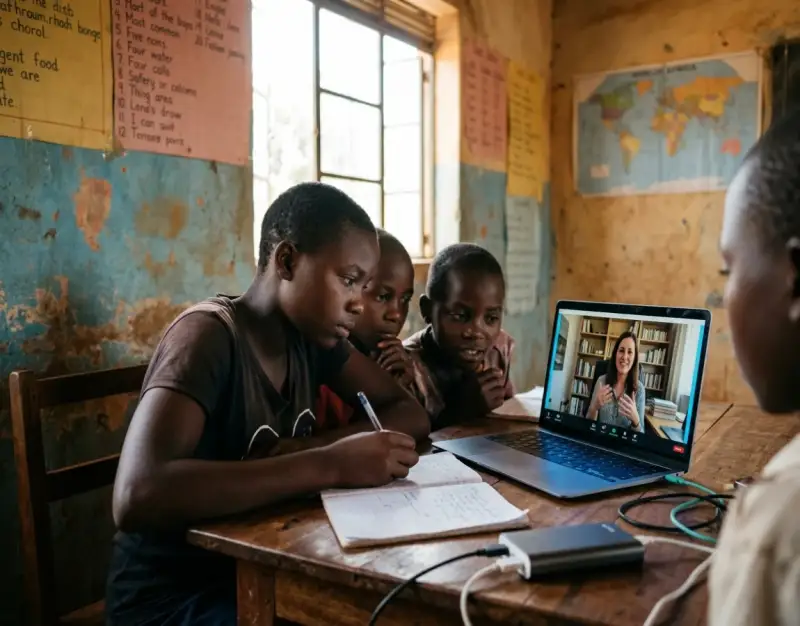
In a small village outside Kumasi, Ghana, an aspiring sixteen-year-old computer programmer sits beneath the shade of a mango tree, adjusting a refurbished tablet connected to a low-bandwidth cellular link. Thousands of miles away in Toronto, a senior software engineer opens an open-source IDE to review the code written by her young Ghanaian mentee. Through real-time terminal sharing and audio notes recorded on messaging applications, the two work through complex data structures. This scene, once considered an idealistic fantasy of the early internet era, is now unfolding across hundreds of rural and underserved communities worldwide. Digital learning and borderless human connection are rapidly changing what it means to access world-class guidance, transcending geography, socioeconomic status, and systemic infrastructure deficits.
The global education landscape is facing a historical turning point. According to data from UNESCO, despite substantial gains in primary school enrollment over the past two decades, more than 250 million children and youth remain out of school, while hundreds of millions more attend classrooms lacking adequate teaching resources, modern STEM curricula, or specialized career pathways. The conventional model of educational aid—which relies heavily on constructing physical brick-and-mortar schools and shipping physical textbooks—has proven insufficient to keep pace with the accelerating demands of the modern digital economy. As broadband connectivity penetrates previously isolated regions via low-Earth orbit satellite networks and mobile data infrastructure, a fundamental shift has taken place: the critical bottleneck in global education is no longer just access to information, but access to human capital, tailored guidance, and professional mentorship.
Online mentorship has emerged as an engine for socio-economic mobility, bridging the gap between passive educational content and meaningful real-world execution. By leveraging low-bandwidth communications tools, culturally responsive pedagogical frameworks, and structured volunteer pipelines, international mentorship initiatives are re-engineering how knowledge is transferred across borders. This publication examines the operational mechanics, technological architectures, cross-cultural strategies, and measurable outcomes driving this movement. Ultimately, we explore how digital learning can evolve from simple content distribution into a transformative ecosystem for human potential.
Foundational Principles & Mechanics of Global Online Mentorship
To understand how digital mentorship functions in developing nations, one must look beyond consumer-grade video conferencing and examine the underlying technical, pedagogical, and operational principles that sustain remote learning across stark digital divides. Online mentorship is not merely tutoring delivered over a web camera; it is a structured, relational intervention that combines technical skills transfer, socio-emotional scaffolding, and social capital expansion.
At its foundation, online mentorship relies on several core mechanics:
- Bandwidth-Agnostic Communication Architectures: Designing technical interactions that operate seamlessly across legacy 2G/3G networks, high-latency satellite connections, and metered mobile data packages.
- Asynchronous Scaffolding: Utilizing delayed-response mechanisms—such as recorded voice notes, annotated code repositories, offline-first learning management systems (LMS), and interactive document threads—to ensure mentorship continues even when power grids or internet connections flicker.
- Culturally Responsive Pedagogy (CRP): Adapting instructional methodologies to reflect the localized socio-cultural realities, linguistic nuances, and economic conditions of the mentee, preventing the imposition of rigid, Western-centric frameworks.
- Reciprocal Social Capital Transfer: Moving beyond traditional one-way charitable dynamics toward an equitable exchange where mentors offer domain expertise and global networks, while mentees provide hyper-local insights, contextual problem-solving, and cross-cultural perspectives.
- Socio-Emotional Learning (SEL) Integration: Building resilience, self-efficacy, and digital confidence alongside academic or technical instruction, addressing the psychological barriers often experienced by marginalized youth.
Just as physical community projects demonstrate how localized, practical human assistance restores dignity and access—such as Building Wheelchair Ramps for Free: The Retired Carpenters Reclaiming Mobility for Seniors—digital mentorship programs deploy human expertise to remove systemic structural barriers, allowing individuals to navigate their surroundings with independence and confidence.
Step-by-Step Strategic Blueprint for Implementing Global Mentorship Programs
1. Technical Infrastructure and Low-Bandwidth Stack Optimization
Designing for Asynchronous-First Workflows
When launching an online mentorship program in emerging markets, assuming reliable high-speed fiber internet is a primary point of failure. Program architects must build an asynchronous-first communication workflow that prioritizes low-data overhead. Mentors and mentees should interact primarily through platforms that cache data locally on mobile devices. Voice notes, compressed PDF guides, and structured text summaries consume a fraction of the data required for standard high-definition video calls, ensuring that mentorship cycles remain uninterrupted during regional outages or data-cap limits.
Organizations should implement tools that support offline synchronization. When a mentee connects to a public Wi-Fi hotspot or temporary cellular network, their application should automatically download audio assignments, offline reading materials, and mentor feedback. The student can then process, complete, and upload their work offline, syncing their progress whenever connectivity is restored. This model minimizes financial burdens on students using pay-per-megabyte data packages while maximizing pedagogical touchpoints.
Deploying Light-Footprint Synchronous Platforms
For sessions requiring real-time interaction, software configurations must be aggressively optimized. Platforms should be selected or built to allow audio-only modes with adaptive bitrate codecs (such as Opus), which maintain clear voice transmission even under poor network conditions experiencing over 20% packet loss. Screen sharing should be replaced or supplemented by collaborative text platforms or lightweight whiteboards that transmit vector data rather than raw video streams, significantly dropping data consumption from megabytes per minute to kilobytes per minute.
Furthermore, hardware compatibility is paramount. Educational software must be backward-compatible with legacy Android operating systems (Android 8.0 and below), as refurbished or older-generation smartphones dominate the hardware landscape in rural areas of sub-Saharan Africa, South Asia, and Latin America. System interfaces must minimize battery consumption, acknowledging that access to consistent electrical power for device charging remains an ongoing challenge in many off-grid regions.
2. Cross-Cultural Frameworks and Curriculum Scaffolding
Implementing Culturally Responsive Scaffolding
Curriculum design in global mentorship programs must avoid copying high-income educational models without adaptation. Technical concepts must be contextualized using local economic engines, environmental conditions, and community challenges. For instance, a data science curriculum should not rely on Western stock market data; instead, it should utilize regional agricultural weather patterns, local market pricing models, or public health logistics. This approach reinforces technical competency while illustrating the immediate practical application of digital learning within the student's immediate community.
Mentors must undergo mandatory cross-cultural training before beginning their interactions. This curriculum should cover implicit bias, power dynamics in international development, history of the mentee's region, and communication strategies tailored to non-native English or multi-lingual learners. True educational impact occurs when mentors approach sessions not as all-knowing instructors, but as facilitators supporting a student's self-directed growth.
Fostering Reciprocal Knowledge Exchange
To avoid creating a unidirectional, paternalistic relationship, mentorship frameworks must intentionally integrate reciprocal learning goals. Mentors should be encouraged to ask questions, learn about the local culture, and seek their mentee's perspective on local innovation strategies. This structural equality builds self-worth and communication skills in mentees, positioning them as active participants in a global dialogue rather than passive recipients of aid.
To effectively mentor students from marginalized backgrounds, educators must develop deep empathy—listening to lived experiences much like the raw human insights documented in Voices of the Homeless: Real Stories from the People We Walk Past Every Single Day.
When mentors listen attentively to the structural realities of their mentees—ranging from local infrastructure gaps to complex social obligations—they adjust their pedagogical pacing, set realistic deliverables, and offer contextual support that respects the mentee's daily environment.
3. Recruitment, Vetting, and Safeguarding Protocols
Multi-Layered Mentor Vetting Architectures
Maintaining safety and high instructional standards across international borders requires a rigorous, transparent vetting architecture. Organizations must implement multi-stage screening processes including background checks, identity verification, socio-emotional evaluations, and practical teaching assessments. Prospective mentors must demonstrate not only technical or professional competence, but also patience, active listening skills, and adaptability across dynamic cultural settings.
The onboarding workflow must follow a structured pipeline:
- Initial Application & Resume Screening: Verification of professional experience, academic credentials, and previous volunteer engagement.
- Automated Background Checks & Identity Verification: Comprehensive screening cross-referencing global legal registries and child safety databases.
- Behavioral & Cultural Aptitude Interview: Scenario-based evaluations assessing emotional intelligence, cross-cultural sensitivity, and problem-solving skills under challenging circumstances.
- Pedagogical Assessment Session: A simulated low-bandwidth teaching exercise designed to test adaptive instructional techniques.
- Safeguarding & Ethics Agreement: Mandatory completion of child protection modules and signing of operational ethics protocols.
Child Protection and Digital Privacy Mechanisms
Child safeguarding protocols must be integrated into the technical architecture of the mentorship platform itself. Direct, unmonitored one-on-one communication over unencrypted or private channels should be prohibited. Platforms should automatically record and transcript sessions, utilizing natural language processing (NLP) algorithms to scan text and audio transcripts for policy violations, predatory patterns, or inappropriate exchanges. Designated safety officers must review flagged sessions immediately to ensure mentee security.
Data privacy compliance requires strict adherence to international standards, such as the General Data Protection Regulation (GDPR) and regional data protection frameworks. Personal identifying details—including physical addresses, personal phone numbers, and full legal names—should be anonymized within the primary communications platform. Mentees and mentors communicate using unique digital IDs, preventing out-of-band contact and securing both parties from online risks.
4. Structuring Learning Pathways: Micro-Mentorship vs. Longitudinal Apprenticeships
Designing High-Impact Sprint Micro-Mentorship Modules
Not every learning objective requires a year-long engagement. Micro-mentorship models—focused, short-term engagements lasting between two to six weeks—are effective for targeted technical skills acquisition, resume revisions, portfolio reviews, or specific project guidance. These sprint modules reduce volunteer drop-off rates while providing mentees with immediate actionable outcomes.
A micro-mentorship sprint should follow a clear layout: Week 1 focuses on goal setting and diagnostic testing; Weeks 2 and 3 involve technical learning and code or project reviews; Week 4 centers on practical application and final project adjustments. This approach produces defined deliverables—such as a functional mobile application interface, a data analysis script, or a business plan—that students can add to their portfolios.
Longitudinal Pathways and Community Integration
For comprehensive career transitions, longitudinal mentorship programs spanning 6 to 12 months offer the sustained support required to master complex disciplines. These multi-month programs pair technical training with deep socio-emotional coaching, professional networking, and soft-skills development. Long-term mentors serve as career advisors, guiding students through university applications, international scholarship submissions, or remote freelance work opportunities.
Restoring confidence in underserved youth requires tangible acts of support, reminiscent of community initiatives like Surprise Prom Dress Shopping: Giving Foster Teens a Night They Will Never Forget, which validate a young person’s intrinsic worth. By celebrating academic milestones and program completions, mentorship organizations help students cultivate a strong sense of pride and social belonging, reinforcing their agency as future leaders.
5. Holistic Impact Measurement and Performance Metrics
Evaluating Cognitive, Technical, and Socio-Emotional Metrics
Evaluating digital mentorship requires looking beyond attendance records and end-of-course completion surveys. Standardized testing models often fail to capture the nuanced gains made by students studying in non-traditional environments. Leading global education programs employ a tri-part assessment framework measuring cognitive mastery, practical portfolio output, and socio-emotional development (e.g., self-efficacy, problem-solving persistence, and digital agency).
Quantitative assessments should track a student's progress through practical performance tasks rather than rote memory tests. For example, evaluating a mentee’s ability to debug a program, refactor code, or write a business proposal provides an accurate measurement of functional skill development. Simultaneously, psychological surveys measure shifts in confidence, career aspirations, and cross-cultural literacy, illustrating the true depth of human growth.
Tracking Long-Term Socioeconomic Mobility
The measure of global educational initiatives lies in their long-term impact on economic mobility. Programs should run longitudinal tracking mechanisms that measure employment rates, income growth, higher-education admissions, and local community leadership involvement 1, 3, and 5 years post-completion. Collecting this data demonstrates program efficacy to corporate partners, institutional donors, and policy makers.
By measuring the movement of mentees from informal labor into stable technical roles, remote software positions, or local entrepreneurial ventures, platforms can calculate the return on investment (ROI) of their mentorship pipelines. Data consistently reveals that access to specialized mentorship creates compound economic benefits, as successful graduates reinvest earnings back into their families and local communities.
6. Grassroots Integration and Sustainable Funding Models
Co-Designing Programs with Local Community Leaders
Global mentorship initiatives face operational hurdles if managed entirely by remote teams without deep local ties. Sustainable programs require co-design with community-based organizations (CBOs), local schools, village educational committees, and regional non-profits. Local partners provide physical infrastructure—such as safe learning centers equipped with solar power and satellite connections—while managing day-to-day attendance and student health metrics.
This hybrid approach combines international digital networks with ground-level community trust. Local facilitators step in during connectivity outages to provide academic guidance, while helping international mentors navigate local customs, seasonal calendars, and regional socio-political dynamics.
Corporate Social Responsibility (CSR) and Enterprise Sponsorships
Relying solely on philanthropic grants can restrict long-term program growth. Sustainable mentorship platforms build financial stability by integrating Corporate Social Responsibility (CSR) partnerships and enterprise sponsorship programs. International corporations provide funding, cloud computing credits, and hardware donations, while encouraging their professional staff to dedicate volunteer hours as mentors.
This model creates mutual value: global corporations gain structured, high-impact employee engagement pathways and access to emerging international tech talent, while non-profit platforms secure multi-year funding streams to scale their operations. These corporate integrations ensure that educational access expands predictably over time.
Real-World Case Studies & Operational Scenarios
To understand the practical realities of running international mentorship networks, examine these two contrasting implementation scenarios derived from real-world operations in global education non-profits.
Scenario A: The Hybrid Micro-Mentorship Ecosystem (Success Case)
Context: An educational initiative aimed to teach Python programming and data literacy to young women across 15 rural townships in Kenya and Rwanda.
Execution Strategy: The organization established a hybrid execution model. Local solar-powered hubs were set up in partnership with community centers, providing shared hardware. Communication relied on an asynchronous WhatsApp-integrated LMS that delivered micro-lessons via low-data text and audio formats. Professional female software engineers from around the globe were recruited for 6-week sprint mentorship cycles. Real-time audio sessions were held once weekly, using dynamic bandwidth management software.
Key Metrics & Outcomes:
- Completion Rate: 89% of enrolled mentees completed their capstone software projects.
- Data Overhead: Average data consumption per student was kept under 450 MB per month.
- Economic Trajectory: Within 12 months post-graduation, 42% of participants secured remote freelance projects or enrolled in computer science degree programs, increasing baseline household income by an average of 185%.
Core Lesson: Prioritizing low-bandwidth infrastructure and localized community hubs yields high retention rates and measurable economic mobility.
Scenario B: The Unadapted Synchronous Video Model (Failure Case)
Context: A high-capital initiative attempted to provide remote STEM tutoring to high school students across underserved districts in Northern India.
Execution Strategy: The organization developed a custom, high-definition live video portal requiring high-speed broadband connections. International volunteers were paired with local students without cross-cultural training, using standard Western AP Physics and Computer Science textbooks without localized adaptations.
Key Metrics & Outcomes:
- Completion Rate: Dropped below 14% within the first eight weeks.
- Technical Friction: Over 65% of scheduled video calls suffered severe latency, dropouts, or failed connections due to local electrical grid stability issues.
- Participant Retention: Volunteer drop-off reached 60%, with mentors citing frustration over logistics and missed sessions, while students reported feeling overwhelmed by unadapted course content.
Core Lesson: Deploying high-bandwidth platforms without accounting for local electrical constraints and cultural context leads to high attrition rates and wasted resources.
Critical Mistakes & Strategic Countermeasures
Building high-impact international digital mentorship systems requires avoiding common operational pitfalls. Below are five strategic errors identified by educational practitioners, along with specific operational countermeasures.
-
Over-Reliance on High-Bandwidth Real-Time Video Interaction
Mistake: Assuming video streaming is mandatory for effective communication, leading to dropped calls, frustrated participants, and high data costs for students.
Countermeasure: Adopt an asynchronous-first communication strategy. Utilize compressed audio messages, collaborative code editors, offline LMS platforms, and lightweight text channels as primary learning tools, reserving synchronous video for milestone events.
-
Imposing Unadapted Western-Centric Curricula
Mistake: Teaching abstract concepts using socio-economic examples that have no relevance to the mentee's lived environment, reducing student engagement.
Countermeasure: Collaborate with local educational leaders to contextualize instructional materials around regional challenges, such as local agriculture, renewable energy management, regional commerce, or public health logistics.
-
Neglecting Mandatory Cross-Cultural Mentor Onboarding
Mistake: Assuming technical expert status automatically translates into effective teaching, which can lead to communication missteps or unintended paternalistic behavior.
Countermeasure: Mandate comprehensive pre-deployment training covering implicit bias, cross-cultural pedagogy, non-native language instruction, active listening, and local socio-economic realities.
-
Inadequate Child Safeguarding and Data Anonymization Protocols
Mistake: Allowing unmonitored communication over personal social media or private messaging channels, exposing vulnerable youth to safety risks and privacy violations.
Countermeasure: Restrict all communication to secure, centralized platforms with built-in activity monitoring, anonymized profiles, automated chat analysis, and explicit behavioral guidelines.
-
Failing to Involve Local Community Leadership
Mistake: Operating completely outside existing community structures, leading to low attendance, lack of local trust, and unsustainable long-term operations.
Countermeasure: Establish formal partnerships with local schools, community-based non-profits, and civic leaders to provide physical learning hubs, ground-level accountability, and ongoing student support.
Comparative Analysis of Global Mentorship Delivery Paradigms
The table below provides a detailed breakdown of different digital learning delivery models, evaluating their operational constraints, technical requirements, scalability, and long-term socio-economic impact across developing markets.
| Mentorship Paradigm | Infrastructure Requirements | Data Bandwidth Profile | Scalability Potential | Primary Pedagogical Benefit | Key Operational Limitation |
|---|---|---|---|---|---|
| Synchronous Video (1-on-1) | High-speed 4G/5G/Fiber, High-end Smart Devices | High (>1.5 GB/hour) | Low to Moderate | Immediate real-time connection and rapid feedback | Vulnerable to connectivity outages and high data costs |
| Asynchronous Audio & Text Messaging | Legacy 2G/3G Cellular Networks, Basic Smartphones | Ultra-Low (<20 MB/hour) | Very High | Accessible, cost-effective, adaptable schedule | Requires strong self-motivation from student |
| Hybrid Local Hub + Remote Digital Mentor | Solar-Powered Hubs, Shared Broadband/Satellite | Moderate (Shared connection) | High (Community-centered) | Combines digital mentorship with local community support | Requires initial capital for physical hub equipment |
| Cohort-Based Sprint Micro-Mentorship | Basic Mobile Data, Asynchronous Collaboration Platforms | Low to Moderate (<100 MB/week) | Extremely High | Focuses on rapid skill building and project output | Shorter duration limits deep emotional relationship building |
| Longitudinal Career Apprenticeships | Consistent Internet Access, Development Workstations | Moderate to High | Moderate | Drives long-term job placement and career progression | High resource investment per participant |
Frequently Asked Questions
How can digital mentorship programs operate effectively in areas with limited electricity and internet access?
Digital mentorship programs maintain effective operations in low-resource environments by deploying low-bandwidth infrastructure and partnering with local physical learning hubs. These hubs—often established in community centers, schools, or local libraries—are equipped with solar panels, battery banks, and satellite or high-gain cellular internet receivers. This setup ensures continuous access to power and internet, even in remote or off-grid locations.
From a software perspective, platforms are engineered around asynchronous-first workflows. Learning platforms cache audio modules, text assignments, and instructional resources directly onto mobile devices during connection windows. Mentees can then review materials, complete assignments, and record audio questions completely offline. The device syncs data automatically when a network connection is re-established, minimizing reliance on continuous connectivity.
What strategies prevent Western-centric bias in international mentorship programs?
Preventing cross-cultural bias requires a deliberate approach to program design, curriculum creation, and volunteer onboarding. Mentorship organizations must collaborate directly with local educators, community leaders, and regional subject-matter experts to co-design learning materials. This ensures instructional content reflects regional economic conditions, local socio-cultural realities, and community needs.
Additionally, all prospective mentors must complete mandatory cross-cultural training before interacting with students. This onboarding covers active listening skills, implicit bias awareness, non-colonial pedagogical frameworks, and the local history of the mentee's region. Platforms also emphasize reciprocal learning dynamics, encouraging mentors to learn from their mentees' contextual problem-solving skills, building an equal partnership.
How do mentorship platforms ensure child safety across international boundaries?
Child protection in international digital mentorship requires a multi-layered security architecture encompassing technical, operational, and administrative safeguards. All communications—whether voice, text, or file exchanges—must occur exclusively within a secure, centralized, and encrypted platform that anonymizes personal identification details. Direct, out-of-band contact via private phone numbers, personal email, or external social media networks is strictly prohibited under program terms.
Technologically, platforms employ automated natural language processing (NLP) to scan text messages and audio transcripts for policy violations, inappropriate language, or predatory patterns. Flagged interactions trigger immediate review by dedicated safeguarding officers. Furthermore, all mentors undergo identity verification, international background checks, and behavioral interviews before receiving platform access.
What is the typical time commitment for a digital mentor, and how are drop-off rates managed?
Volunteer time commitments vary based on program architecture, ranging from short-term micro-mentorship sprints (1 to 2 hours per week for 4 to 6 weeks) to longitudinal apprenticeship programs (2 to 4 hours per week for 6 to 12 months). Clear expectation setting during recruitment is critical to maintaining low mentor attrition rates.
To reduce drop-off, leading platforms utilize structured, asynchronous interaction templates that allow mentors to review assignments and record feedback around their professional schedules. Gamified milestone tracking, regular peer-support forums, and ongoing pedagogical support keep volunteers engaged, ensuring consistent guidance for mentees.
How do organizations measure the long-term ROI of online mentorship initiatives?
Measuring long-term return on investment (ROI) requires moving beyond immediate output metrics—such as course completion rates—to track longitudinal outcomes over multi-year periods. Organizations measure cognitive advancement, practical project completion, and socio-emotional growth (such as self-efficacy and digital literacy) using diagnostic evaluations and portfolio reviews.
Longitudinally, organizations track alumni at 1, 3, and 5-year intervals to measure career trajectories, employment rates in formal or remote technology sectors, income growth, and university enrollment rates. By demonstrating a direct link between digital mentorship access and measurable household income growth, platforms can articulate clear economic impact to corporate partners, foundation donors, and international development agencies.
Strategic Roadmap & Strategic Vision for the Global Classroom
The convergence of low-cost satellite broadband, artificial intelligence translation systems, and accessible mobile hardware is creating new opportunities for global educational equity. Over the next two to five years, the traditional constraints of geographic location will continue to lessen, enabling real-time skill sharing across previously disconnected regions.
Key developments shaping the future of global online mentorship include:
- Real-Time AI-Assisted Multilingual Translation: AI translation engines will allow mentors and mentees to converse fluidly in their native languages via synchronous voice and text channels, removing major linguistic barriers.
- Edge-Computing Learning
Be the first to share a gentle reflection on this story.