
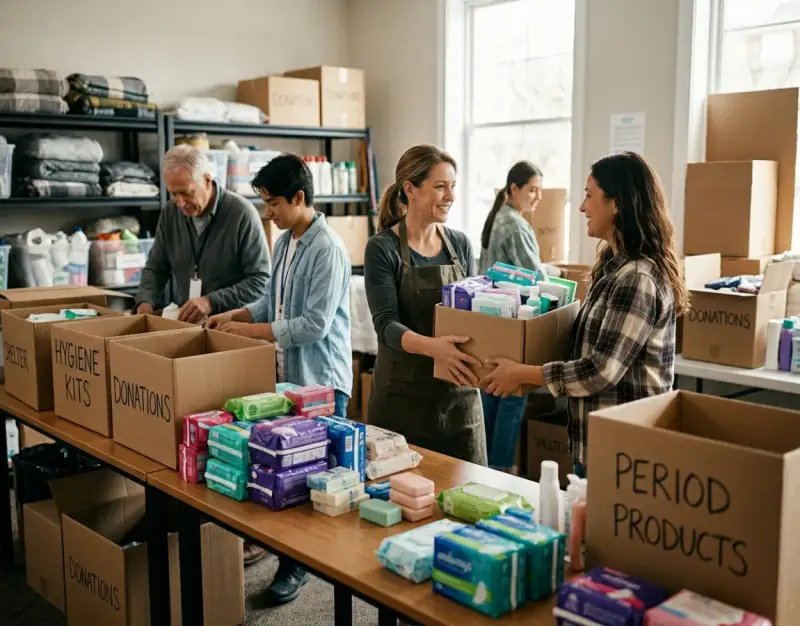
Imagine waking up on the first day of an unexpected period without access to basic sanitary products, forcing you to choose between buying food or purchasing a box of tampons. This is the daily reality for millions of individuals experiencing homelessness, low-income instability, and housing crises across the globe. Period poverty—the systemic lack of access to menstrual products, hygiene facilities, and adequate education—is not merely an inconvenience; it is a profound public health crisis and a violation of human dignity. For decades, traditional social service models relied heavily on sporadic charity drives that, while well-intentioned, offered only temporary band-aids to a bleeding wound of structural inequality.
What has fundamentally changed in the modern nonprofit and civic landscape is the shift toward collaborative welfare projects. Rather than operating in isolated silos, forward-thinking shelters, municipal agencies, and local commercial entities are forging strategic alliances. These private-public and business-shelter partnerships integrate menstrual equity directly into local business ecosystems, turning everyday retail locations, corporate offices, and neighborhood establishments into sustainable distribution hubs and collection centers. By leveraging the logistical prowess and consumer reach of the private sector, communities are discovering that ending period poverty requires more than occasional donations—it demands systemic operational integration.
The core thesis of this article is that sustainable eradication of period poverty is entirely achievable through formalized, mutually beneficial shelter partnerships and structured community hygiene drives. When local businesses anchor themselves as active participants in welfare delivery, they not only fulfill corporate social responsibility metrics but also build unbreakable civic bonds with their surrounding neighborhoods. Just as communities have learned to foster empathy through structured initiatives—much like exploring The Art of Active Listening: How Deep Empathy Can Transform Broken Relationships—addressing period poverty requires listening deeply to the marginalized populations who navigate these vulnerabilities every single day. This comprehensive guide provides an exhaustive blueprint for establishing, scaling, and maintaining collaborative welfare frameworks that permanently alter the landscape of menstrual equity.
Understanding the Ecosystem of Period Poverty and Welfare Collaboration
Defining Period Poverty in Modern Socioeconomic Contexts
Period poverty encompasses far more than the financial inability to purchase tampons or pads. It includes the lack of access to clean water, private sanitation facilities, washing machines, and comprehensive menstrual health education. When individuals cannot manage their periods safely, the cascading consequences affect every area of life. Students miss school, workers lose wages due to absenteeism, and vulnerable populations face increased risks of reproductive tract infections and toxic shock syndrome. Understanding this multifaceted crisis requires looking beyond the sheer numbers to comprehend the psychological toll of menstrual stigma and systemic neglect.
Furthermore, government safety-net programs historically excluded menstrual products from assistance eligibility, categorizing them alongside luxury items rather than basic health necessities. Although recent legislative shifts in various jurisdictions have begun to repeal the so-called "tampon tax," low-income and unhoused individuals still find these products financially out of reach. Collaborative welfare projects bridge this legislative and economic gap by creating parallel distribution infrastructures that bypass traditional retail barriers entirely, ensuring that those in need receive critical supplies directly at trusted shelter locations.
The Economic and Social Imperative for Local Business Involvement
Why should local businesses invest time, capital, and floor space into period poverty solutions? The answer lies in the undeniable convergence of social good and local economic vitality. Modern consumers—particularly Millennials and Gen Z—increasingly patronize brands that demonstrate authentic, community-rooted social responsibility. When a local boutique, coffee shop, or regional grocery chain hosts a permanent hygiene drop-off box or sponsors a shelter supply chain, they signal shared community values that drive customer loyalty and brand equity.
Moreover, healthy communities foster thriving local economies. When unhoused individuals and shelter residents have reliable access to basic hygiene products, their overall health outcomes improve, reducing strain on local emergency rooms and public health systems. Local businesses that actively participate in shelter partnerships help stabilize their immediate neighborhoods, creating a safer, more resilient economic environment where both commerce and community welfare can flourish simultaneously.
Core Principles of Sustainable Welfare Partnerships
Building a lasting collaboration between shelters and commercial enterprises requires adhering to strict operational principles. First and foremost is the principle of dignity. Whether executing large-scale community hygiene drives or daily product distributions, the process must preserve the self-respect of the recipient. Second is the principle of reciprocity; partnerships fail when they extract value from one party without offering tangible benefits in return. Businesses must receive community recognition, employee engagement opportunities, and tax advantages where applicable, while shelters secure reliable, predictable inventory flows.
The final core principle is radical transparency. Donors, corporate partners, and shelter residents need clear data demonstrating how resources move from the point of collection to the point of distribution. Establishing shared key performance indicators (KPIs)—such as total boxes distributed, unique individuals served, and corporate volunteer hours logged—ensures accountability and drives continuous improvement across all collaborative initiatives. Without these foundational metrics, well-meaning partnerships easily dissolve into disorganized charity efforts.
Designing a Sustainable Business-Shelter Partnership Framework
Identifying and Vetting Potential Corporate and Retail Partners
The first strategic step in building a robust collaborative welfare project is identifying local businesses whose brand identity, physical footprint, and customer demographics align with the mission of menstrual equity. Ideal partners include pharmacies, salons, yoga studios, independent bookstores, and mid-sized corporate offices. These establishments often have loyal customer bases, high foot traffic, and secure indoor spaces suitable for hosting permanent or semi-permanent collection kiosks without disrupting their primary commercial operations.
Vetting these potential partners requires rigorous dialogue regarding their motivations and logistical capacity. Organizers must assess whether leadership is genuinely committed to sustained social impact or merely seeking a superficial marketing stunt. Conversations should establish clear expectations regarding collection frequency, staff training, and promotional support. By signing a memorandum of understanding (MOU) early in the relationship, both the shelter and the business establish clear boundaries and accountability mechanisms, preventing friction down the road.
Structuring Mutually Beneficial Memorandums of Understanding (MOUs)
An effective MOU serves as the operational constitution for business-shelter partnerships. This legal and administrative document must explicitly outline responsibilities, logistics, and timelines. The shelter typically agrees to provide promotional collateral, educational signage, and regular collection pickups, while the business agrees to allocate designated floor space, brief staff on the initiative's goals, and encourage customer participation.
Crucially, the MOU should also address liability, brand usage guidelines, and privacy protocols. Because shelters serve vulnerable populations—including domestic violence survivors and unhoused youth—marketing materials must never exploit personal stories for corporate gain. Instead, the focus remains strictly on the collective impact of the partnership. Drafting a comprehensive MOU protects both organizations and sets a professional tone that elevates the initiative from a casual favor to a serious civic enterprise.
Integrating Employee Volunteerism and Corporate Giving Programs
A partnership between a shelter and a local business becomes truly transformative when it engages the business's internal workforce. Corporate giving programs often include matching grants, volunteer time off (VTO), and team-building days. Shelters can capitalize on this by organizing specialized packing events where corporate employees assemble custom hygiene kits, sort donations, and learn firsthand about the systemic realities of housing instability and period poverty.
This internal engagement transforms passive donors into passionate advocates. When employees spend an afternoon packing thousands of menstrual care kits for a local shelter, they return to their workplaces with heightened empathy and a deeper investment in the community. Over time, these engaged employees often spearhead broader corporate philanthropy initiatives, expanding the partnership far beyond its initial scope and securing long-term financial support for the shelter's overarching mission.
Executing High-Impact Community Hygiene Drives
Campaign Planning, Goal Setting, and Timeline Development
Successful community hygiene drives do not happen by accident; they are the result of meticulous project management and strategic scheduling. Organizers must begin planning at least three to four months in advance, establishing clear, quantifiable goals (e.g., collecting 10,000 tampons and pads within a 30-day window). The timeline should be broken down into distinct phases: research and partner recruitment, marketing asset creation, active collection, sorting and packaging, and final distribution to shelter networks.
During the planning phase, organizers must also coordinate directly with recipient shelters to understand their specific inventory needs. While standard pads and tampons are universally required, shelters frequently report severe shortages of specialized items such as overnight pads, pantyliners, menstrual cups, and incontinence supplies for aging populations. Aligning the hygiene drive's goals with actual shelter inventory gaps prevents the accumulation of surplus items while starving critical categories of needed supplies.
Multi-Channel Marketing and Local Media Mobilization
To maximize community participation, hygiene drives require a dynamic, multi-channel marketing strategy that combines grassroots community organizing with digital reach. Promotional efforts should utilize eye-catching physical signage placed inside partnering business locations, paired with targeted social media campaigns, local radio spots, and press releases sent to regional newspapers and television stations. The messaging must demystify menstruation, remove lingering social stigmas, and frame product donation as an act of basic human decency.
Furthermore, digital campaigns can leverage peer-to-peer fundraising tools, allowing community members to set up virtual collection pages or purchase items directly from an online wish list that ship straight to the shelter warehouse. By combining physical drop-off boxes in local storefronts with digital e-commerce options, drives capture both traditional shoppers and digitally native consumers who rarely carry physical cash or loose items.
Logistics, Sorting, and Quality Control Protocols
As donations flood into partnering businesses and shelter intake centers, efficient logistics and quality control become paramount. Unmanaged piles of donated goods quickly overwhelm shelter staff, turning a celebratory drive into an administrative nightmare. Establishing a centralized sorting and inventory management protocol is essential. Volunteers must be trained to inspect all incoming products to ensure they are unopened, unexpired, and hygienically sealed.
Once sorted, products should be categorized by type and absorbency, then repackaged into discreet, durable, and easily transportable distribution kits. Similar to how communities organize material distribution for other basic needs—such as the meticulous planning required when executing initiatives like How to Organize a Free Neighborhood Coat Drive That Actually Dignifies Recipients—menstrual product distribution must prioritize ease of access, privacy, and absolute user dignity. Clear labeling and organized storage ensure that shelter caseworkers can quickly grab what residents need without administrative bottlenecks.
Overcoming Logistical, Legal, and Cultural Barriers
Navigating Health Regulations and Product Safety Standards
One of the most common hurdles in collaborative welfare projects is navigating health and safety regulations governing the donation of personal care items. Unlike canned food or shelf-stable goods, menstrual products are medical devices regulated by strict health agencies. Organizers and partnering businesses must ensure that all collected products are brand-new, commercially packaged, and free from any signs of tampering or environmental damage.
Shelters must establish clear policies declining opened packages, homemade cloth pads (unless produced under certified sanitary conditions), or expired items. Educating corporate partners on these safety standards prevents the distribution of compromised goods and protects the health of shelter residents. Clear signage at every collection kiosk explaining what can and cannot be accepted helps filter donations at the point of entry, saving countless hours of manual sorting for shelter volunteers.
Combating Menstrual Stigma and Cultural Resistance
Despite progressive strides, menstruation remains a deeply entrenched cultural taboo in many communities, workplaces, and faith-based organizations. This stigma often manifests as hesitation from local business owners who worry that displaying a tampon collection box might make customers uncomfortable or damage their family-friendly brand image. Overcoming this resistance requires patient, empathetic communication and reframing menstrual health as a standard component of wellness and healthcare.
Advocates must approach hesitant business owners with educational materials that highlight the economic and health realities of period poverty. By emphasizing that menstruation is a biological necessity experienced by half the world's population, organizers can disarm discomfort and replace it with civic pride. When businesses realize that supporting menstrual equity reflects progressive, compassionate leadership, cultural resistance quickly gives way to enthusiastic participation.
Securing Long-Term Funding and Supply Chain Resilience
Temporary hygiene drives provide crucial short-term relief, but they do not solve the structural problem of chronic inventory depletion. To achieve true sustainability, collaborative welfare projects must transition from one-off events to ongoing supply chain integrations. This requires securing diverse revenue streams, including corporate sponsorships, municipal grants, recurring individual donations, and wholesale purchasing agreements with hygiene product manufacturers.
Establishing wholesale purchasing partnerships is particularly powerful. By pooling financial donations from various business partners, shelters can bypass retail markups and purchase tampons and pads in bulk directly from distributors, stretching every dollar significantly further. Developing a reliable, recurring financial pipeline ensures that shelters never face sudden inventory droughts, providing consistent, uninterrupted support to the individuals who rely on them.
Real-World Case Studies and Operational Scenarios
Case Study A: The Metropolitan Business-Shelter Alliance
In a mid-sized Midwestern city, a coalition of thirty local independent businesses partnered with the city's largest family shelter network to launch "Project Redline," a permanent collaborative welfare initiative. Rather than relying on annual holiday drives, the coalition placed branded, aesthetically pleasing collection kiosks in high-traffic commercial hubs, including local cafes, co-working spaces, and boutique fitness studios. Each business committed to promoting the drive through their monthly newsletters and social media channels.
The results were transformative. Within the first twelve months, Project Redline collected over 150,000 individual period products—a 300% increase compared to the shelter's previous standalone donation efforts. Furthermore, participating businesses reported a measurable boost in customer goodwill and employee morale. By turning routine commercial spaces into agents of social welfare, the city effectively eradicated severe period poverty within participating shelter facilities, proving the immense power of decentralized, business-backed distribution networks.
Case Study B: The Corporate-Sponsored Supply Chain Failure
Conversely, examining a failed initiative offers invaluable cautionary lessons. In a coastal metropolitan area, a major commercial real estate firm partnered with a local youth shelter to execute a massive, highly publicized hygiene drive. The campaign focused heavily on digital marketing and corporate public relations, urging tenants and office workers to flood a single central lobby with donations. Unfortunately, organizers failed to establish protocols for sorting, storage, and communication with shelter staff.
When the dust settled, over 50,000 products arrived at the shelter within a single week—overwhelming the facility's tiny storage room. Worse yet, because collection boxes were left unsecured in public lobbies, a significant portion of the donations were damaged, opened, or contaminated, rendering them unsafe for distribution. The shelter lacked the human resources to process the avalanche of goods, leading to severe logistical gridlock and strained relations between the corporate sponsor and the nonprofit. The project collapsed within six months due to burnout and lack of operational alignment.
Comparative Analysis: Success vs. Failure in Welfare Collaboration
The stark contrast between Project Redline and the corporate lobby failure highlights the core determinants of success in collaborative welfare projects. Success requires distributed collection points, rigorous quality control, deep operational communication with shelter staff, and scalable logistics. Failure is almost always the result of top-down marketing without bottom-up operational planning, treating social welfare as a PR campaign rather than a complex logistical supply chain.
Organizations embarking on shelter partnerships must internalize these lessons. By investing time upfront in infrastructure, training, and realistic goal-setting, collaborative projects can avoid catastrophic logistical bottlenecks and build sustainable, resilient systems that permanently protect vulnerable populations from the indignity of period poverty.
Critical Mistakes to Avoid in Collaborative Welfare Projects
- Failing to Coordinate with Shelter Inventory Needs: Collecting thousands of luxury-brand scented items while shelters desperately need basic, unscented pantyliners and tampons leads to wasted effort and storage gridlock. Always consult shelter directors before launching a drive.
- Ignoring Recipient Dignity and Privacy: Distributing products in clear plastic bags or forcing individuals to publicly justify their need strips away self-respect. Package hygiene kits discreetly and make acquisition seamless and confidential.
- Treating Partnerships as One-Off PR Stunts: Launching a drive solely for social media clout without building long-term operational ties leaves shelters stranded once the campaign ends. Aim for permanent, recurring infrastructure.
- Neglecting Quality Control and Safety Standards: Allowing unverified, opened, or expired products into the collection stream risks the health of shelter residents and creates massive sorting burdens for exhausted staff.
- Failing to Establish Clear MOUs and Accountability: Operating on handshake agreements often leads to misaligned expectations regarding pickup schedules, storage responsibilities, and promotional credit. Always formalize partnerships in writing.
Comprehensive Comparison of Welfare Strategies
| Strategy / Approach | Sustainability | Logistical Complexity | Impact on Recipient Dignity | Primary Risk |
|---|---|---|---|---|
| Standalone Charity Drives | Low (Episodic) | Low to Moderate | Moderate | Inventory droughts and volunteer burnout. |
| Decentralized Business Kiosks | High (Ongoing) | Moderate | High | Inconsistent collection rates across different storefronts. |
| Corporate Wholesale Sourcing | Very High | Low | High | High initial capital required; relies on financial donations. |
| Governmental Voucher Programs | High | High (Bureaucratic) | Variable | Excludes undocumented and unhoused individuals without IDs. |
Frequently Asked Questions About Collaborative Welfare and Period Poverty
How can small businesses with limited physical space participate in shelter partnerships?
Small businesses do not need large retail floors to make a meaningful impact. Compact countertop collection boxes, digital QR-code donation displays, or hosting a single weekend packing event require minimal physical footprint while yielding significant inventory results. Furthermore, small businesses can participate by donating a percentage of sales on specific days or by offering their communication channels—such as email newsletters and social media platforms—to raise awareness for shelter hygiene drives.
What specific types of menstrual products are most in demand by shelters?
While standard regular and super absorbency pads and tampons are universally required, shelters frequently report severe shortages of specialized items. Overnight pads, pantyliners, reusable menstrual cups, and period underwear are highly valued because they offer long-lasting protection for individuals who may not have access to private bathrooms during the day. Additionally, incontinence supplies for aging populations and accessible hygiene wipes are constantly needed in family and senior shelters.
How do shelters ensure that distributed products maintain strict hygiene and safety standards?
Shelters implement rigorous intake protocols that require all donated goods to be commercially packaged, unexpired, and completely sealed. Volunteers and intake staff inspect every donation box before moving items into storage. Any opened boxes, homemade items, or compromised packaging are immediately discarded. By maintaining these strict quality control guidelines, shelters protect vulnerable residents from potential infections and ensure absolute product safety.
What is the best way to approach a local business owner about starting a shelter partnership?
When approaching a local business owner, lead with empathy, mutual benefit, and clarity. Frame the partnership not as a charity plea, but as an opportunity to deepen their community roots, engage their customer base, and demonstrate authentic social responsibility. Provide a one-page overview detailing the exact logistical commitments required (e.g., hosting a small collection bin) and outline how the shelter will handle pickups, marketing, and operational heavy lifting.
How can communities measure the long-term success of collaborative welfare projects?
Long-term success is measured through a combination of quantitative metrics and qualitative feedback. Key performance indicators include total weight and count of products distributed, frequency of collections, number of active business partners, and retention rates of corporate volunteers. Additionally, qualitative feedback from shelter residents regarding the ease, discretion, and dignity of product access provides invaluable insight into the true human impact of the collaborative welfare project.
Strategic Roadmap and Final Takeaway
As we look toward the next two to five years, the landscape of collaborative welfare is poised for profound transformation. Emerging technologies—such as decentralized inventory tracking apps connecting shelters directly with local retail backrooms—will streamline the supply chain, virtually eliminating logistical bottlenecks. Furthermore, as municipal governments increasingly recognize menstrual equity as a fundamental human right, public-private partnerships will likely expand, offering tax incentives and structural grants to businesses that anchor community hygiene initiatives.
The ultimate takeaway for community leaders, nonprofit directors, and business owners is clear: ending period poverty is not an insurmountable challenge; it is an operational puzzle waiting to be solved through intentional collaboration. By dismantling silos, respecting the innate dignity of every recipient, and transforming commercial storefronts into nodes of care, we can build a society where no individual ever has to compromise their health, education, or self-respect because of a natural biological cycle. The time to forge these partnerships is now—because true community welfare begins the moment we decide to lift each other up.
Be the first to share a gentle reflection on this story.