
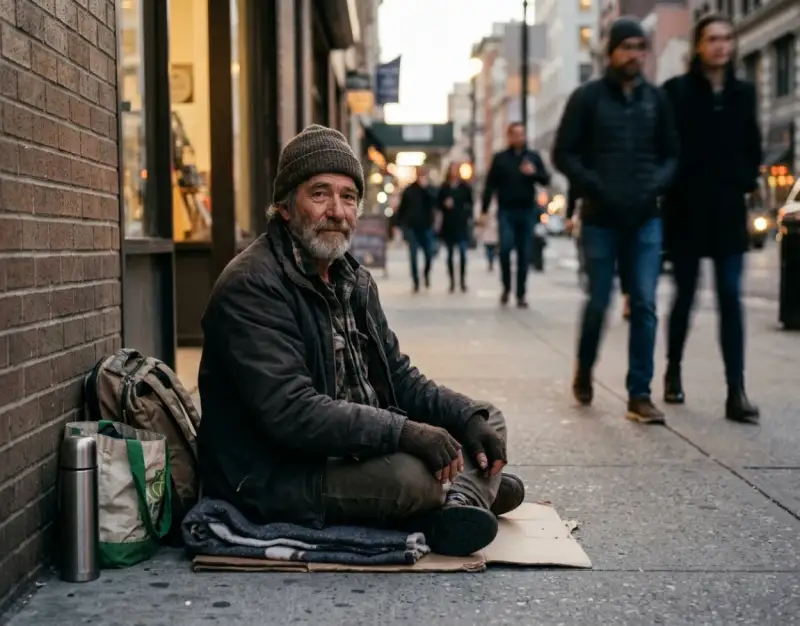
On any given afternoon in major urban centers and quiet suburban enclaves alike, thousands of people perform a subtle, unconscious choreography. We adjust our walking pace, shift our gaze upward toward glass skyscrapers, pull out our smartphones to look purposefully occupied, or cross the street entirely to avoid a fellow human being sitting on a folded piece of cardboard. In doing so, we participate in a quiet crisis of modern civilization: the systematic erasure of our unhoused neighbors. The physical reality of homelessness is undeniable, yet the human beings experiencing it are subjected to an agonizing form of public hyper-invisibility. We see the tents, the shopping carts, and the makeshift shelters, but we routinely fail to see the mothers, veteran mechanics, former teachers, and foster youth who inhabit them.
According to the U.S. Department of Housing and Urban Development (HUD), point-in-time counts reveal that over 650,000 individuals experience homelessness on any single night in the United States alone—a figure that represents a dramatic surge driven by catastrophic housing shortages, inflationary pressures, and the erosion of social safety nets. Yet, mainstream narratives remain stubbornly fixated on individual moral failing, addiction, or severe psychiatric illness as the sole drivers of unhoused living. This narrow focus conveniently abstracts the crisis away from systemic failures, reducing complex structural collapse into comfortable tropes of personal accountability. What has fundamentally changed in recent years is not merely the sheer volume of people rendered homeless, but the rapid acceleration of housing precarity across previously stable socioeconomic classes.
This flagship publication is dedicated to amplifying the authentic voices of the homeless and dismantling the pervasive myths that dehumanize them. By centering first-person narratives, analyzing trauma-informed intervention models, examining structural housing economics, and outlining actionable frameworks for community solidarity, we aim to bridge the gulf between public perception and human reality. True social awareness requires more than passive sympathy; it demands that we listen to the lived experiences of unhoused individuals, confront hostile urban policies, and support scalable solutions rooted in fundamental human dignity.
Foundational Principles & Mechanics: Understanding Unhoused Realities
To engage meaningfully with the crisis of homelessness, one must first master the structural terminology and psychosocial mechanics that define the unhoused experience. Public discourse frequently treats homelessness as a monolithic condition, but policy experts and street-level advocates distinguish between several distinct operational classifications. Understanding these distinctions is critical for deploying targeted, empathetic, and effective community interventions.
- Literal Homelessness: Individuals or families sleeping in places not meant for human habitation (e.g., cars, parks, abandoned buildings, streets) or residing in emergency shelters.
- Chronic Homelessness: Long-term or repeatedly unhoused individuals who have been continuously homeless for at least one year—or have experienced at least four episodes of homelessness in the past three years—combined with a disabling condition.
- Situational (or Episodic) Homelessness: Sudden, temporary displacement caused by a catastrophic life event, such as medical bankruptcy, sudden job loss, domestic violence, or family eviction.
- Doubled-Up or Couch-Surfing (Hidden Homelessness): Individuals living temporarily with relatives or friends because they lack independent housing, often moving frequently between overcrowded, unstable living arrangements.
Beyond administrative categories lies the devastating psychosocial phenomenon known as "social death." Coined by sociologists to describe conditions under which a person is denied full human status by society, social death manifests daily for unhoused people through prolonged social isolation, ambient hostility, and systematic non-recognition. When hundreds of passersby purposefully avert their eyes every hour, the psychological toll is cumulative and profound. Unhoused individuals report that the acute feeling of being utterly invisible is frequently more painful than the physical hardships of cold weather or sleep deprivation.
Furthermore, the systemic drivers of modern homelessness are overwhelmingly financial and structural rather than behavioral. Research consistently demonstrates that the primary predictor of regional homelessness rates is not drug use or mental illness, but the median rent-to-income ratio and the availability of low-income housing stock. When housing costs outpace wage growth, vulnerable individuals living near the financial margin are displaced. Addiction and mental health crises are often the consequence of the severe trauma of street survival, rather than its initial cause. By recognizing these foundational mechanics, we shift our collective approach from moral judgment to structural problem-solving.
Deconstructing the Stigma: Listening to First-Person Narratives
The Power of Oral History and Narrative Reclamation
For decades, the story of homelessness has been told by non-profit directors, city council members, police departments, and sensationalized news outlets. Rarely are unhoused people given the platform or agency to articulate their own lived realities without editorial filter. Oral history and direct narrative reclamation are vital tools for restoring human dignity. When an unhoused individual shares their story on their own terms, it disrupts the viewer's pre-packaged biases and forces a direct human-to-human recognition that statistics can never achieve.
Consider the story of Marcus, a 48-year-old former logistics manager in Ohio. After a sudden layoffs-and-medical-crisis spiral left him unable to cover a $3,000 hospital bill following an emergency appendectomy, Marcus fell behind on rent. Within four months, he transitioned from a suburban apartment to sleeping in his sedan, and eventually to an urban encampment when his vehicle was impounded for unpaid parking fines incurred while trying to sleep safely. "The day I lost my car was the day I stopped feeling like a citizen," Marcus shared during a street interview. "You don't realize how paper-thin the wall between stability and the sidewalk really is until you crash through it." Marcus's story is not an anomaly; it reflects the economic vulnerability shared by millions of working-class families.
Listening to these voices requires intentionality. It demands that community members, advocates, and journalists create safe, non-transactional spaces where unhoused individuals can speak without needing to perform tragic trauma for public consumption. Empowering individuals to share their expertise on surviving public space transforms them from passive subjects of charity into active architects of social policy.
Breaking the Monolith: Diverse Pathways into Homelessness
The path to the street is as unique as the individual walking it. Humanizing homelessness requires exploring the intersecting identities—age, race, sexual orientation, veteran status, and gender dynamics—that shape unhoused trajectories. For instance, LGBTQ+ youth represent up to 40% of the unaccompanied unhoused youth population, despite accounting for less than 10% of the overall youth demographic, primarily due to family rejection and religious ostracization.
Similarly, senior citizens constitute the fastest-growing segment of the unhoused population in many metropolitan areas. Fixed retirement incomes cannot withstand annual rent hikes of 15% to 30%, forcing elderly individuals—many with complex mobility and health challenges—onto concrete sidewalks. By collecting and elevating diverse first-person stories, advocates can demonstrate that there is no single "homeless identity," but rather a vast spectrum of human beings trapped in a systemic crisis.
The Mechanics of Effective Community Outreach
Practicing Trauma-Informed Engagement on the Front Lines
Effective street outreach is an art grounded in clinical psychology and deep human respect. Standard approaches to charity often fail because they treat unhoused people as passive recipients of aid rather than autonomous adults deserving of self-determination. Trauma-informed engagement operates on five core principles: safety, trustworthiness, choice, collaboration, and empowerment. Outreach workers and compassionate citizens must understand that hyper-vigilance, skepticism, and social withdrawal are natural survival adaptations for individuals residing in unsafe public environments.
When approaching an unhoused neighbor, tone, body language, and spatial awareness are critical. Standing directly over someone who is sitting or lying down creates an immediate power imbalance and can trigger trauma responses. Instead, crouch down to eye level, maintain a respectful distance, introduce yourself by name, and ask permission before opening a conversation. Never assume what a person needs—ask directly. A simple question such as, "Hi, my name is Sarah. I’m grabbing a coffee down the block. Can I bring you something to drink or eat, or would you prefer bottled water?" restores agency to the individual by offering a meaningful choice.
Building trust requires consistency over time. Showing up predictably, honoring small commitments, and respecting a person's decision to decline assistance are fundamental steps in restoring the social contract that systemic neglect has shattered.
Meeting Immediate Needs While Preserving Human Dignity
While long-term structural housing solutions are built, meeting day-to-day survival needs remains an urgent moral imperative. However, the methodology of aid delivery dictates whether an action builds dignity or reinforces degradation. Dump-and-run charitable efforts—where groups throw used goods at encampments without talking to residents—frequently create litter, waste resources, and treat unhoused communities like waste disposal sites for unwanted household clutter.
A far superior approach involves organized, community-driven resource networks. High-quality hygiene kits containing socks, lip balm, menstrual products, wet wipes, hand sanitizer, and gift cards to local food outlets empower recipients to navigate their day with comfort and autonomy. Similarly, community drive models that emphasize high-quality selection over haphazard donations yield far better outcomes. For instance, learning How to Host a Clothing Swap: Save Money, Reduce Waste, and Build Community offers a brilliant blueprint for gathering clean, high-grade winter coats, professional interview clothing, and weather-resistant gear that can be redirected directly to unhoused individuals through respectful, organized distributions.
"Dignity is not something we grant to unhoused people out of charity; dignity is their inherent human right. Our job is simply to stop violating it through our policies, our urban designs, and our silent indifference."
Structural Solutions: Shifting from Mitigation to Permanent Rehousing
The Evidentiary Success of Housing First Models
For decades, municipal homeless services operated on the "Staircase Model" (or linear housing model). Under this outdated paradigm, unhoused individuals were required to prove "housing readiness" by passing drug tests, completing psychiatric treatment programs, maintaining employment, and completing life-skills courses while living in shelters before being considered for permanent housing. This approach failed catastrophically because it expected individuals to stabilize complex health conditions while enduring the severe trauma, sleep deprivation, and danger of street homelessness.
The "Housing First" approach flipped this failing model on its head. Housing First operates on a simple, evidence-based premise: shelter is a basic human right and the primary platform required for any personal recovery, health stabilization, or employment success. Under Housing First, individuals are provided immediate, non-contingent access to permanent housing, combined with voluntary, intensive wrap-around support services (behavioral healthcare, addiction counselling, employment assistance, and case management).
Decades of rigorous empirical data confirm the overwhelming superiority of Housing First:
- Housing Retention Rates: Longitudinal studies show that 80% to 90% of individuals housed through Housing First retain their housing long-term, compared to less than 40% under traditional staircase models.
- Cost Savings to Taxpayers: Chronically unhoused individuals utilize extraordinary amounts of public emergency services (ER visits, ambulance calls, police encounters, jail stays). Providing permanent supportive housing costs taxpayers an average of 40% to 50% *less* per year than leaving an individual unhoused on the street.
- Health Outcomes: Access to a door that locks, private sanitation, and regular sleep dramatically decreases acute medical crises and improves management of chronic illnesses like diabetes, hypertension, and severe depression.
Supportive Housing and Integrated Behavioral Health Care
Housing First is not simply "housing only." The second half of the equation—robust supportive services—is essential for individuals dealing with long-term chronic homelessness and severe mental health challenges. Permanent Supportive Housing (PSH) pairs deeply subsidized housing units with on-site or assertive community treatment (ACT) teams. These multi-disciplinary teams include social workers, peer support specialists, psychiatrists, and nurses who engage residents in their own homes.
By integrating healthcare directly into housing management, residents build stable daily routines. They reconnect with family, address trauma, and regain self-sufficiency. When communities invest in scaling PSH inventory rather than temporary emergency shelters or punitive police enforcement, homelessness rates plummet dramatically.
Countering Hostile Architecture and Urban Criminalization
Decoding Defensive Urban Design
In response to visible homelessness, many municipal governments and private property owners have turned to defensive urban design—commonly known as "hostile architecture." This design philosophy intentionally constructs public infrastructure to guide, restrict, or prevent human behavior, specifically targeting unhoused people seeking rest, shelter, or community gathering.
Examples of hostile architecture permeate modern cities:
- Divided Bench Seating: Park and transit benches equipped with center armrests or metal dividers to prevent someone from lying down.
- Anti-Homeless Spikes and Studs: Metal spikes, concrete pyramids, or metal studs embedded into flat stone ledges, window sills, and under overpasses to render resting impossible.
- Bouldering and Landscaping Barriers: Large jagged boulders placed beneath highway overpasses where unhoused people formerly erected tents during severe weather.
- High-Frequency Sound Emitters and Sprinklers: Automated water sprinklers deployed on sidewalks at night or high-pitched acoustic deterrents designed to clear public plazas.
Hostile architecture does not resolve homelessness; it merely redistributes human suffering. It broadcasts a clear municipal message: you are unwelcome in public space. By spending public dollars on spikes and divided benches, cities actively choose punitive exclusion over real housing investment.
Advocating for Inclusive Public Spaces and Right-to-Rest Policies
A growing movement of urban designers, legal advocates, and grassroots organizers is fighting back against defensive urbanism. Advocates push for "Right-to-Rest" legislation, which protects the fundamental civil rights of unhoused citizens to use public spaces, rest, move freely, and protect themselves from inclement weather without fear of criminalization or harassment.
Urban planners are championing trauma-informed design principles for public infrastructure. This includes creating public plazas with open, flexible seating, public restrooms, free drinking water stations, and covered rest zones accessible to all community members regardless of housing status. Transforming public space into an inclusive sanctuary fosters community integration and challenges the systemic dehumanization of unhoused residents.
Supporting Vulnerable Youth and Aging-Out Pipelines
The Intersection of Foster Care Transitions and Youth Homelessness
One of the most predictable yet underfunded pipelines into adult homelessness is the transition out of the child welfare system. Every year, approximately 20,000 young adults "age out" of the foster care system upon reaching age 18 or 21. Denied financial safety nets, family support networks, and affordable housing options, up to 36% of foster youth experience at least one episode of homelessness within 24 months of aging out.
The transition is often abrupt and terrifying. Overnight, a teenager loses case management, housing stipends, and medical coverage. Lacking credit history, co-signers, or security deposit funds, securing a private market apartment is virtually impossible. This structural failure funnels traumatized youth directly onto the streets, where they face high risks of human trafficking, exploitation, and long-term economic dislocation.
Intervening early in this pipeline yields massive social dividends. Programs that provide extended foster care benefits up to age 26, combined with transitional housing vouchers and professional mentorship, dramatically reduce youth homelessness rates. Innovative community initiatives also focus on psychological healing and self-worth. For instance, projects like Surprise Prom Dress Shopping: Giving Foster Teens a Night They Will Never Forget illustrate how tailored community care and landmark milestone experiences instill dignity, hope, and belonging in vulnerable teens, serving as a vital emotional buffer during fragile life transitions.
Dedicated Micro-Housing and Mentorship Initiatives
To address youth homelessness effectively, communities are pioneering specialized transitional housing models tailored specifically to young adults aged 18-24. Micro-housing developments, communal co-living spaces with built-in life skills coaching, and host-home initiatives—where community members offer spare rooms to youth pursuing education or employment—provide the stable springboard required for a successful transition to adulthood.
When paired with adult mentors who offer emotional support, career guidance, and financial literacy training, young adults exiting foster care can break the generational cycle of housing insecurity and build thriving, independent futures.
Therapeutic Interventions and Grassroots Care Networks
Micro-Volunteering and Crafting for Comfort
While macro-level policy shifts and housing developments are critical, grassroots community care provides immediate relief, warmth, and relational healing. For unhoused individuals battling exposure to severe elements, handmade items carry immense practical and emotional value. A mass-produced blanket distributed from a warehouse provides physical insulation, but a hand-crafted, high-quality quilt or heavy-knit blanket communicates love, care, and individual human effort.
Grassroots care networks increasingly leverage micro-volunteering and creative activism to support unhoused neighbors. Community members involved in charitable crafting discover that their creative hobbies can address real-world vulnerability while fostering personal wellness. Exploring The Therapeutic Power of Knitting for Charity: How Handmade Blankets Soothe Anxiety highlights how crafting handmade winter goods for shelter residents creates a reciprocal cycle of healing—alleviating anxiety for the maker while delivering warmth, dignity, and tangible relief to an unhoused neighbor facing severe climate conditions.
Building Long-Term Relational Networks Over One-Off Charity
One-off charitable distributions during major holidays (such as serving Thanksgiving dinners) are common, but true community solidarity requires persistent, relational engagement. Unhoused individuals need trusted, long-term allies who know them by name, understand their healthcare needs, and advocate alongside them throughout their journey toward permanent housing.
Establishing local mutual aid networks, community fridges, weekly street outreach walk-and-talks, and volunteer mentorship initiatives transforms passive donors into active community partners. Relational care shifts the focus from "helping those poor people" to building a resilient, interconnected neighborhood where every resident's safety and housing stability are recognized as shared community responsibilities.
Real-World Case Studies: Policy Success vs. Systemic Failure
To understand the practical impact of contrasting approaches to homelessness, we examine two real-world urban scenarios that illustrate the dramatic difference between evidence-based housing solutions and punitive municipal enforcement.
Case Study A: The Houston Model (Coordinated Housing First Success)
In 2011, the city of Houston, Texas, faced a massive unhoused population with over 8,400 individuals living on the streets or in emergency shelters. Municipal leadership made a courageous decision: they dismantled fragmented, competing non-profit silos and unified more than 100 regional organizations into a single coordinated system known as "The Way Home."
They committed fully to the Housing First philosophy, prioritizing rapid rehousing and permanent supportive housing while eliminating prerequisites such as mandatory sobriety or employment. Over a ten-year period, Houston achieved astonishing results:
- 63% Reduction in Overall Homelessness: More than 25,000 individuals were placed directly into permanent homes with supportive services.
- 90%+ Housing Retention: Over 90% of individuals housed remained in their permanent housing long-term without returning to the streets.
- Dismantled Encampments Safely: Instead of executing hostile police sweeps, outreach teams engaged encampment residents for weeks prior to closing a camp, securing housing vouchers and move-in dates for every resident before closing the physical site.
The Houston model proves conclusively that homelessness is a solvable structural issue when public funds, non-profit resources, and evidence-based housing policies align around fundamental human dignity.
Case Study B: The Hostile Sweep Trap (City X Infrastructure Enforcement Failure)
In contrast, a major West Coast metropolitan area ("City X") pursued a punitive, enforcement-heavy strategy between 2018 and 2022. Facing public outcry over visible street encampments, the city spent tens of millions of dollars deploying police sweeps, sanitation bulldozers, and hostile architecture installation (boulders, metal spikes, and curved benches).
The consequences were catastrophic both humanly and financially:
- 0% Reduction in Unhoused Population: The unhoused population actually increased by 18% over the four-year period.
- Destruction of Vital Identification & Medications: Sweeps repeatedly destroyed unhoused residents' birth certificates, social security cards, state IDs, life-saving medications, and tents—setting back their progress toward securing employment or housing by months.
- Massive Taxpayer Waste: The city spent an estimated $12,000 per unhoused person annually on policing, encampment clearings, legal defense fees, and emergency room visits—without housing a single individual.
This comparative analysis demonstrates that punitive criminalization is not only morally indefensible but economically reckless, whereas Housing First strategies restore lives while conserving community financial resources.
Critical Mistakes & How to Avoid Them
Well-intentioned citizens, advocate organizations, and municipal workers frequently commit strategic errors that inadvertently prolong homelessness or cause psychological harm to unhoused neighbors. Below are the top five critical mistakes and the precise countermeasures required to eliminate them.
-
Conflating Transactional Pity with Relational Dignity:
The Mistake: Treating unhoused people as objects of pity or photo-ops for social media validation, handing out resources condescendingly without learning names or listening to their actual needs.
The Countermeasure: Practice relational solidarity. Approach every interaction as an equal exchange between neighbors. Always ask permission before giving items or starting conversations, and never film or photograph unhoused individuals for publicity without explicit, informed consent.
-
Misdiagnosing Housing Shortages as Individual Moral Failures:
The Mistake: Assuming that an unhoused person is on the street solely due to laziness, substance use, or lack of effort, while ignoring regional housing affordability crises and wage stagnation.
The Countermeasure: Educate yourself and your community on local housing economics. Advocate for municipal zoning reform, affordable housing construction, high-density residential development, and tenant protection laws that address the root structural causes of housing loss.
-
Supporting Punitive Sweeps and Hostile Infrastructure:
The Mistake: Petitioning city officials to bulldoze encampments or install anti-homeless spikes to clear sidewalk visibility without providing alternative permanent housing options.
The Countermeasure: Oppose all anti-homeless ordinances and hostile architecture in your city council meetings. Demand that public funds be redirected from policing and sweeps toward rapid rehousing, permanent supportive housing, and low-barrier shelter models.
-
Operating Outreach Without Trauma-Informed Principles:
The Mistake: Invading personal space, making demands regarding mandatory rehabilitation or religious conversion in exchange for aid, or reacting defensively when an unhoused person expresses frustration or distress.
The Countermeasure: Undergo formal trauma-informed care training before conducting outreach. Recognize that survival on the street creates hyper-vigilance, respect boundaries, and offer unconditional support without demanding behavioral compliance.
-
Excluding Unhoused Voices from Policy and Program Design:
The Mistake: Designing homeless services, non-profit boards, and municipal advisory task forces entirely composed of housed professionals who lack lived experience of homelessness.
The Countermeasure: mandate lived-experience representation on municipal housing boards, non-profit leadership committees, and advocacy groups. Compensate unhoused and formerly unhoused advisors equitably for their policy expertise and lived insight.
Comprehensive Approach Comparison Table
The following detailed matrix compares the primary methodologies utilized in public policy and community work to address homelessness across key operational dimensions.
| Approach Dimension | Traditional Staircase Model | Housing First Paradigm | Punitive / Hostile Enforcement | Relational Community Solidarity |
|---|
Be the first to share a gentle reflection on this story.