
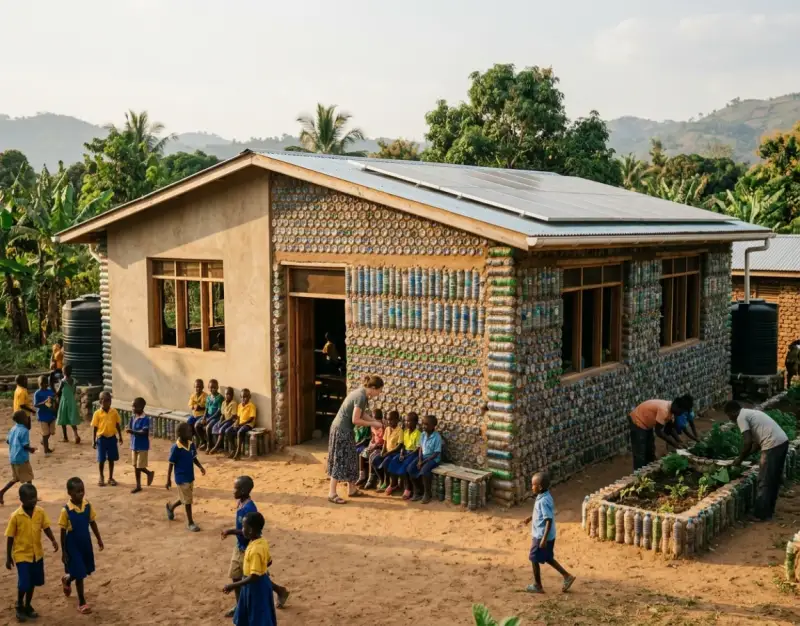
Across the globe, the crisis of plastic pollution continues to choke landfills, poison marine ecosystems, and loom as an enduring monument to modern consumerism. Yet, in pockets of extraordinary ingenuity, visionaries are transforming this environmental hazard into a literal foundation for education. The concept of global goodness manifests profoundly when communities band together to rethink refuse, viewing discarded polyethylene terephthalate (PET) containers not as eternal trash, but as sturdy, modular bricks. This paradigm shift in civil engineering has given birth to a remarkable wave of educational institutions constructed entirely from waste materials, changing the landscape of infrastructure for disadvantaged youth.
Traditional construction methods are resource-intensive, environmentally taxing, and frequently prohibitively expensive for rural or impoverished regions. Cement production alone accounts for a staggering percentage of global carbon emissions, while timber harvesting depletes vulnerable forest canopies. In response, modern architects, structural engineers, and grassroots organizers have pioneered eco friendly school construction techniques that bypass traditional supply chains entirely. By packing discarded bottles with compressed earth, sand, or non-organic debris, builders create high-performance masonry units that rival traditional bricks in compressive strength while costing a fraction of the price.
This comprehensive exploration delves deep into the mechanics of plastic bottle building, examining how a simple discarded soda container can be engineered into a seismic-resistant, thermally insulated learning sanctuary. As we examine the principles of sustainable architecture, we will also explore how community-driven initiatives are reshaping human potential. Much like how communities unite to bridge technological divides—mirroring initiatives such as Collaborative Welfare: Tech Giants and Local Nonprofits Team Up to Bridge the Digital Divide—environmental innovation requires cross-sector collaboration, shared knowledge, and a fierce commitment to human dignity.
The Genesis of Plastic Bottle Architecture
Understanding the Global Plastic Crisis
To fully appreciate the gravity of building schools from waste, one must first confront the sheer scale of global plastic consumption. Millions of plastic bottles are purchased every minute, and the vast majority escape recycling streams to find their way into natural environments. This pervasive material takes centuries to degrade, breaking down into microplastics that infiltrate the food chain. Environmentalists and municipal planners have long struggled to manage this deluge of synthetic waste, making large-scale reuse models an urgent planetary necessity.
In response to this ecological crisis, forward-thinking designers began experimenting with structural reuse. Rather than melting down plastics—a process that requires significant energy and specialized industrial facilities—engineers realized that filled bottles could serve as structural masonry. When tightly packed with dry soil, sand, or mud, a standard PET bottle becomes virtually indestructible under vertical loads. This foundational insight unlocked a decentralized, zero-cost building block available in virtually every corner of the earth, bridging the gap between waste management and community infrastructure.
The Thermodynamics and Physics of Eco-Bricks
The core building block of these innovative structures is often referred to as an "eco-brick"—a PET bottle packed densely with clean, dry non-biodegradable waste or earth. When engineered correctly, these packed bottles exhibit extraordinary physical properties. The air trapped within the plastic walls, combined with the dense core, creates a phenomenal thermal insulation barrier. Buildings constructed using this method naturally regulate interior temperatures, remaining cool in sweltering tropical climates and retaining heat during cold mountain winters.
Furthermore, structural testing has repeatedly demonstrated that bottle walls possess exceptional seismic resilience. Unlike rigid concrete block walls that crack and shatter under sudden lateral shifts during earthquakes, bottle-and-mud matrices offer a degree of flexibility. The individual bottles act as shock absorbers within a stabilizing web of wire mesh and plaster, distributing kinetic energy evenly throughout the structure. This makes plastic bottle building not only an environmental triumph but a life-saving safety innovation in earthquake-prone regions.
Engineering and Material Preparation Methodologies
Sourcing, Sorting, and Cleaning the Raw Materials
The transformation of waste into architecture begins with rigorous material sourcing and preparation. Not all plastic bottles are created equal; builders typically prioritize heavy-duty carbonated beverage containers because their thick walls and pressurized design withstand higher compression loads than thinner water bottles. Community collection drives often mobilize students, parents, and local volunteers, turning the gathering of raw materials into an engaging civic lesson on environmental stewardship and resource conservation.
Once collected, the bottles must undergo careful sorting by size, volume, and structural integrity. Damaged or warped bottles are discarded or diverted to standard recycling. The selected containers are washed thoroughly to remove residual sugars, labels, and organic matter that could attract pests or compromise the internal filling over time. Drying the interior completely is a critical prerequisite; trapped moisture can foster mold growth or weaken the integrity of organic fillings inside the sealed container.
The Art and Science of Bottle Packing
Packing an eco-brick is an exact science that requires physical exertion and meticulous attention to detail. The filling material—typically dry subsoil, clay, or clean sand—is introduced in small increments and packed down aggressively using a specialized tamping rod. Every single layer must achieve maximum compaction to eliminate air pockets, ensuring the final unit feels solid and unyielding, much like a dense wooden log or concrete block.
Quality control at this stage is paramount. Builders frequently weigh the packed bottles against strict baseline standards. A standard 500ml or 1.5-liter bottle must reach a predetermined minimum weight to qualify for structural use. If a bottle yields under hand pressure or exhibits internal shifting, it is rejected or re-packed. This obsessive focus on standardization ensures that when the bricks are laid into walls, load distribution remains uniform across the entire architectural footprint.
Laying the Foundation and Structural Framework
Designing for Stability: Foundations and Reinforcement
While the walls consist primarily of plastic bottles, a resilient school building requires a robust traditional foundation to anchor it against wind loads, soil settling, and moisture seepage. Engineers typically pour a reinforced concrete or stone-masonry footing trench that elevates the building above ground level. This prevents sub-surface ground moisture from weakening the lower courses of the wall and provides a perfectly level plane upon which the bottle-brick matrix can rise.
Steel reinforcement bars (rebar) are integrated vertically into the corners and structural spans of the building footprint. These steel columns are tied into the foundation and later woven through horizontal wire mesh layers that sandwich the bottle courses. This hybrid construction methodology marries the low-impact benefits of waste reuse with the proven safety margins of modern engineering, ensuring the resulting school building meets or exceeds local structural building codes.
Laying Techniques: Mud Mortar and Horizontal Binding
Laying bottle bricks differs significantly from traditional bricklaying. Instead of cement mortar, builders often utilize an earth-and-clay slurry or mud mortar that chemically and physically bonds with both the plastic surface and the wire mesh reinforcement. The bottles are laid horizontally in alternating patterns, with their bases facing outward or inward depending on the desired aesthetic finish. Some avant-garde designs even leave strategic rows of bottle bases exposed to act as natural stained-glass windows, filtering colorful ambient light into the classrooms.
As each course of bottles is laid, horizontal chicken wire or galvanized wire mesh is wrapped tightly over the layer and pinned down before the next course begins. This intricate web creates a composite material system. The wire mesh prevents the round bottles from rolling or slipping out of alignment under pressure, locking the entire wall assembly into a unified monolithic block once the exterior plaster coat is applied.
Plastering, Finishing, and Aesthetic Integration
Applying Breathable Earth and Lime Plasters
Once the structural skeleton of bottle walls is complete, the exterior and interior surfaces must be sealed and protected from weathering, UV degradation, and mechanical damage. UV rays from the sun can degrade exposed plastics over time, making a protective outer skin absolutely vital for long-term durability. Builders apply multiple coats of breathable, eco-friendly plasters—typically a blend of clay, sand, straw, and natural lime.
This natural plaster application serves several crucial functions. Aesthetically, it completely masks the unconventional building materials, rendering the school indistinguishable from a high-end adobe or conventional stucco building. Functionally, the plaster acts as a weather-resistant shield, protecting the plastic beneath from sunlight while allowing trapped moisture vapor to escape harmlessly, preventing internal condensation and rot.
In designing spaces dedicated to holistic growth and learning, attention to sensory details matters deeply. Just as communities create healing environments for vulnerable populations—such as those explored in How to Create Sensory Gardens for Individuals With Autism and Dementia—sustainable schools incorporate textures, natural earth tones, and calming spatial arrangements that foster psychological well-being and concentration among students.
Ventilation, Natural Lighting, and Interior Ergonomics
A successful school building must prioritize the health and cognitive performance of its occupants. Poor indoor air quality and inadequate lighting impair student learning and physical health. Architects of bottle-built schools integrate passive cooling and solar orientation strategies into their initial blueprints. High ceilings, strategically placed clerestory windows, and louvered vents harness prevailing wind currents to maintain a constant flow of fresh air without mechanical air conditioning.
Furthermore, creative manipulation of bottle placement allows for unique architectural illumination. By inserting unpainted, crystal-clear bottles filled with water and a drop of bleach (to prevent algae growth) through the walls, builders create "solar tube" skylights that refract and diffuse brilliant daylight deep into the interior rooms. This ingenious zero-electricity lighting solution illuminates classrooms throughout daylight hours, dramatically reducing energy burdens in remote off-grid communities.
Real-World Case Studies and Comparative Metrics
Examining successful implementations of plastic bottle building reveals both the immense potential and the practical hurdles of alternative architecture. In regions spanning Central America, South Asia, and sub-Saharan Africa, grassroots organizations have partnered with local communities to construct dozens of functional, seismically sound eco-schools.
| Metric / Parameter | Traditional Concrete School | Eco-Friendly Bottle School |
|---|---|---|
| Material Cost | High (Commercial cement, steel, bricks) | Low to Zero (Discarded bottles, local earth) |
| Carbon Footprint | Extremely High (Intensive cement manufacturing) | Minimal (Upcycling waste, localized labor) |
| Thermal Insulation | Poor (Requires artificial heating/cooling) | Superior (Air pockets regulate ambient climate) |
| Community Engagement | Low (Outsourced to commercial contractors) | Extremely High (Participatory sweat equity) |
| Seismic Resilience | Rigid; prone to catastrophic cracking | Flexible matrix absorbs and disperses shock |
A notable project in Central America demonstrated that constructing a multi-classroom school from bottle bricks reduced overall construction material expenditures by nearly 60 percent. Furthermore, the initiative diverted over 30,000 plastic bottles from local landfills and waterways within a single semester. Beyond the hard economic and environmental data, the intangible benefits proved equally profound: local students developed an intense, lifelong sense of ownership and pride in their educational facility because they had physically built the walls themselves.
Critical Mistakes and How to Avoid Them
1. Failing to Shield Exposed Plastics from UV Radiation
One of the most catastrophic errors inexperienced builders make is leaving plastic bottles exposed to direct sunlight without an opaque plaster or cladding layer. Polyethylene degrades rapidly when exposed to ultraviolet light, becoming brittle and disintegrating into dust. Countermeasure: Always ensure that every exterior square inch of the bottle matrix is sealed completely behind a thick, weather-resistant layer of earth plaster, cement stucco, or protective cladding.
2. Using Wet or Organic Matter as Bottle Filling
In a rush to pack bricks, some workers utilize damp soil, green grass, or food waste to fill the bottles. As organic matter decomposes inside a sealed, airtight container, it releases moisture and gases, causing the bottle to swell, rupture, or emit foul odors within the wall structure. Countermeasure: Enforce strict quality control protocols requiring 100% dry, inert inorganic fill materials such as dry sand, subsoil, or shredded non-recyclable plastic foil.
3. Neglecting Structural Engineering and Seismic Codes
Treating bottle walls as load-bearing structures without proper vertical reinforcement, corner columns, or beam ties can lead to structural collapse under heavy roof loads or minor earth tremors. Countermeasure: Always consult qualified structural engineers to design a hybrid framing skeleton incorporating reinforced concrete or timber tie-beams that carry the roof load independently of the infill walls.
4. Poor Water Management and Foundation Seepage
Building bottle walls directly on damp ground without an elevated foundation causes capillary action to draw moisture up into the earth mortar, weakening the structural integrity of the entire wall. Countermeasure: Construct a raised foundation plinth using water-impermeable stone masonry or waterproofed concrete to elevate the bottle courses at least 30 centimeters above the surrounding soil grade.
5. Skipping Community Training and Standardization
Attempting to build without training volunteers or failing to standardize bottle weights leads to uneven wall alignment, structural weak points, and compromised load-bearing capacity. Countermeasure: Establish mandatory workshops on proper tamping techniques, weight thresholds, and masonry alignment before full-scale construction begins.
Frequently Asked Questions
Are schools built from plastic bottles structurally safe during earthquakes?
Yes, when engineered correctly. The combination of flexible plastic bottles, horizontal wire mesh binding, and earth mortar creates a composite wall system that absorbs and dissipates kinetic shockwaves far better than rigid brick or unreinforced concrete. Many eco-schools have successfully withstood significant seismic events without suffering catastrophic structural failure.
How long do plastic bottle buildings last?
When properly constructed, shielded from UV radiation, and protected from moisture penetration, plastic bottle buildings can last for decades—potentially centuries. Because the plastic inside the wall is protected from sunlight, oxygen, and physical wear, the structural integrity remains stable over generations.
What types of materials are best for filling the bottles?
The industry standard is clean, dry subsoil, sand, or clay packed tightly to maximum density. Some modern initiatives also use clean, non-organic non-recyclable plastic packaging shredded into fine particles. The key requirement is that the filling must be completely dry and devoid of organic material that could rot or decompose.
Do these buildings look like trash, or do they look like normal schools?
They look entirely normal! Once the exterior and interior walls are finished with breathable earth or lime plasters, the building is visually indistinguishable from traditional stucco or adobe architecture. Only intentional design features—such as exposed bottle bottoms acting as decorative stained-glass accents—reveal the sustainable materials hidden within.
How does plastic bottle construction contribute to global goodness?
This construction methodology addresses multiple interconnected crises simultaneously. It cleans up local environmental pollution, provides affordable and thermally comfortable infrastructure for impoverished communities, empowers local citizens through participatory sweat equity, and educates the next generation on the practical realities of a circular, sustainable economy.
Strategic Roadmap and Final Takeaway
The architectural phenomenon of building schools entirely from recycled plastic bottles represents a profound triumph of human creativity over systemic environmental neglect. As we look toward the next two to five years, the trajectory of sustainable architecture points unmistakably toward decentralized, resource-conscious methodologies. Municipalities, NGOs, and educational authorities are increasingly recognizing that waste is merely a resource in the wrong place. By scaling these innovative construction techniques, we can simultaneously eradicate plastic pollution and build safe, inspiring learning environments for children in every corner of the globe.
The path forward requires continued collaboration between engineers, policymakers, educators, and local communities. Practitioners must continue to refine building codes, share open-source architectural blueprints, and champion participatory construction models. When communities take ownership of their infrastructure using the very waste they produce, they cultivate an enduring ethos of resilience, resourcefulness, and global goodness that transcends bricks and mortar, laying the physical and philosophical foundation for a brighter, more sustainable future.
Be the first to share a gentle reflection on this story.