
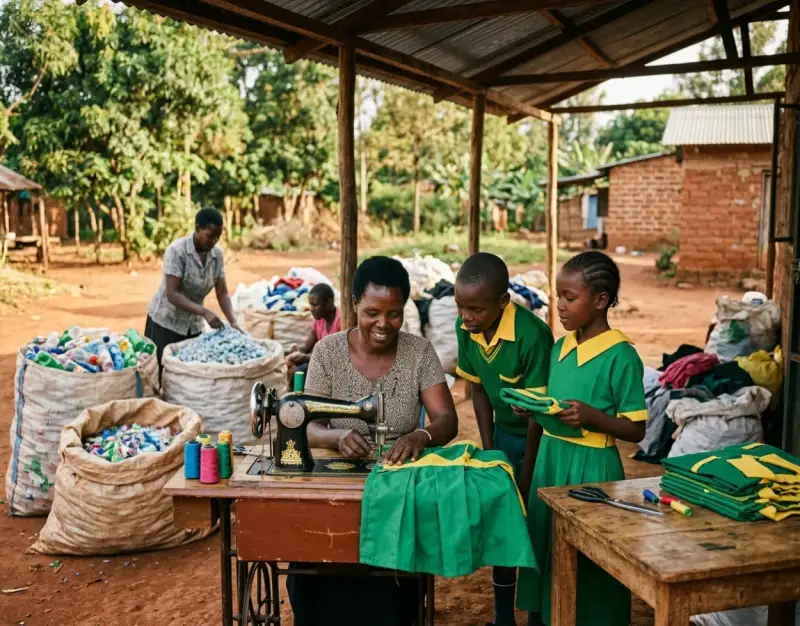
Across the dusty, sun-baked pathways of a rural Kenyan village, a quiet revolution is taking shape—one that is fundamentally redefining the intersection of environmental conservation and grassroots community welfare. For decades, discarded single-use plastics, discarded water sachets, and tangled polyethylene bags choked local drainage systems, marred the landscape, and posed severe public health hazards. Yet, rather than resigning themselves to an encroaching tide of synthetic debris, local community leaders, artisans, and educators forged an ingenious alliance. They asked a transformative question: What if the very material threatening our ecosystem could be systematically harvested to clothe our children and keep them in the classroom?
This remarkable initiative stands as a beacon of global goodness, demonstrating how localized grassroots ingenuity can tackle macro-level ecological crises while simultaneously removing barriers to foundational human needs. Around the world, communities are beginning to recognize that traditional waste management models are obsolete. True progress requires a circular economy mindset—one where waste is viewed not as a terminal burden, but as a vital raw material. By turning polyethylene terephthalate (PET) bottles and low-density polyethylene (LDPE) films into high-grade textile fibers, this Kenyan village has pioneered a blueprint that transcends borders, inspiring similar ventures from Southeast Asia to Latin America.
As we examine the mechanics of this transformation, we uncover a multi-layered ecosystem involving micro-entrepreneurship, chemical upcycling, educational equity, and cultural revitalization. Much like the profound lessons uncovered in our exploration of Voices of Change: The Indigenous Elder Preserving Ancient Ecological Wisdom, this project proves that sustainable survival depends on listening deeply to local environments and transforming traditional vulnerabilities into long-term strengths. In the sections that follow, we will dissect the foundational principles, step-by-step methodologies, real-world case studies, and strategic blueprints that make this transformative enterprise possible.
Foundational Principles and Mechanics of Plastic-to-Textile Upcycling
To fully grasp how a rural village can convert discarded trash into wearable, durable garments, one must first understand the fundamental mechanics of polymer upcycling. Unlike traditional downcycling—where plastic bottles are melted down into lower-grade items like plastic lumber or fence posts—upcycling clothing requires a sophisticated balance of mechanical sorting, chemical breakdown, and fiber extrusion. The process begins with rigorous source separation at the community level, ensuring that contaminants such as organic residue, metal caps, and paper labels are entirely removed before the polymers enter the processing phase.
At the microscopic level, synthetic plastics are composed of long, repeating chains of molecules. Polyethylene terephthalate (PET), commonly found in beverage bottles, possesses ideal thermal and tensile properties for textile production. When shredded into uniform flakes, washed, and melted, these flakes can be extruded through spinnerets—precision nozzles that form continuous filaments. These filaments are then crimped, cut, and spun into yarn. This spun yarn can be blended with organic cotton or hemp to create breathable, durable fabrics specifically engineered to withstand the rigors of daily school life.
Furthermore, these plastic recycling initiatives operate on closed-loop economic principles that retain financial capital within the community. When villagers collect waste plastic and sell it to local collection hubs, they generate direct micro-incomes. These hubs then supply the cottage-industry processing units, which manufacture the fabric locally. By eliminating expensive international supply chains, the community reduces its carbon footprint while ensuring that the economic dividends of environmental stewardship directly benefit the families whose children wear the uniforms. This localized autonomy forms the bedrock of truly resilient sustainable education projects.
Step 1: Establishing Community Collection Networks and Source Separation
The success of any textile upcycling venture hinges entirely on a reliable, consistent, and high-purity supply of raw plastic waste. Without structured community participation, processing facilities risk running dry or receiving contaminated materials that compromise the structural integrity of the final fabric.
Designing Decentralized Drop-Off Points
Establishing effective collection networks requires strategic placement of secure drop-off bins across high-traffic community zones, including local markets, places of worship, and community health centers. These bins must be clearly labeled with visual aids, accommodating literacy variations and ensuring community-wide comprehension. Local youth groups and women's cooperatives are often mobilized to manage these sites, fostering a shared sense of civic ownership and responsibility.
Implementing Rigorous Sorting Protocols
Raw plastic waste cannot be processed uniformly; mixing different polymer types results in structural failure during the melting and extrusion phases. Volunteers and workers are trained to sort plastics by resin identification codes—primarily separating PET bottles from LDPE films and HDPE containers. Once sorted, materials undergo initial quality checks to filter out degraded plastics that have suffered excessive sun damage or chemical contamination.
Expert Insider Tip: Incentivize collection by pairing waste drop-offs with community welfare credits. For instance, families can exchange a specific weight of clean plastic bottles for school supplies, nutritional supplements, or direct discounts on the final upcycled school uniforms, driving exponential engagement rates.
Step 2: Processing, Washing, and Shredding Post-Consumer Plastics
Once raw plastics are collected and sorted, they must undergo intensive physical transformation before they are ready for chemical or mechanical conversion into textile-grade polymers.
Industrial Washing and Contaminant Removal
Post-consumer waste is frequently contaminated with dirt, glue, residual liquids, and paper labels. The processing facility utilizes large-scale industrial washing vats infused with biodegradable, eco-friendly detergents. Agitation tanks loosen stubborn adhesives and paper labels, which are skimmed off the surface through density separation techniques. Cleaned plastic flakes are then rinsed thoroughly with recycled graywater to minimize freshwater consumption.
Precision Shredding and Drying
After washing, the clean plastic pieces are transferred to commercial-grade granulators or shredders equipped with razor-sharp steel blades. These machines reduce the bottles into uniform, millimeter-sized flakes known as "regrind." This regrind is then fed into industrial dehumidifying dryers. Eliminating moisture is a critical step; even trace amounts of water vapor can hydrolyze the polymer chains during high-temperature melting, drastically weakening the resulting fibers.
Practical Application: Partner with local technical vocational schools to maintain shredding machinery. This provides students with hands-on mechanical engineering experience while ensuring that processing equipment operates at peak efficiency with minimal downtime.
Step 3: Polymer Melting, Extrusion, and Yarn Spun Production
The transition from solid plastic flakes to soft, wearable textile yarn represents the most technically demanding phase of the entire upcycling lifecycle.
Thermal Extrusion and Filament Formation
The dried plastic flakes are fed into a single-screw or twin-screw extruder, where thermal heaters melt the polymer to precise temperatures—typically between 250°C and 280°C. The molten plastic is pressurized and forced through a spinneret, a specialized metal plate containing dozens of microscopic holes. As the molten streams emerge from the spinneret, they are cooled by controlled air jets, solidifying into continuous, fine filaments.
Drawing, Crimping, and Blending
Freshly extruded filaments lack the elasticity and texture required for comfortable clothing. They pass through a series of drawing rollers that stretch the fibers molecularly, aligning the polymer chains to maximize tensile strength. The fibers are then mechanically crimped to mimic natural cotton texture and cut into uniform staple lengths. In many advanced community setups, these recycled polyester staples are blended with locally sourced organic cotton fibers to produce a softer, highly breathable fabric blend.
Expert Insider Tip: Monitor melt-flow indices rigorously during extrusion. Inconsistent polymer viscosity will result in uneven yarn thickness, leading to weak spots in the woven fabric that will fail quality control inspections.
Step 4: Textile Weaving, Dyeing, and Garment Construction
With high-grade yarn successfully manufactured, the production process shifts to traditional textile arts adapted for modern, sustainable garment manufacturing.
Eco-Friendly Weaving and Dyeing
The blended yarn is loaded onto industrial looms operated by skilled local artisans. These looms weave the yarn into heavy-duty, tear-resistant twill fabrics specifically engineered to endure the physical demands of active school children. To maintain the project's ecological integrity, dying processes utilize closed-loop water systems infused with non-toxic, plant-based or reactive dyes that prevent harmful chemical runoff into local watersheds.
Tailoring and Quality Assurance
Once bolts of fabric are produced, local tailors—often supported by micro-grants and vocational training—cut and sew the material into standardized school uniforms. Each garment undergoes strict quality assurance checks, testing for seam strength, colorfastness, and comfort. These uniforms are then distributed directly to schools, ensuring that children from low-income families can attend classes with dignity and pride.
Similar to how community-based safety nets uplift vulnerable populations—as explored in our feature on Collaborative Welfare: Partnering Local Businesses With Shelters to End Period Poverty—this tailored distribution model ensures that no child is left behind due to financial destitution or lack of required attire.
Step 5: Scaling Distribution and Measuring Social Impact
Creating high-quality uniforms is only half the battle; scaling the enterprise requires robust distribution frameworks and data-driven impact assessment.
Establishing Direct-to-School Partnerships
To maximize reach, project organizers collaborate directly with school boards, parent-teacher associations, and regional ministries of education. By securing bulk purchasing agreements, the initiative can subsidize uniform costs for orphaned and vulnerable students, funded partially by external grants and carbon offset credits.
Transparent Impact Tracking and Reporting
Donors, partner organizations, and local stakeholders require quantifiable metrics to validate project success. Comprehensive digital registries track key performance indicators, including kilograms of plastic waste diverted from landfills, gallons of water saved, number of local jobs created, and student attendance rates before and after uniform distribution.
Practical Application: Implement QR codes on uniform tags linked to blockchain-backed impact trackers. This allows parents and supporters to trace the exact journey of the plastic waste that went into manufacturing their child's garment, fostering absolute transparency and trust.
Real-World Case Studies & Scenarios: Success vs. Common Failures
Examining actual field implementations reveals the stark difference between thriving community upcycling enterprises and well-intentioned projects that ultimately collapse under logistical pressures. Consider the contrast between the Nakuru Eco-Textile Project and the hypothetical Coastal Plastics Initiative.
Case Study A: The Nakuru Eco-Textile Project (Successful Execution)
In Nakuru County, a grassroots cooperative launched a decentralized plastic collection network tied directly to local primary schools. By investing in modular, low-energy shredding units and partnering with regional textile artisans, the project achieved a closed-loop model. Over three years, they diverted over 120 metric tons of plastic waste, manufactured 15,000 durable school uniforms, and increased local school attendance by 28%. The key to their success was prioritizing community ownership, comprehensive vocational training, and strict quality control standards from day one.
Case Study B: The Coastal Plastics Initiative (Common Failure)
Conversely, the Coastal Plastics Initiative attempted to scale too rapidly by importing high-capacity industrial extrusion machinery without conducting local technical training or securing a reliable, sorted plastic supply. Within six months, the complex machinery broke down due to contaminated PVC plastics entering the shredder, and the project lacked the specialized engineering support required for repairs. Furthermore, because they failed to consult local tailors and parents regarding sizing and comfort, the resulting garments were rejected by the schools. The project accumulated massive debt and ultimately abandoned operations.
Lessons Learned: Scaling must always match technical capacity and community integration. Prioritizing modular, repairable technology and local stakeholder buy-in is vastly superior to importing expensive, opaque industrial systems.
Critical Mistakes and How to Avoid Them
Initiating a plastic-to-textile upcycling project in a developing region is fraught with technical, social, and economic hurdles. Practitioners must proactively identify and neutralize common missteps.
- Mistake 1: Ignoring Polymer Contamination. Mixing PET with PVC or PP ruins entire batches during thermal extrusion. Countermeasure: Implement strict, multi-stage manual and chemical sorting protocols with mandatory training for all collection center workers.
- Mistake 2: Overlooking Comfort and Cultural Preferences. Pure recycled polyester can feel stiff or trap heat if not blended correctly. Countermeasure: Always blend recycled synthetic fibers with natural cotton or hemp and conduct rigorous wearer trials with local students before mass production.
- Mistake 3: Centralizing Operations Too Quickly. Building a massive processing facility before establishing a stable supply chain leads to idle machinery and financial burnout. Countermeasure: Scale progressively, starting with localized collection and shredding before investing in heavy extrusion and weaving hardware.
- Mistake 4: Neglecting Equipment Maintenance Training. Importing complex machinery without local mechanical support guarantees catastrophic downtime upon first breakdown. Countermeasure: Partner with technical vocational institutes to train local technicians in preventative maintenance and machine repair.
- Mistake 5: Failing to Secure Long-Term Offtake Agreements. Producing uniforms without guaranteed buyers leaves warehouses overstocked and cash flows paralyzed. Countermeasure: Establish formal memoranda of understanding (MOUs) with regional school districts and educational authorities prior to full-scale manufacturing.
Comprehensive Comparison Table: Traditional vs. Upcycled Uniform Production
To understand the profound structural shift represented by this community-led model, review the comparative breakdown below:
| Metric / Feature | Traditional Linear Model | Upcycled Circular Model |
|---|---|---|
| Raw Material Source | Virgin petroleum, conventionally farmed cotton | Post-consumer plastic waste, recycled blends |
| Carbon Footprint | Extremely high due to global shipping and synthetic extraction | Low, minimized by localized processing and waste diversion |
| Community Economic Impact | Capital leaves community for multinational conglomerates | Retains capital locally via micro-collection and artisanal labor |
| Waste Management Outcome | Contributes to overflowing landfills and ocean pollution | Actively remediates local ecosystems and drainage systems |
| Educational Equity Support | Uniforms remain an expensive barrier for impoverished families | Subsidized or directly bartered, boosting school attendance |
Frequently Asked Questions (FAQ)
How safe are school uniforms made from recycled plastic waste?
Recycled plastic school uniforms are entirely safe, durable, and hygienic. The manufacturing process involves melting the plastic at temperatures exceeding 250°C, which effectively sterilizes the material. Once extruded into filaments, blended with natural fibers, and thoroughly washed, the resulting fabric meets or exceeds all standard textile safety regulations, containing no harmful chemical residues or abrasive irritants.
How does the community collection process incentivize waste pickers?
Community collection networks operate on a localized micro-economy model. Waste collectors—often local villagers, youth groups, and informal recyclers—receive direct financial compensation, vouchers, or welfare credits based on the weight and purity of the plastic they deliver. This structure transforms environmental cleanup into a reliable, dignified source of supplementary income.
Can this model be replicated in urban environments or other countries?
Yes, the foundational principles of modular upcycling and decentralized collection are highly adaptable. While this specific case study focuses on a rural Kenyan village, urban centers in Latin America, Southeast Asia, and Eastern Europe have successfully implemented similar micro-factories by tailoring collection logistics to dense population hubs and partnering with municipal waste management authorities.
What happens to the uniforms once children outgrow them?
True to circular economy principles, programs implementing upcycled school uniforms often establish take-back initiatives. Outgrown or worn uniforms are collected, shredded back down into polymer regrind or fiber blend, and re-extruded into new garments or durable textile goods, ensuring that the material remains perpetually in use and out of local landfills.
How do these projects secure initial funding and financial self-sustainability?
Initial capital is typically raised through a combination of international grants, environmental philanthropy, impact investing, and crowdfunded sustainable education projects. Over time, financial self-sustainability is achieved by selling the uniforms at subsidized rates to regional schools, partnering with corporate social responsibility (CSR) programs, and trading verified carbon and plastic-offset credits on global markets.
Strategic Roadmap and Final Takeaway
The remarkable journey of a rural Kenyan village turning plastic waste into school uniforms offers a masterclass in modern sustainability, proving that ecological crisis and social empowerment are inextricably linked. By bypassing rigid, top-down industrial models and embracing community-led circular economies, these pioneers have demonstrated how local action can yield global resonance. Just as supportive environments are vital for mental well-being—a dynamic explored in our analysis of Therapy Dogs in Schools: How Canine Companions Are Lowering Student Anxiety—providing clean, accessible uniforms removes acute psychological and financial stressors from vulnerable students, allowing them to thrive academically.
Looking ahead to the next 2 to 5 years, the future of global goodness lies in the hyper-localization of recycling technology. As modular, low-energy shredders and desktop extruders become increasingly affordable, more rural and semi-urban communities will establish autonomous micro-factories. Practitioners, policymakers, and global citizens must commit to supporting these grassroots innovations through ethical partnerships, open-source technological sharing, and sustained investment. The blueprint has been drawn: by viewing waste as an untapped resource, we can clothe the next generation while healing the planet, one recycled thread at a time.
Be the first to share a gentle reflection on this story.