
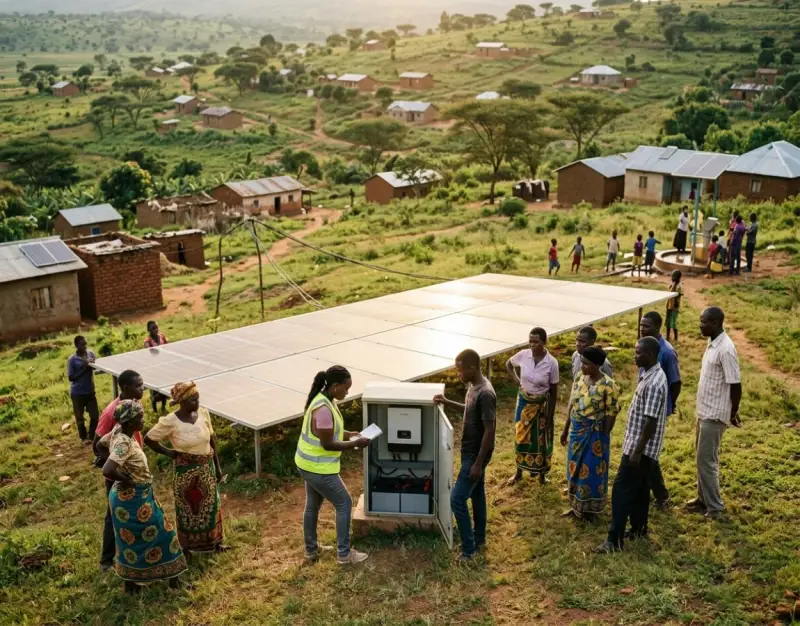
For decades, standard centralized electrification models have failed the world’s most vulnerable populations. Millions of people across rural Sub-Saharan Africa, South Asia, and isolated regions of Latin America live beyond the economic reach of national power grids. When darkness falls, life halts. Families rely on hazardous kerosene lamps, expensive disposable batteries, and polluting diesel generators that drain household incomes and degrade indoor air quality. This systemic lack of energy access creates a persistent barrier to human development, capping economic productivity, hindering rural healthcare, and limiting educational attainment for generations.
However, a quiet revolution is redefining rural development. Decentralized Renewable Energy (DRE) systems, structured around community-owned clean energy cooperatives, are dismantling the traditional centralized energy model. By pairing local solar microgrid infrastructure with democratic community governance, these cooperatives are proving that energy access is not merely about lighting a lightbulb—it is an engine for long-term economic mobility and poverty alleviation. Rather than waiting for national utilities to extend transmission lines across difficult terrain, remote villages are taking power generation into their own hands.
This article provides an exhaustive, field-tested guide to how solar-powered villages operate, scale, and transform rural economies. We will analyze the engineering mechanics of off-grid microgrids, evaluate the financial structures that ensure decade-long operational stability, explore actionable methodologies for fostering productive energy use, and examine how community ownership serves as the crucial foundation for sustainable socio-economic development.
Foundational Principles and Mechanics of Community Solar Cooperatives
To understand why clean energy cooperatives succeed where traditional top-down development projects frequently stall, one must examine their underlying technical and organizational architecture. A solar-powered village microgrid is an integrated localized energy ecosystem. Unlike stand-alone solar home systems (SHS)—which supply low-wattage direct current (DC) power for basic lighting and phone charging—a mini-grid generates power centrally, stores it in high-capacity energy storage systems, and distributes alternating current (AC) electricity across a localized distribution network.
At the center of this model is the Clean Energy Cooperative (CEC). A CEC is a democratically governed enterprise owned by community members. In traditional utility models, villagers are passive consumers subjected to external pricing and indifferent customer service. In a cooperative framework, consumers are active member-owners who possess voting rights, participate in tariff setting, and share in surplus revenues. Dividend payouts or community reinvestment funds allow profits to remain directly within the local economy.
"Energy independence is the prerequisite for economic independence. When a community controls its electron generation, it controls its industrial development, healthcare outcomes, and educational trajectory."
A critical technical concept within these operational frameworks is the Productive Use of Energy (PUE). PUE refers to applying agricultural, commercial, or industrial electrical loads to directly generate income or improve productivity. While residential lighting improves quality of life, PUE—such as solar-powered water pumping, cold storage refrigeration, grain milling, welding, and digital connectivity—drives economic growth. High day-time productive loads provide the stable revenue foundation required to finance microgrid operations and maintenance costs.
Finally, financial sustainability depends on modern metering technologies. Early microgrid attempts failed due to revenue collection challenges and unmetered consumption. Modern solar cooperatives utilize Pay-As-You-Go (PAYGO) smart meters linked with cellular machine-to-machine (M2M) networks or localized Internet of Things (IoT) protocols. This allows community members to purchase energy credits in flexible, micro-denominated digital payments, aligning energy expenditure directly with cash-flow cycles in rural agricultural communities.
1. Feasibility Assessment and Community Engagement Architecture
Conducting Participatory Load Profiling and Demand Forecasting
The primary reason remote microgrids fail technically or financially is inaccurate demand forecasting. Over-sizing an array leads to unrecoverable capital expenditures and stranded assets, while under-sizing leads to load-shedding, battery degradation, and community frustration. Project planners must execute a participatory load profiling methodology that spans at least three months. This process maps baseline domestic consumption, seasonal agricultural cycles, prospective commercial enterprises, and public infrastructure demands (schools, health clinics, water pumping stations).
Engineers and social scientists must conduct extensive household surveys alongside focus group discussions. Data collection must capture hourly load profiles across different seasons, accounting for monsoon rain cycles, harvest peaks, and cultural festivals. Incorporating indigenous perspectives on seasonal resource availability and land use ensures that system parameters reflect local realities. Similar participatory frameworks are explored in Voices of the Amazon: The Indigenous Leaders Protecting the Earth's Green Lungs, which underscores how local stewardship drives sustainable resource management.
Once raw consumption data is gathered, project teams run stochastic simulation modeling (using tools like HOMER Pro or Python-based microgrid optimization libraries) to model prospective demand growth over a 10-year period. The design must accommodate an initial "suppressed demand" jump, where energy consumption rises rapidly during the first 12 to 18 months as households acquire appliances and small businesses purchase electrical machinery.
Establishing Democratic Governance and Cooperative Charter Design
Technical reliability means little without robust governance. A legal foundation must be laid before installing mounting racks or laying distribution cable. Setting up a Clean Energy Cooperative requires drafting a formal cooperative charter that defines membership rights, board selection mechanisms, transparency protocols, and conflict resolution mechanisms. The charter must ensure equal representation across gender lines, socio-economic strata, and geographical clusters within the village.
The general assembly of cooperative members must elect a managing board comprising executive roles: Chair, Treasurer, Secretary, and Technical Liaison. Board members should complete mandatory literacy, financial management, and basic electrical systems training. Charter design must explicitly outline how operational profits are allocated: a minimum recommended split mandates 40% reserved for system depreciation and maintenance reserves, 30% for local community development projects, 20% distributed as member dividends, and 10% set aside for emergency social safety nets.
Transparency mechanisms must be hardcoded into the governance model. Public boards displayed at the cooperative office should show monthly billing collections, operational expenditures, battery state-of-health metrics, and maintenance logs. Regular bi-monthly town hall meetings provide a transparent venue to address consumer complaints, adjust tariff schedules democratically, and discuss new applications for microgrid extension.
2. Technical Architecture and Resilient Infrastructure Design
Sizing PV Array, Battery Energy Storage Systems (BESS), and Distribution Networks
Designing an off-grid solar microgrid capable of running reliably for 20+ years in tropical or desert environments requires strict adherence to engineering standards. The solar PV array must utilize tier-1 monocrystalline PERC or bifacial modules, mounted on hot-dip galvanized steel structures capable of withstanding local extreme weather events, including wind loads up to Category 4 storm intensity. Array tilt angles should be optimized for seasonal solar irradiance while facilitating natural rainfall cleaning.
Battery Energy Storage Systems (BESS) represent the main operational expense (OpEx) risk and capital expenditure (CapEx) burden. Modern projects should transition away from traditional flooded lead-acid or gel batteries in favor of Lithium Iron Phosphate (LiFePO4) chemistries. LiFePO4 batteries offer higher depth of discharge (up to 80-90%), longer cycle life (4,000–6,000 cycles at 25°C), superior operational efficiency, and better thermal stability. Battery banks must be installed in climate-controlled, well-ventilated, theft-secured enclosures equipped with automated fire suppression systems.
The distribution network must balance voltage drop parameters against copper/aluminum cable expenditures. Low-voltage AC networks (400V three-phase / 230V single-phase) are standard for coverage radii under 2 kilometers. For spread-out settlements, single-wire earth return (SWER) or medium-voltage step-up transformers (11kV) should be deployed to prevent transmission losses exceeding 5%. Aluminum Conductor Steel-Reinforced (ACSR) cables mounted on treated utility poles or concrete posts ensure mechanical stability against falling branches and extreme weather events.
Deploying Smart Metering and Pay-As-You-Go (PAYGO) Integration
Revenue leakages, electricity theft, and unpaid bills can undermine microgrid viability. Integrating modern smart metering and PAYGO platforms mitigates these risks. Smart meters equipped with integrated disconnect relays, tamper detection sensors, and two-way communication modules should be installed at every drop line connection point.
The system architecture relies on cloud-based billing platforms integrated with local mobile money providers (such as M-Pesa, MTN Mobile Money, or local banking APIs). Villagers purchase energy credits using standard USSD codes or smartphone applications. The cloud platform communicates via cellular (2G/4G/NB-IoT) or mesh radio networks to send security key tokens directly to the meter, crediting kilowatt-hours (kWh) to the household. If credit reaches zero, the internal relay safely disconnects load access until replenishment, preventing unpaid debt accumulation.
Advanced smart metering also allows dynamic tariff management. Cooperatives can set lower rates during peak daylight hours when solar generation exceeds demand. This encourages energy-intensive tasks—such as grain milling or water pumping—to run during solar peak hours, reducing strain on the battery storage system at night.
3. Sustainable Financial Engineering and Capital Structuring
Blending Philanthropic, Subsidized, and Commercial Capital
Remote off-grid microgrids rarely achieve project equity returns purely through private commercial investments due to low initial rural purchasing power. Successful financial engineering relies on a blended finance structure that combines concessionary capital, government subsidies, and commercial debt or community equity. Concessionary capital cushions initial capital expenditures, lowering tariff requirements to rates rural consumers can afford.
A typical viable capital stack for a 100 kWp village microgrid might comprise:
- 40% Capital Grants: Funded by international development institutions, climate funds, or philanthropic organizations to cover core solar panels, structural racking, and grid distribution line assets.
- 30% Subsidized Concessionary Debt: Sourced from impact investors or green development banks with low interest rates (2-4%) and extended grace periods (5+ years).
- 20% Local Commercial or Microfinance Loans: Sustained by local commercial entities to build regional financial integration.
- 10% Local Community Equity: Contributed through direct monetary investment or sweat equity (land donation, labor for pole clearing and trenching), securing genuine community ownership and alignment.
Building local institutional trust through collective funding models mirrors social interventions observed in urban community projects. For example, Healing Through Art: How Community Mural Projects Are Transforming High-Crime Neighborhoods illustrates how shared investments in infrastructure build civic ownership and mitigate local security issues.
Designing Equitable Tariff Structures and Maintenance Reserve Funds
Tariff design requires a balance between socioeconomic equity and financial self-sustainability. Flat-rate pricing models often fail because they reward over-consumption and penalize low-income users. The gold standard for clean energy cooperatives is a multi-tier, volumetric tariff structure with cross-subsidization capabilities.
Under a multi-tier structure, essential domestic lighting and phone charging fall under a low, subsidized baseline tier. Commercial and productive-use clients pay a standard commercial rate, while anchor loads (such as telecom towers or large water pumping stations) pay an off-take tariff that guarantees baseline revenue for the cooperative. Cross-subsidization from anchor tenants ensures domestic tariffs remain accessible for low-income households.
Every collected kilowatt-hour payment must automatically funnel into segregated banking accounts controlled by the cooperative board:
- Operational & Maintenance (O&M) Account: Funds day-to-day technician salaries, minor repairs, cleaning supplies, and cloud billing software subscriptions.
- Capital Replacement Reserve Account (Sinking Fund): Ring-fenced exclusively for long-term component replacements—specifically inverter replacements (every 8-10 years) and battery module replacements (every 12-15 years). Without a locked sinking fund, microgrids risk failure when major equipment reaches end-of-life.
4. Catalyzing Productive Use of Energy (PUE) for Economic Development
Integrating Solar Irrigation, Agro-Processing, and Cold-Chain Logistics
Deploying a solar microgrid without driving productive energy use is an incomplete intervention. Power generation acts as an enabler; the true driver of poverty alleviation is transforming latent agricultural potential into value-added economic output. Clean energy cooperatives must serve as catalysts for modernizing agricultural value chains.
Solar-powered irrigation pumps extract ground or surface water, replacing expensive diesel pumps and allowing smallholders to cultivate crops during dry seasons. Agro-processing machines—including solar-powered hullers, cold-press oil extractors, and cassava graters—allow farmers to process raw harvests locally. Selling processed goods (e.g., packaged flour or refined oil) instead of raw commodities captures significantly higher profit margins directly within the village.
Cold-chain storage units powered by diurnal microgrid energy address post-harvest loss—a challenge that destroys 30% to 50% of produce in off-grid tropical regions. Walk-in solar cold rooms allow farming groups to aggregate fresh produce, milk, or fish, preserving quality until market prices are favorable. Similar ecological land management strategies are highlighted in The Ultimate Guide to Fostering Orphaned Wildlife: What It Takes to Raise Baby Animals, which explores how sustainable localized practices support fragile natural ecosystems.
Fostering Local Entrepreneurship and Energy-Enabled Micro-Enterprises
Beyond agriculture, universal electricity access unlocks dynamic micro-entrepreneurship. The clean energy cooperative should establish an internal business development program—often termed a "PUE Incubator"—to help local entrepreneurs acquire energy-efficient appliances through asset-financing models.
Under an asset-financing model, the cooperative purchases appliances in bulk—such as commercial refrigerators, electric tailoring machines, digital printing centers, power tools, and hair-salon kits—and leases them to cooperative members through micro-installments bundled directly into their daily or weekly PAYGO electricity bills. The income generated by the appliance helps service the debt lease over time.
Furthermore, digital inclusion follows access to energy. Microgrids allow communities to host low-power Wi-Fi hotspot infrastructure and mobile phone charging centers. Access to internet connectivity provides farmers with real-time market prices, allows local students to access digital educational platforms, and enables micro-entrepreneurs to utilize mobile banking tools.
5. Operational Management, Local Capacity Building, and Lifecycle Stewardship
Training Local Technicians and Establishing Rapid-Response Maintenance Protocols
Dependence on distant urban technicians for simple maintenance tasks introduces significant operational risk. If an inverter trips or a distribution line breaks, waiting weeks for a field engineer leads to prolonged downtime, loss of local trust, and missed tariff collection. Sustainable cooperative models require robust local capacity building.
During installation, the project developer must select and train a cohort of local youth as resident technical operators. The training curriculum should cover basic electrical safety, low-voltage wiring, array tilt maintenance, panel washing, battery terminal inspection, fault diagnosis using smart meter diagnostic codes, and standard operating procedures for basic maintenance.
Resident operators handle tier-1 troubleshooting (such as clearing wire obstructions, replacing blown fuses, and cleaning dust off PV arrays). They are equipped with standardized maintenance kits and a mobile diagnostic application connected directly to the microgrid developer’s remote engineering center. Tier-2 and Tier-3 technical interventions (such as inverter parameter re-configurations or battery management system board replacements) are escalated to regional technical hubs via remote monitoring telemetry platforms, guaranteeing service recovery within 24 to 48 hours.
Implementing E-Waste Recycling and Responsible Battery End-of-Life Management
Clean energy solutions must manage their full lifecycle environmental impacts. In many off-grid regions, unregulated disposal of electronic waste and degraded batteries poses risks to localized soils and water tables. Cooperatives must establish a comprehensive cradle-to-cradle lifecycle management plan from day one.
The cooperative charter must enforce a strict extended producer responsibility (EPR) policy alongside agreements with regional solar suppliers and certified e-waste recyclers. When battery units reach end-of-life status (typically designated when functional capacity degrades below 70% of original rating), they should not be abandoned or opened locally. Instead, the cooperative coordinates return logistics through established regional collection pathways.
Lithium and inverter electronic components contain valuable metals (including lithium, cobalt, nickel, copper, and silver) that can be recovered in specialized recycling facilities. The cooperative’s sinking fund accounts must explicitly budget for end-of-life decommission, transport, and recycling logistics, ensuring the microgrid leaves zero toxic footprint behind over its multi-decade operating lifecycle.
Real-World Case Studies & Scenarios: Success vs. Failure Analysis
Analyzing real-world deployments provides key insights into operational trade-offs and practical execution strategies. Below are two field-derived case studies contrasting a successful community cooperative model against a standard top-down mini-grid failure mode.
Case Scenario A: The Village of Kibali (Democratic Solar Cooperative Model)
Context: Kibali, a remote community of 350 households reliant on coffee and maize farming, lacked grid access. Kerosene spending averaged $12 per household monthly.
Execution: A 75 kWp solar array paired with a 210 kWh LiFePO4 battery system was installed using a blended capital structure (50% grant, 40% soft debt, 10% community equity via sweat labor). Governance was vested in a democratically elected cooperative board featuring equal gender representation. The microgrid was built around an anchor tenant (a coffee washing station) and integrated three communal solar cold-storage units alongside six commercial maize mills.
Outcome & Metrics:
- Average household energy expenditure dropped by 35% compared to kerosene baselines.
- Coffee washing station reduced processing spoilage by 65%, driving a 42% increase in average household farm income within two years.
- System operational uptime was recorded at 99.4% over 48 consecutive months.
- The capital replacement sinking fund was fully funded on schedule, securing future battery and inverter replacement capital.
Case Scenario B: The Village of Namora (Top-Down NGO Grant Model)
Context: Namora, a fishing village of 400 households, received a fully donated 60 kWp microgrid system installed by an international development agency.
Execution: The project was executed as a turnkey solution without local participatory consultation or ongoing community ownership mechanisms. Electricity was offered at a flat, unmetered monthly rate to domestic users. Productive use applications (such as ice-making for local fish preservation) were not incorporated into the technical system design or initial load sizing.
Failure Analysis & Metrics:
- Unmetered flat pricing triggered significant load over-consumption; villagers used high-wattage inefficient cooking resistance heaters at night, quickly depleting lead-acid battery banks past safe depths of discharge.
- Within 14 months, lead-acid battery capacity suffered severe degradation, reducing available night-time power to less than two hours.
- Because no maintenance sinking fund was built into the payment structure, no capital was available to replace degraded components when the central inverter failed in month 18.
- The project was abandoned after 20 months, leaving stranded electronic waste and returning the community to kerosene reliance.
Critical Mistakes in Microgrid Execution and How to Avoid Them
Field experience across hundreds of rural electrification initiatives reveals recurring technical, structural, and financial mistakes. Understanding these pitfalls allows developers and cooperative leaders to build resilience into project lifecycles.
1. Designing Microgrids for Lighting Only (Ignoring Productive Loads)
Designing a microgrid around basic domestic lighting leads to low average revenue per user (ARPU), making the project dependent on permanent external operational subsidies. Countermeasure: Ensure that at least 50% to 60% of Daytime System Load is allocated to productive enterprises (such as agro-processing, cold storage, micro-manufacturing, or telecom towers) before finalizing initial generation capacity.
2. Neglecting Long-Term Capital Component Replacement (The Sinking Fund Void)
Assuming that long-term system maintenance can be financed through future emergency fundraising is a common structural error. Solar panels last 25+ years, but inverters and batteries require replacement every 8 to 15 years. Countermeasure: Enforce an unalterable contract requirement where a specific percentage (minimum 25-30%) of every kilowatt-hour tariff collected is automatically routed into a locked, interest-bearing Sinking Fund reserve account managed via joint escrow controls.
3. Installing Complex Systems Without Standardized Local Technical Capacity
Relying exclusively on urban engineering firms for basic maintenance creates prolonged system outages over simple operational faults. Countermeasure: Establish a formalized local technician certification pathway during system construction. Ensure at least two resident technicians are trained, compensated, and equipped with standard spare part inventories (such as fuses, breakers, smart meter relays, and wiring splitters).
4. Implementing Inflexible Standardized Tariffs That Ignore Agricultural Seasonality
Charging flat monthly bills to subsistence farming populations causes high default rates during post-planting seasons when household liquidity is constrained. Countermeasure: Deploy flexible PAYGO smart meters with dynamic pricing structures. Allow farmers to purchase energy micro-credits during harvest revenue peaks, and introduce lower baseline rates during pre-harvest periods funded by commercial anchor load revenues.
5. Failing to Establish clear Battery End-of-Life Disposal Logistics
Treating battery modules as standard local refuse leads to heavy metal contamination and local toxic hazards. Countermeasure: Integrate binding reverse-logistics contracts with system suppliers and certified regional recycling organizations at project inception, establishing clear protocols for decommissioning and recycling worn-out battery systems.
Comprehensive Comparison of Off-Grid Electrification Strategies
The table below provides a detailed structural comparison of the primary off-grid electrification methodologies deployed across rural developing regions.
| Electrification Model | Initial CapEx per Household | Supported Load Capacity & Use Cases | Governance & Ownership Model | Long-Term Economic Impact | Sustainability & Reliability Index |
|---|---|---|---|---|---|
| Stand-Alone Solar Home Systems (SHS) | Low ($50 – $250) | Tier 1–2: Domestic lighting, mobile charging, small DC TV/fans. No PUE support. | Individual household ownership (often financed via PAYGO). | Low: Reduces domestic kerosene costs, but does not drive industrial growth. | Moderate: Limited battery lifetime (3–5 yrs); high household maintenance burden. |
| Top-Down Private Mini-Grids | High ($1,200 – $2,500) | Tier 3–5: Full AC domestic power, commercial lighting, medium PUE. | External private utility firm; community acts solely as paying customers. | Moderate-High: Drives commercial growth, but profits leave the community. | Moderate: Vulnerable to low ARPU defaults and local billing disputes. |
| Community-Owned Solar Cooperatives | Moderate-High ($1,000 – $2,000) | Tier 4–5: Heavy AC domestic power, high-capacity PUE (milling, cold chain, irrigation). | Democratic local cooperative ownership (one member, one vote). Profits retained locally. | Very High: Captures processing margins, builds local assets, and funds community development. | High: Strong community stewardship coupled with dedicated sinking reserve funds. |
| Centralized Grid Extension | Extremely High ($2,500 – $5,000+) | Unlimited potential load capacity (subject to utility power quality). | State-owned or national centralized utility enterprise. | High (if reliable): Provides base power, but rural connections face frequent brownouts. | Low-Moderate in Remote Areas: High line losses, delayed repairs, high transmission costs. |
Frequently Asked Questions (FAQ)
How do clean energy cooperatives maintain long-term financial viability when rural household incomes are low?
Long-term financial viability is achieved by shifting away from relying solely on domestic lightbulb consumption to powering productive high-energy commercial applications. While low-income households may consume minimal electricity for basic lighting and communications, local industrial users—such as agro-processing mills, cold storage facilities, water distribution systems, and telecom towers—consume substantial energy during peak daylight hours.
These commercial anchor loads supply predictable revenue streams that subsidize system maintenance, lower baseline domestic tariffs, and ensure consistent deposits into the cooperative's capital replacement reserves. Coupled
Be the first to share a gentle reflection on this story.