
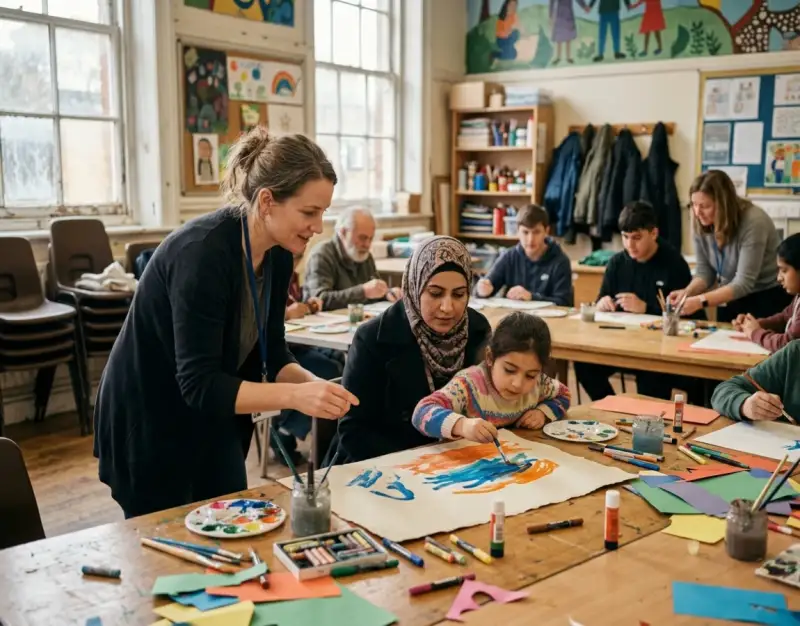
The dust of displacement rarely settles in the mind, even long after a refugee crosses an international border, secures temporary housing, and receives a fledgling identification card. For millions fleeing the devastating fractures of war, systemic persecution, and environmental collapse, survival is only the first battle. The invisible architecture of trauma remains meticulously intact—locked behind a wall of unspeakable horrors, cultural dislocation, and the overwhelming grief of lost homelands. Traditional talk therapy, while invaluable in many clinical contexts, frequently hits a brick wall when confronted with linguistic barriers, profound cultural stigma regarding mental health, and the sheer neurological impossibility of verbalizing experiences that defy human comprehension. It is precisely within this harrowing fracture that a quiet, radical revolution is taking place across global humanitarian corridors.
Today, dedicated social change agents are rewriting the playbook of international aid by harnessing the non-verbal, neurological power of aesthetic expression. Across makeshift community centers in Jordan, urban settlements in Greece, and sprawling displacement camps in East Africa, creative interventions are proving that paintbrushes, clay, and textiles can bridge the chasms left by political violence. Much like the community-driven resilience highlighted in stories of grassroots transformation, such as Global Goodness: How One Village in Kenya Turned Plastic Waste Into School Uniforms, modern humanitarian initiatives are discovering that sustainable healing requires bottom-up, empowering frameworks rather than top-down charity. This paradigm shift recognizes that survivors are not merely passive recipients of aid, but active authors of their own psychological reconstruction.
As the geopolitical landscape grows increasingly volatile, with climate-induced migration and protracted regional conflicts multiplying displacement figures year after year, the integration of art therapy for trauma has transitioned from a fringe auxiliary activity to an indispensable pillar of comprehensive refugee support programs. This comprehensive guide explores the neurological mechanisms, strategic blueprints, ethical imperatives, and real-world execution strategies required to implement transformative creative healing initiatives that honor the dignity and agency of displaced populations worldwide.
Foundational Principles and Mechanics of Creative Trauma Recovery
To understand why aesthetic creation succeeds where traditional conversation often stalls, one must examine the neurobiology of severe psychological trauma. When an individual experiences life-threatening terror, the brain's rational processing center—the prefrontal cortex—goes offline, while the amygdala and emotional survival centers hyper-activate. Traumatic memories are typically stored not as linear, verbal narratives with a beginning, middle, and end, but as fragmented sensory impressions, visceral bodily sensations, and terrifying visual flashes. Because these memories bypass the language centers of the brain, forcing a traumatized refugee to "just talk about it" can retraumatize them by demanding verbal translation of non-verbal neural codes.
Art therapy bypasses these linguistic and cognitive roadblocks by directly engaging the sensory and motor cortices. When an individual shapes a lump of clay or sweeps charcoal across paper, they externalize their internal chaos into a tangible, bounded object. This externalization creates what psychologists call "aesthetic distance"—a safe psychological buffer that allows the survivor to look at their trauma, manipulate it, contain it, and ultimately let it go without being consumed by it. Furthermore, the tactile nature of art-making regulates the nervous system, shifting the body out of chronic fight-or-flight sympathetic arousal and into parasympathetic rest-and-digest recovery.
At its core, this approach rests on the fundamental belief that human beings possess an innate drive toward self-actualization and integration. When integrated into broader refugee support programs, creative modalities do not merely treat pathology; they rebuild identity. They restore a sense of personal agency to individuals whose lives have been dictated by external forces, oppressive regimes, and bureaucratic border controls. By mastering a medium—whether through painting, weaving, or sculpture—participants reclaim authorship over their narratives, transforming feelings of helplessness into visible tokens of resilience and power.
Designing Safe Spaces: The Architecture of Community Art Studios
Establishing Physical and Psychological Safety
The foundation of any successful creative intervention within a displaced population is the absolute sanctity of the physical and psychological container. Refugees frequently come from environments where safety was non-existent and boundaries were violently violated. Therefore, the art studio must be meticulously designed to counteract these dynamics. The space should be well-lit, easily accessible, culturally neutral, and strictly confidential. Practitioners must establish clear, predictable routines for sessions, ensuring that participants know when the space opens, how materials are handled, and that their artistic expressions will never be judged, critiqued, or displayed without explicit, enthusiastic consent.
Moreover, psychological safety requires trauma-informed facilitation. Facilitators must be trained to recognize the subtle physical signs of emotional flooding or dissociation, such as shallow breathing, trembling, or sudden withdrawal. Unlike traditional art classes where the goal is technical skill or a finished product, the community art studio prioritizes the internal process over the external output. Every rule, layout decision, and introductory icebreaker is calibrated to lower defenses gently, inviting voluntary engagement rather than demanding compliance. This careful environmental framing is what allows deeply wounded individuals to risk vulnerability.
Cultivating Cultural Humility and Local Leadership
A critical error in early international aid models was the imposition of Western psychological frameworks onto non-Western populations without regard for local healing traditions, spiritual beliefs, or cultural understandings of suffering. Modern social change agents understand that sustainable creative healing must be co-designed with the communities it serves. This means partnering directly with local artists, community elders, and bilingual translators who understand the nuanced semiotics of grief, honor, and survival within that specific cultural matrix. Much like honoring indigenous ecological stewardship as explored in Voices of Change: The Indigenous Elder Preserving Ancient Ecological Wisdom, respecting traditional systems of expression ensures that psychological interventions resonate deeply rather than alienating participants.
To operationalize this, programs should establish advisory committees composed of displaced community members who guide every phase of the initiative. These leaders help identify culturally taboo imagery, suggest traditional craft techniques that hold historical resonance, and ensure that gender dynamics are navigated safely. When refugees see their own cultural aesthetics and leadership validated within the healing space, the program sheds its identity as an external welfare intervention and transforms into an organic, community-owned sanctuary of restoration.
Step-by-Step Implementation Blueprint for Practitioners
Phase 1: Needs Assessment and Participatory Mapping
Before purchasing a single paintbrush or renting a community room, practitioners must conduct a thorough, culturally sensitive needs assessment. This involves engaging directly with community stakeholders, camp managers, and potential participants to map out the specific demographic makeup, trauma histories, daily stressors, and existing coping mechanisms of the population. Are the participants primarily unaccompanied minors, survivors of gender-based violence, or families experiencing protracted limbo? Each demographic requires tailored creative modalities. For example, adolescents may respond intensely to graffiti art, comic-book creation, and digital media, whereas older adults might find solace in traditional textile arts, embroidery, or clay sculpting.
During this phase, logistics must also be meticulously planned. Practitioners need to assess supply chains, material durability in harsh camp climates, storage security, and the availability of private consultation rooms for participants who experience acute emotional breakthroughs. By mapping these variables early, organizations prevent resource scarcity and ensure that the program can scale smoothly without overwhelming the host community or burning out the facilitation staff.
Phase 2: Sequencing the Expressive Modalities
Trauma recovery cannot be rushed; it requires a carefully sequenced methodological arc that moves from grounding to expression, and finally to integration. The initial sessions of a program should focus exclusively on low-stakes, highly controllable, tactile materials that promote nervous system regulation. Exercises like abstract finger-painting, mandala coloring, or simple clay squishing allow participants to experience control over matter without confronting traumatic memories directly. These opening weeks build trust, establish group cohesion, and teach basic emotional regulation tools.
As group trust solidifies, facilitators can introduce more evocative prompts designed to externalize internal experiences. Participants might be invited to sculpt a physical representation of their "invisible backpack" of worries, or paint a landscape divided into "the country I left" and "the ground I stand on now." The final phase of the sequence emphasizes closure, collective witnessing, and legacy-building. Participants often engage in collaborative mural projects or create memory books that honor their journeys, cementing their identities as survivors with futures rather than victims trapped in the past.
Building Resilience Through Collaborative Community Art Projects
Fostering Social Cohesion Across Factions
Refugee camps and urban displacement hubs are rarely homogenous; they frequently bring together diverse ethnic, religious, and political groups that may have been adversaries in their countries of origin. Introducing populations with raw, unhealed grievances into confined spaces can easily ignite friction. Collaborative art projects serve as a powerful sociological solvent in these volatile environments. When individuals from conflicting backgrounds stand side-by-side painting a massive community mural or weaving a large-scale tapestry, the shared physical task creates a neutral third space that supersedes political and sectarian divisions.
In collaborative art-making, participants must negotiate space, share colors, and synchronize their movements. This non-verbal cooperation fosters empathy, humanizes "the other," and breaks down the dehumanizing stereotypes fostered by civil conflict. Facilitators intentionally structure these collaborative tasks so that success depends on mutual contribution. As participants witness the collective beauty of what they have built together, a profound shift occurs: the collective trauma of displacement is gradually counterbalanced by a newly forged collective resilience and mutual solidarity.
Public Exhibitions and Reclaiming Public Voice
Isolation is one of the most debilitating psychological symptoms of displacement. Refugees often feel invisible, silenced, and erased by the bureaucratic machinery of host countries. Bringing their artwork out of the studio and into public exhibition spaces—such as municipal galleries, community centers, and digital platforms—acts as a powerful reclamation of voice. These exhibitions transform private pain into public dialogue, forcing host communities to look past political rhetoric and witness the raw, creative humanity of displaced individuals.
For the artists themselves, seeing their work framed, respected, and admired by the wider public is an astonishingly restorative experience. It shifts their societal label from "burden" or "refugee" to "artist," "creator," and "contributor." This external validation rebuilds shattered self-esteem and instills a profound sense of civic pride. Furthermore, these exhibitions often generate vital advocacy momentum, mobilizing local resources, policy shifts, and grassroots solidarity networks—much like the collaborative welfare partnerships detailed in Collaborative Welfare: Partnering Local Businesses With Shelters to End Period Poverty, proving that community resilience multiplies when local businesses and civil society unite around shared humanitarian goals.
Monitoring, Evaluation, and Measuring Psychosocial Impact
Establishing Qualitative and Quantitative Metrics
Securing funding and ensuring program longevity in the humanitarian sector requires rigorous monitoring and evaluation (M&E). However, measuring the efficacy of creative healing presents unique methodological challenges because psychological recovery is inherently subjective and non-linear. Effective organizations combine quantitative psychosocial assessment tools—such as standardized trauma, anxiety, and well-being scales adapted for cross-cultural use—with rich qualitative methodologies, including participant storytelling, artistic portfolio tracking, and facilitator observation logs.
Quantitative metrics provide baseline data and demonstrate statistical trends in symptom reduction, such as decreased self-reported anxiety, improved sleep quality, and enhanced emotional regulation over a 12-week intervention cycle. Meanwhile, qualitative data captures the nuance, capturing personal breakthroughs, shifts in interpersonal trust, and cultural nuances that numbers miss. By triangulating these data streams, program directors can continuously refine their curricula, prove accountability to donors, and build an unassailable evidence base for the institutional adoption of art therapy in global humanitarian policy.
Mitigating Compassion Fatigue and Ensuring Staff Well-Being
No discussion of art therapy in refugee settings is complete without addressing the immense psychological toll placed on facilitators, social workers, and mental health professionals. Working daily with individuals who have survived unspeakable atrocities exposes practitioners to secondary traumatic stress, vicarious trauma, and severe compassion fatigue. If the mental health of the staff is neglected, the entire program collapses under the weight of burnout and high staff turnover.
Sustainable programs mandate regular clinical supervision, peer support circles, and mandatory rotation schedules for staff working in high-intensity displacement zones. Furthermore, facilitators are encouraged to engage in their own creative processing to metabolize the heavy emotions they absorb during group sessions. Treating staff well-being not as an afterthought, but as an operational priority, ensures program continuity and protects the integrity of the therapeutic container for the participants.
Real-World Case Studies: Successes and Structural Failures
To ground these strategic principles in reality, examining concrete field scenarios reveals the stark contrast between sustainable, culturally resonant programming and well-intentioned but flawed interventions.
Case Study A: The Za'atari Community Arts Initiative (Success)
In a major Syrian refugee settlement, an international NGO partnered with local artists to establish an open-access art tent. Rather than importing foreign therapists, they trained local teachers and community leaders in trauma-informed art facilitation. The program integrated traditional mosaic-making with contemporary storytelling.
- Data Points: Over 18 months, 1,200 participants engaged in weekly sessions; standardized pre- and post-tests showed a 42% reduction in reported post-traumatic stress symptoms among adolescents.
- Key Takeaway: Localized training combined with culturally resonant mediums creates high retention rates and builds lasting community capacity that outlasts foreign funding cycles.
Case Study B: The Rapid-Response Painting Drop-In (Structural Failure)
In an emergency border camp in Eastern Europe, a visiting charity set up a one-off weekend painting workshop for newly arrived refugees experiencing acute crisis. Facilitators handed out canvases and asked participants to paint their worst wartime memories without prior grounding, established trust, or psychological aftercare.
- Data Points: Of the 50 participants, 12 experienced severe emotional flooding, panic attacks, and dissociative episodes. Only 5 individuals returned for a second session, and local camp managers asked the charity to leave due to destabilizing community impacts.
- Key Takeaway: Unstructured exposure to traumatic triggers without safety containers, cultural contextualization, or clinical support causes severe retraumatization and damages community trust.
Critical Mistakes to Avoid in Trauma-Informed Art Programs
Even seasoned humanitarian organizations can stumble when implementing creative healing initiatives. Avoiding these five catastrophic pitfalls is essential for ethical, effective practice:
- Imposing Western Diagnostic Lenses: Forcing foreign psychological frameworks onto participants without acknowledging local idioms of distress alienates communities and misdiagnoses culturally specific coping mechanisms. Countermeasure: Co-design frameworks with local elders and adapt psychological assessments to honor indigenous worldviews.
- Ignoring Safety and Containment: Opening high-evocation art prompts without establishing emotional grounding, clear boundaries, and accessible aftercare leads directly to retraumatization. Countermeasure: Prioritize nervous system regulation and tactile, low-stakes materials in the opening phases of any program.
- Treating the Artwork as a Clinical Commodity: Exploiting participant artwork for fundraising, public relations, or exhibition without explicit, informed, and revokable consent violates basic ethical boundaries. Countermeasure: Enforce strict participant ownership rights and transparent consent protocols for all public displays.
- Neglecting Facilitator Burnout: Operating high-intensity trauma programs without clinical supervision, peer debriefing, or burnout prevention protocols leads to systemic staff collapse. Countermeasure: Mandate regular supervision, secondary trauma training, and staff creative processing time.
- Failing to Plan for Sustainability: Designing short-term, donor-dependent projects that vanish overnight leaves vulnerable participants stranded and shatters newly built community trust. Countermeasure: Train local community members as co-facilitators from day one to ensure organic, long-term program ownership.
Comprehensive Comparison of Humanitarian Trauma Interventions
| Intervention Type | Primary Modality | Cultural Adaptability | Barrier to Entry | Best Suited For |
|---|---|---|---|---|
| Traditional Talk Therapy | Verbal counseling & CBT | Low to Moderate | High (Stigma & Language) | Individuals with high verbal fluency and established stability. |
| Community Art Therapy | Visual arts, clay, & tactile creation | Very High | Low (Non-verbal expression) | Mixed refugee populations, trauma survivors, and youth. |
| Emergency Drop-In Workshops | Unstructured craft activities | Moderate | Very Low | Immediate distraction, though poor for deep trauma recovery. |
| Collaborative Mural Projects | Large-scale public painting/weaving | High | Low (Collaborative labor) | Fostering social cohesion across fractured ethnic factions. |
Frequently Asked Questions About Refugee Art Therapy
Do participants need prior artistic skill to benefit from art therapy?
Absolutely not. Art therapy is entirely process-oriented rather than product-oriented. The goal is not to create a masterpiece fit for a gallery wall, but to use color, line, and texture to externalize internal emotional states that defy verbal description. Anyone who can hold a brush, smear clay, or arrange scraps of paper can fully participate and experience profound neurological and psychological benefits.
How do facilitators handle participants who become emotionally overwhelmed during a session?
Trauma-informed facilitators are rigorously trained to recognize the early signs of emotional flooding, such as rapid breathing, sudden silence, or trembling. When a participant becomes overwhelmed, facilitators guide them through grounding exercises—such as feeling their feet flat on the floor, naming objects in the room, or drinking water—to bring their awareness back to the safe present moment. Private, confidential support spaces are always maintained nearby so that participants can step away with a clinician if acute stabilization is required.
Can art therapy replace traditional medical and psychiatric care in displacement camps?
No. Art therapy is a powerful complementary modality, not a standalone replacement for comprehensive medical, psychiatric, and humanitarian care. For refugees suffering from severe clinical depression, acute psychosis, or complex post-traumatic stress disorder, creative healing works best when integrated into a multidisciplinary care network that includes medical doctors, social workers, case managers, and psychiatric professionals.
How can grassroots organizations secure sustainable funding for creative healing programs?
Funding can be secured by building rigorous monitoring and evaluation frameworks that demonstrate clear quantitative and qualitative psychosocial outcomes to institutional donors. Additionally, partnering with local businesses, cultural foundations, and international aid networks helps pool resources. Showcasing ethical, participant-approved public art exhibitions also attracts philanthropic interest and public solidarity.
What makes art therapy particularly effective for refugee children and adolescents?
Children and adolescents often lack the abstract cognitive maturity and vocabulary required to articulate complex psychological trauma through talk therapy. Play, drawing, and sculpting are the natural languages of childhood. Art therapy meets young refugees in their native expressive medium, allowing them to process war, loss, and displacement safely while playing, regaining a sense of childhood agency and developmental momentum.
Strategic Roadmap and Final Takeaway
As we look toward the next two to five years, the intersection of forced migration, climate displacement, and global sociopolitical instability demands a radical evolution in how the international community approaches humanitarian support. The archaic model of treating displaced populations solely as bodies to be fed, housed, and managed is no longer morally defensible or practically effective. True humanitarian aid must restore the human soul, honor cultural dignity, and reactivate individual agency.
Art therapy for trauma represents a proven, scientifically backed, and deeply humanizing cornerstone for the future of global welfare. By empowering local social change agents, embedding trauma-informed practices into all refugee support programs, and prioritizing sustainable creative healing frameworks, we can move beyond mere survival. We can build resilient communities where survivors are no longer defined by the borders they crossed or the horrors they fled, but by the extraordinary beauty, strength, and creative futures they construct with their own hands.
Be the first to share a gentle reflection on this story.