
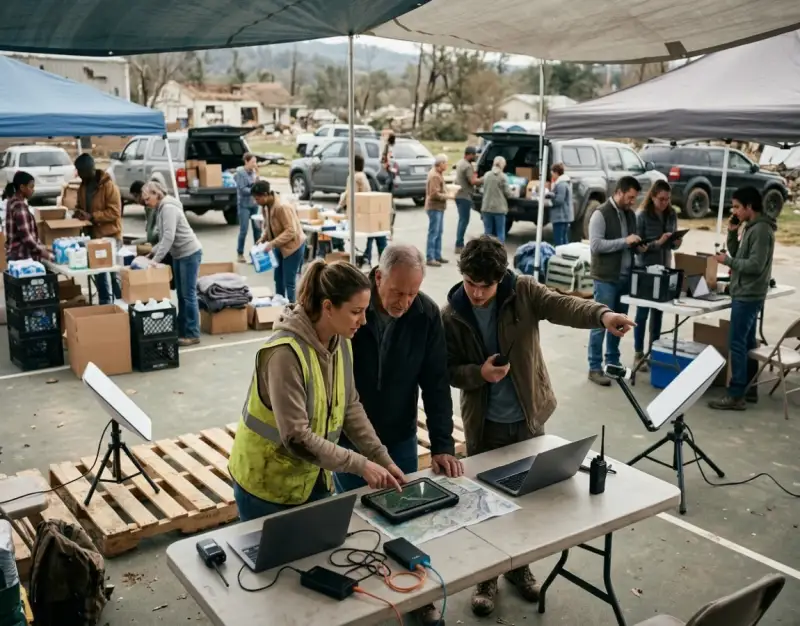
When catastrophic floods submerged entire rural valleys in Central Europe, traditional humanitarian machinery stalled. Bureaucratic bottlenecks, frozen supply chains, and rigid institutional hierarchies left stranded families waiting weeks for government relief trucks that never arrived. Yet, within forty-eight hours of the disaster, a decentralized coalition of software engineers, local farmers, and off-grid ham radio operators had established a fully functioning, peer-to-peer supply chain. Utilizing encrypted messaging platforms, autonomous drone logistics, and localized cryptocurrency funds, this grassroot collective delivered clean water, medical supplies, and solar generators directly to doorsteps long before the first official state assessment teams even deployed. This seismic shift marks a defining paradigm evolution in modern crisis intervention.
For decades, international humanitarian response has relied heavily on monolithic, top-down institutions. While these legacy organizations possess immense financial resources and logistical depth, their operational frameworks are frequently plagued by administrative friction, communication silos, and a dangerous disconnect from hyper-local realities. Today, however, a new vanguard of social change agents is challenging this status quo. By leveraging the principles of decentralization—such as peer-to-peer distribution, open-source intelligence, and community-led governance—these innovators are rewriting the playbook on how humanity responds to catastrophe. This article explores the mechanics behind this revolution, analyzing how decentralized aid networks are driving unprecedented disaster relief innovation and redefining the future of global crisis response.
Understanding this transition requires looking beyond the immediate imagery of emergency tents and floodwaters to examine the underlying digital and social architecture powering modern movements. From decentralized autonomous organizations (DAOs) pooling capital within minutes to localized grassroots networks ensuring nutritional security akin to initiatives detailed in Global Goodness: 7 Inspiring Community Kitchens Feeding Millions Across Continents, the modern humanitarian ecosystem is fragmenting into a resilient, highly adaptive web of micro-responders. The core thesis of this movement is straightforward: empowerment at the edge beats centralization at the core every single time a disaster strikes.
Foundational Principles and Mechanics of Decentralized Aid
To fully grasp how modern crisis interventions operate, we must examine the core structural differences between legacy humanitarian models and decentralized networks. At its heart, a decentralized system eliminates single points of failure by distributing authority, decision-making, and resource allocation across multiple autonomous nodes. In a disaster scenario, these nodes consist of local volunteers, neighborhood associations, regional tech hubs, and independent donors interacting directly via trustless or cryptographic protocols.
The mechanics rely on three primary pillars: radical transparency, programmatic self-execution, and edge-computed intelligence. Radical transparency ensures that every dollar donated or resource deployed is tracked on immutable public ledgers, virtually eliminating corruption and administrative overhead. Programmatic self-execution utilizes smart contracts—automated code that releases funds instantly when predefined criteria, such as a seismic sensor threshold or a verified meteorological alert, are met. Finally, edge-computed intelligence empowers people on the ground to run localized mesh networks, translate damage assessment data via decentralized AI models, and coordinate relief without needing permission from a distant headquarters.
Strategic Blueprint for Mobilizing Decentralized Relief Networks
Mapping Local Infrastructure and Vulnerability Nodes
The first operational phase of building a resilient decentralized relief mechanism involves meticulous community-level mapping. Before a crisis ever strikes, modern change agents work alongside grassroots leaders to identify vulnerable populations, critical supply caches, and communication dead zones. This process resembles the localized empowerment seen when young activists tackle environmental challenges, echoing the community-first dedication found in Voices of Change: Meet the Teen Activist Fighting for Clean Water in Rural Schools, where hyper-local focus yields systemic impact.
Practitioners must deploy participatory GIS (Geographic Information Systems) mapping tools that allow community members to log critical infrastructure points directly into an open-source database. These digital maps are then replicated across decentralized peer-to-peer networks, ensuring that even if regional cell towers and cloud servers collapse during an earthquake or hurricane, local nodes retain offline access to vital logistical layouts. Insiders recommend conducting bi-annual simulation drills where community members must locate alternative water sources and operationalize mesh Wi-Fi routers entirely independent of municipal power grids.
Establishing Encrypted Communication and Mesh Architectures
Communication is the lifeblood of effective crisis response. When traditional telecommunications fail, centralized systems go blind. Decentralized networks solve this vulnerability by deploying hardware-agnostic mesh networks using inexpensive off-the-shelf devices like LoRa (Long Range) radios and Wi-Fi extender nodes. These devices allow encrypted text, GPS coordinates, and urgent medical requests to hop dynamically from phone to phone and router to router across neighborhoods.
To implement this successfully, organizers must distribute pre-configured communication kits to neighborhood block captains. Software applications such as Briar, Serval, or Meshtastic should be pre-installed and tested regularly within local cohorts. Furthermore, establishing a protocol for cryptographic identity verification ensures that bad actors cannot inject false distress signals or misinformation into the mesh network during chaotic emergency windows, preserving trust when it is needed most.
Deploying Autonomous Financial Pipelines and DAOs
Traditional wire transfers and banking systems often freeze assets, demand extensive KYC (Know Your Customer) compliance during emergencies, or take days to clear international borders. Decentralized aid networks bypass these archaic friction points by leveraging cryptocurrency stables, multi-signature wallets, and Decentralized Autonomous Organizations (DAOs). These financial pipelines allow global donors to fund local relief efforts instantaneously.
When executing this strategy, organizers must establish multi-sig treasuries where control of funds requires cryptographic approval from multiple trusted local and international stakeholders. This eliminates autocratic misuse while maintaining lightning-fast liquidity. For instance, if a hurricane destroys coastal fishing boats, a regional relief DAO can vote and disburse funds to affected families within fifteen minutes, enabling them to purchase emergency fuel and repair equipment immediately.
Leveraging Open-Source AI and Drone Logistics for Rapid Deployment
The sheer volume of incoming data during a disaster can overwhelm human analysts. Decentralized networks combat this by utilizing open-source artificial intelligence models running on local edge devices to process satellite imagery, social media SOS posts, and drone feeds. These decentralized AI nodes categorize damage severity, prioritize medical evacuation routes, and flag areas experiencing severe supply deprivation.
Coupled with open-source drone hardware, communities can orchestrate localized aerial delivery of high-priority items such as insulin, water purification tablets, and sterile bandages. Practitioners should train local youth and tech enthusiasts in basic autonomous flight programming and drone maintenance. Much like the collaborative community spirit highlighted in Youth and Elders Unite: How Intergenerational Gardening Projects Are Healing Isolation, bringing diverse generations together to learn technical disaster-response skills builds unbreakable social cohesion and technological self-reliance.
Cultivating Cross-Border Solidarity and Resource Pools
A decentralized network is only as strong as its inter-node connections. While hyper-local execution is essential, isolation can doom a relief effort if a disaster exceeds local resource capacity. Therefore, successful networks establish federation protocols—interoperable agreements where neighboring decentralized collectives share surplus supplies, technical expertise, and computational power.
To build this, organizers should participate in global humanitarian hackathons, open-source repositories (such as GitHub disaster-response forks), and decentralized federations that share standardized API protocols for inventory management. When an emergency overwhelms Node A, automated signals broadcast resource deficits across the federated mesh, prompting nearby Node B and Node C to dispatch automated convoys or digital resource transfers seamlessly.
Real-World Case Studies and Operational Scenarios
Examining practical implementations reveals the stark difference between resilient decentralized execution and fragile institutional response. Consider the contrasting outcomes of two distinct flood events occurring in mountainous terrain over the past three years.
In Scenario A, a traditional centralized model was deployed. An international NGO dispatched a fleet of heavy relief trucks toward a disaster-stricken province. However, a major bridge collapse blocked the primary highway. Because the convoy lacked local reconnaissance and possessed rigid routing mandates, the trucks sat idle on the tarmac for six days awaiting central authorization to reroute. Meanwhile, stranded villagers exhausted their food and clean water supplies, leading to secondary public health crises.
In Scenario B, a decentralized network spearheaded the response. Local neighborhood nodes utilized satellite messsengers to report bridge failure instantly. The decentralized command node utilized an open-source routing algorithm to dynamically redirect nearby independent boat owners and all-terrain vehicle operators. Concurrently, a multi-sig crypto fund released micro-grants to fuel stations, enabling volunteers to fill tanks without waiting for corporate bank clearance. Supplies reached 94% of affected households within thirty-six hours. This stark contrast underscores why social change agents are fiercely advocating for decentralized frameworks across all facets of humanitarian intervention.
Critical Mistakes and How to Avoid Them
Transitioning from traditional relief models to decentralized networks involves steep learning curves. Well-intentioned practitioners frequently stumble into several high-impact pitfalls that undermine operational integrity:
- Ignoring Local Power Dynamics: Decentralization does not automatically equal equity. If technical elites dominate the node setup, marginalized voices can be excluded. Countermeasure: Implement radical inclusion protocols, ensuring historically underserved groups hold cryptographic administrative keys and direct operational input.
- Failing to Stress-Test Offline Infrastructure: Building a relief network reliant on high-speed internet and uninterrupted power guarantees catastrophic failure during major grid collapses. Countermeasure: Mandate regular "blackout drills" where all communication must occur exclusively via solar-powered mesh nodes and analog walkie-talkies.
- Overcomplicating Tech Stacks: Forcing elderly residents or stressed survivors to navigate complex web3 wallets or obscure software interfaces creates insurmountable adoption barriers. Countermeasure: Design zero-friction user interfaces that abstract blockchain and cryptographic complexities behind familiar messaging apps like WhatsApp or Signal integrations.
- Neglecting Legal and Regulatory Compliance: Uncoordinated cross-border cryptocurrency flows and unlicensed drone deployments can trigger severe crackdowns from authoritarian state actors or financial watchdogs. Countermeasure: Partner with established legal aid collectives specializing in humanitarian tech exemptions and compliance frameworks.
- Creating Data Silos within Open Networks: Ironically, decentralized groups often create isolated Telegram channels or proprietary databases that fail to interoperate with other relief factions. Countermeasure: Enforce open data standards and universal API connectors across all participating relief nodes from day one.
Comparative Analysis of Humanitarian Response Models
| Metric / Feature | Legacy Centralized Relief | Decentralized Aid Networks |
|---|---|---|
| Deployment Speed | Slow (Days to weeks due to bureaucratic sign-offs and convoy preparation) | Instantaneous (Minutes to hours via automated triggers and local nodes) |
| Financial Transparency | Low to Moderate (Often obscured by heavy administrative overhead and delayed reporting) | Radical (Immutable public ledgers and multi-sig wallets track every asset in real-time) |
| Vulnerability to Point Failure | High (Single headquarters, centralized supply chains, and dependent on state grids) | Near Zero (Distributed nodes, mesh communication, and peer-to-peer redundancy) |
| Community Ownership | Low (Top-down aid delivered to passive recipients with minimal local input) | High (Grassroots leadership actively designing and executing localized response) |
| Adaptability to Chaos | Rigid (Strict standard operating procedures struggle with unpredictable environments) | Fluid (Autonomous edge nodes rapidly adapt tactics to immediate ground realities) |
Frequently Asked Questions
What exactly is a decentralized aid network in the context of disaster relief?
A decentralized aid network is an autonomous, peer-to-peer collective of individuals, technologists, local businesses, and grassroots organizations that coordinate crisis response without relying on a single central authority, government agency, or legacy international NGO. By utilizing tools like encrypted mesh communication, open-source AI mapping, and multi-sig cryptocurrency treasuries, these networks empower people on the ground to manage and distribute resources instantly and transparently during emergencies.
How do decentralized networks handle funding and prevent financial corruption?
Funding is typically managed through Decentralized Autonomous Organizations (DAOs) and transparent blockchain-based multi-signature wallets. Unlike traditional charities where donations sit in opaque bank accounts controlled by executives, decentralized funds require cryptographic approval from multiple trusted community stakeholders to release capital. Furthermore, every transaction is recorded on public ledgers, making embezzlement or administrative bloat virtually impossible.
Are these networks legal and compliant with international humanitarian laws?
Legality varies by jurisdiction, which is why leading decentralized change agents actively collaborate with legal advocacy groups specializing in humanitarian tech. While peer-to-peer coordination and mutual aid are protected in many democratic regions, cross-border digital fundraising can run into regulatory hurdles. Successful networks proactively establish compliance frameworks, partner with registered local NGOs for on-the-ground physical distribution, and engage regulators transparently.
Can ordinary citizens without technical skills participate in decentralized relief?
Absolutely. While software engineers and logistics experts build the underlying infrastructure, the vast majority of roles within decentralized networks require zero advanced technical skills. Ordinary citizens contribute by acting as neighborhood block captains, distributing physical supplies, operating analog backup stations, cooking community meals, and sharing verified damage reports with local coordination nodes.
What happens when the immediate crisis ends and long-term rebuilding begins?
Unlike traditional emergency responders who often pull out once the acute phase concludes, decentralized networks are inherently rooted in the local community. As the crisis subsides, these networks transition from emergency triage into long-term resilience building—such as maintaining mesh infrastructure, establishing permanent community gardens, upgrading local water purification systems, and preparing neighborhoods for future climate shocks.
Strategic Roadmap and Final Takeaway
The evolution of crisis response is at a historic crossroads. As climate volatility intensifies and geopolitical instability strains legacy institutions, the traditional top-down humanitarian model is no longer sufficient to protect vulnerable populations. Over the next two to five years, we will witness an accelerating convergence between grassroots civic action and advanced decentralized technologies. Social change agents who master the integration of peer-to-peer logistics, encrypted mesh comms, and transparent financial tooling will define the gold standard of modern humanitarian resilience.
The definitive takeaway for practitioners, technologists, and community leaders is clear: resilience cannot be imported from the outside; it must be cultivated from within. By embracing decentralization, we strip away the bottlenecks of bureaucracy and return power where it rightfully belongs—directly into the hands of communities on the front lines of change. Equip your neighborhood, build your local nodes, and prepare for a future where collective solidarity is powered by unstoppable, decentralized innovation.
Be the first to share a gentle reflection on this story.