
Walk through any modern urban neighborhood on trash collection day, and the ecological tragedy of our daily consumption is laid bare on the curb. Heavy black plastic bins overflow not just with packaging and discarded goods, but with an immense volume of nutrient-rich organic matter: vegetable peelings, coffee grounds, eggshells, and uneaten meals. Across the globe, municipal solid waste streams are heavily burdened by organic waste that, when buried deep inside anaerobic landfills, breaks down to produce staggering quantities of methane gas—a greenhouse gas with a warming potential drastically higher than carbon dioxide over a 20-year timeline. For decades, managing this waste was outsourced entirely to municipal authorities, leaving citizens as passive generators rather than active stewards of their local ecosystems.
Yet, a profound cultural and logistical shift is underway as grassroots environmentalism redefines neighborhood infrastructure. Modern urban and suburban neighborhoods are no longer waiting for sluggish municipal bureaucracies to overhaul regional waste management. Instead, communities are taking matters into their own hands, recognizing that turning food scraps into dark, crumbly "black gold" is not merely an act of waste diversion, but a cornerstone of neighborhood resilience. Launching a community compost program creates a closed-loop system that heals depleted local soils, reduces municipal tipping fees, fosters profound social cohesion among residents, and directly addresses the urgent crisis of local food security. When neighbors gather to manage their organic refuse collectively, they transform an invisible burden into a tangible, shared asset.
The landscape of community composting has evolved far beyond the rustic, poorly managed backyard heaps of the past. Today's initiatives are sophisticated, data-driven, and community-integrated systems that combine ancient biological principles with modern organizational strategies. Whether you live in a dense apartment complex with zero private yard space or a sprawling suburban cul-de-sac, establishing a collective composting initiative requires a nuanced understanding of biological dynamics, social psychology, local zoning laws, and operational logistics. This ultimate guide provides an exhaustive, step-by-step roadmap designed to take you from a solitary visionary with an idea to the director of a thriving, self-sustaining neighborhood composting network that will endure for generations.
Foundational Principles and Mechanics of Community Composting
Before driving a single stake into the ground or purchasing your first collection bucket, it is vital to master the fundamental science and operational models that govern successful composting. At its core, composting is the controlled, aerobic decomposition of organic matter by a vast biological army of bacteria, fungi, actinomycetes, macro-invertebrates, and earthworms. These microorganisms require a precise balance of four fundamental elements to thrive: carbon (energy-rich "browns" such as dry leaves, wood chips, and shredded cardboard), nitrogen (protein-rich "greens" like food scraps, coffee grounds, and fresh grass clippings), moisture (roughly equivalent to the dampness of a wrung-out sponge), and oxygen (maintained through mechanical turning or passive aeration).
Understanding the distinction between decentralized and centralized community models is critical for tailoring a program to your neighborhood's unique layout. Decentralized systems, often referred to as neighborhood hub models, rely on multiple small-scale drop-off points or backyard systems spread across a neighborhood, where participants manage their own material locally. Centralized systems utilize a single, high-capacity site—such as an urban farm, community garden, or church yard—where all neighborhood waste is aggregated and processed using larger vessels like three-bin wooden systems, tumbler drums, or aerated static piles. Each model presents distinct advantages regarding labor distribution, land use, and odor management.
Furthermore, navigating the regulatory and logistical frameworks of your municipality is a foundational requirement that cannot be overlooked. While backyard composting for single-family residences is universally permitted, commercial or community-scale collection often triggers health department regulations, vector control guidelines, and zoning restrictions regarding waste handling and odor nuisances. A successful community program must proactively establish clear operational protocols, define acceptable and prohibited inputs, and build transparent channels of communication with local environmental health officers to ensure long-term legitimacy and community trust.
Step 1: Building Your Core Organizing Committee and Securing Land
No successful community compost program was ever built by a single individual working in isolation. The first operational phase requires cultivating a dedicated core organizing committee that brings diverse skill sets to the table. You will need passionate individuals who excel in logistics and operations, financial tracking, public outreach, and biological management. Begin by hosting an informational neighborhood meeting—either online via local forums or in a physical community space—to gauge interest, recruit founding members, and identify key stakeholders who can champion the project within local civic associations or neighborhood councils.
Securing and Vetting Your Composting Site
Finding the right physical location is often the most challenging hurdle for urban and suburban organizers. The ideal site requires accessible pathways for drop-offs, adequate sunlight or shade depending on the composting method, a nearby water source for moisture management, and a sufficient buffer zone from immediate residential windows to mitigate any potential aesthetic or odor concerns. Excellent candidates for sites include community gardens, public parks (with municipal partnership), church grounds, school campuses, and underutilized asphalt lots that can be converted using raised-bed bin systems.
Establishing Formal Partnerships and Land-Use Agreements
Once a prospective site is identified, you must secure formal authorization before depositing a single organic scrap. Approach property owners or municipal departments with a polished, professional proposal that outlines the environmental benefits, safety protocols, and liability protections of your program. Draft a clear land-use agreement or memorandum of understanding (MOU) that specifies operating hours, maintenance responsibilities, and protocols for site decommissioning if necessary. Building these formal relationships early prevents future disputes and establishes your community compost program as a serious, well-managed civic endeavor akin to broader urban resilience projects, such as Fixing the Food Desert Crisis: How Urban Community Gardens Are Feeding the Future.
Step 2: Designing the Operational Infrastructure and Equipment Selection
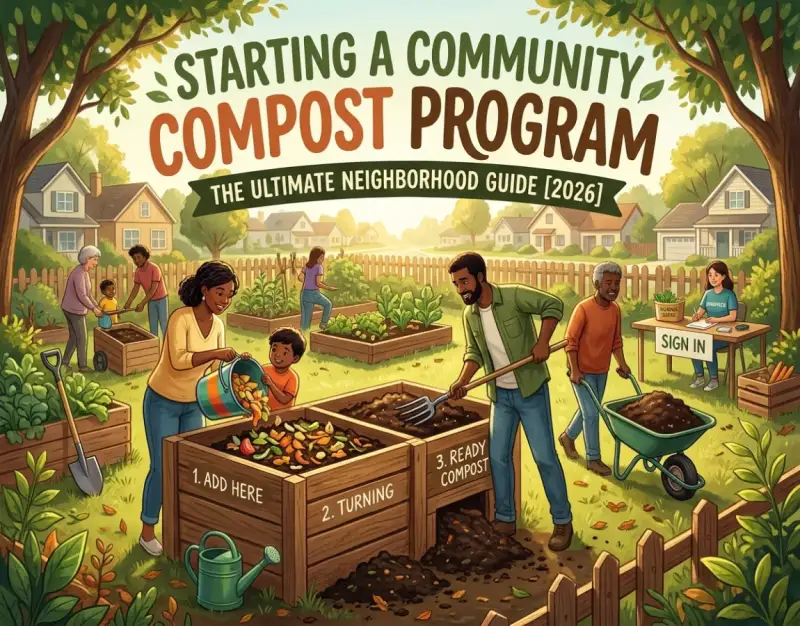
With a secured location and an enthusiastic committee, your focus must shift toward procuring the physical infrastructure required to process organic waste efficiently. The choice of equipment will dictate your labor requirements, processing speed, and capacity. For smaller neighborhood hubs, three-bin wooden or wire-mesh systems constructed from rot-resistant lumber (such as cedar or redwood) offer an economical, modular approach. One bin is designated for active collection and mixing, the second for active thermal decomposition, and the third for curing and finished compost storage.
Selecting Advanced Containment and Processing Systems
If your site faces space constraints, rodent pressures, or heavy municipal volume, investing in specialized containment infrastructure is essential. Tumbler barrels mounted on horizontal axes allow for effortless mixing and rapid aeration, though they have fixed volumetric capacities. For larger community programs, Aerated Static Pile (ASP) systems utilizing perforated PVC pipes connected to a low-pressure blower can process massive volumes of food scraps without the grueling labor of manual turning, ensuring high internal temperatures that rapidly sanitize pathogens and weed seeds.
Procuring Essential Tools and Material Reserves
Beyond the primary compost vessels, your operational kit must be fully stocked with supporting tools and safety equipment. Essential inventory includes heavy-duty pitchforks, long-stemmed compost thermometers to monitor internal microbial heating phases, garden hoses with spray nozzles, pH test kits, and wheelbarrows for material transport. Crucially, you must establish an off-site or on-site cache of carbon-rich "browns"—such as bulk wood chips from local arborists, shredded office paper, or dry autumn leaves collected during seasonal cleanups—ensuring you always maintain the mandatory 30:1 carbon-to-nitrogen operational ratio.
Step 3: Developing Intake Protocols, Training, and Community Onboarding
The operational Achilles' heel of any community compost program is contamination. If participants treat the collection bins as a general landfill, introducing plastics, pet waste, glossy paper, or toxic chemicals, the entire system can fail, generating foul anaerobic odors and ruining hundreds of pounds of valuable organic matter. To prevent this, you must institute a rigorous, welcoming, and crystal-clear onboarding and training protocol for every household involved in the program.
Creating Clear "Yes" and "No" Input Guidelines
Your program must publish easily digestible visual guides detailing precisely what materials are accepted and rejected. Accepted items typically include raw and cooked fruit and vegetable scraps, coffee grounds and paper filters, tea bags (staple-free), crushed eggshells, nut shells, and yard trimmings. Strictly prohibited items must include meat, dairy, oils, pet waste, diseased plants, and non-compostable bioplastics. Emphasize the biological reasons *why* certain items are banned, transforming the rules from arbitrary restrictions into educational empowerment for your participants.
Implementing Drop-Off Mechanics and Membership Tiers
Design a secure, weather-proof drop-off station equipped with airtight collection buckets and a dedicated bin of carbon cover material. Every participant who drops off scraps must immediately layer a shovelful of "browns" over their food waste to suppress insect activity and eliminate odors instantly. To ensure accountability, consider implementing a small membership fee or a mandatory volunteer hour requirement. This fosters a deep sense of ownership; individuals who invest sweat equity or financial support are vastly more respectful of the program's rules than casual passersby.
Step 4: Managing the Biological Process, Monitoring, and Troubleshooting
Once your program is receiving a steady influx of organic waste, your operational focus pivots to biological management and quality control. Composting is an active horticultural science. To produce high-grade, pathogen-free compost rapidly, your piles must enter the thermophilic (hot) phase, where internal temperatures reach between 130°F and 160°F (54°C to 71°C) sustained over several days. This critical temperature window destroys weed seeds, plant pathogens, and harmful human bacteria while encouraging specialized thermophilic actinomycetes to break down complex lignins and cellulose.
Monitoring Moisture, Aeration, and C:N Ratios
Your operational team must establish a routine maintenance schedule involving weekly temperature logging and moisture checks. If a pile drops below 40% moisture, microbial activity stalls; if it exceeds 60%, air pockets collapse, creating anaerobic, foul-smelling zones. Combat this by turning the pile methodically—moving material from the outer edges into the scorching core. Similarly, if a pile begins to emit an ammonia odor, it is overly rich in nitrogen; immediately remediate this by folding in massive quantities of dry carbon-rich wood shavings or autumn leaves.
Troubleshooting Common Neighborhood Composting Complications
Even well-managed community programs will occasionally encounter operational hiccups. Rodents and insect vectors are the most common community concern; deter them instantly by ensuring all food scraps are completely buried beneath a 6-inch insulating layer of carbon material, and utilize hardware cloth mesh beneath wooden bins. If stubborn odors arise, they are almost universally symptomatic of compaction and excess moisture—remediate immediately by aerating the pile thoroughly and incorporating dry structural amendments.
Step 5: Harvesting, Distributing, and Closing the Neighborhood Loop
The ultimate reward of a community compost program is the moment of harvest—transforming pungent, discarded kitchen scraps into rich, sweet-smelling, dark brown humus teeming with beneficial biology. After a pile has completed its active heating phase (typically 6 to 12 weeks), it must be moved to a curing bay for an additional 4 to 8 weeks, allowing complex organic compounds to stabilize and beneficial fungi to colonize the matrix. Once cured, pass the material through a rotating trommel screen or a quarter-inch wire mesh screen to separate out un-degraded twigs or avocado pits, yielding a silky, refined amendment.
Equitable Distribution and Community Reinvestment
The distribution of finished compost must be managed transparently to reward participant contributions and benefit the broader neighborhood. Establish a tiered distribution model: participating households receive a designated share of compost proportional to their contribution or volunteer hours for their home container gardens, while the remaining bulk material is allocated to local urban agriculture projects, street tree beds, and community gardens. For further insights on how grassroots community organizing can revitalize shared urban infrastructure, consider exploring related initiatives such as How to Build a Neighborhood Tool-Sharing Library: A Step-by-Step Community Guide.
Scaling and Educational Outreach
As your community compost program matures, leverage its success to expand educational outreach within local schools, community centers, and municipal boards. Host bi-annual workshops on soil biology, sheet mulching, and zero-waste living. By positioning your composting hub as an educational beacon, you secure long-term municipal backing, attract new funding grants, and inspire neighboring districts to replicate your model, triggering a city-wide regenerative renaissance.
Real-World Case Studies and Scenarios
To contextualize these principles, examining real-world deployment scenarios highlights the stark contrast between structured success and systemic failure. Consider the Green Canopy Collective in a densely populated Midwestern urban neighborhood. Faced with strict municipal waste codes and limited open park space, the organizers established a micro-hub model utilizing sealed, pest-proof tumble bins housed in a fenced community garden. They implemented a strict digital-access lock on the gate, requiring all 45 participating households to complete a 15-minute online safety module before receiving the entry code. Over 24 months, the collective diverted 18,000 pounds of organic waste from landfills, produced 6 cubic yards of premium soil amendment for local urban agriculture, and recorded zero rodent complaints or odor violations.
Conversely, examine the cautionary tale of the Oakridge Open Bin Initiative, which failed within six months. Organizers placed an open, unmonitored three-bin wooden system in an accessible public park without community orientation or secure boundaries. Within weeks, local residents began dumping household trash, plastic packaging, and prohibited meat scraps directly into the heap. The lack of carbon cover material caused massive anaerobic rotting, generating severe putrid odors that triggered immediate neighborhood backlash and health department citations. The site was forcibly shut down, underscoring the absolute necessity of rigorous operational governance, community training, and physical security in any viable community composting framework.
Critical Mistakes and How to Avoid Them
Launching a community composting initiative is an immensely rewarding endeavor, but it is fraught with operational pitfalls that can derail your project if not proactively anticipated and neutralized.
- Mistake 1: Accepting Prohibited Inputs (Meat, Dairy, and Pet Waste). Allowing protein-rich or pathogen-heavy materials into a poorly managed pile attracts rodents, creates severe putrid odors, and violates health codes. Countermeasure: Enforce an uncompromising intake policy with clear visual signage and routine volunteer monitoring during designated drop-off windows.
- Mistake 2: Neglecting the Carbon-to-Nitrogen Balance. Dumping endless buckets of wet food scraps without sufficient dry carbon creates a dense, soggy, anaerobic sludge. Countermeasure: Maintain a mandatory "Browns Rule"—every participant must deposit two shovelfuls of dry wood chips or leaves for every single bucket of food scraps.
- Mistake 3: Failing to Secure Municipal and Landowner Buy-In. Operating a composting site without formal authorization or a signed land-use agreement leaves the project vulnerable to sudden eviction or legal shutdowns. Countermeasure: Secure an explicit MOU with property owners or local parks departments before establishing physical infrastructure.
- Mistake 4: Underestimating Labor and Burnout Among Organizers. Relying on a single visionary to manage hauling, turning, and sorting inevitably leads to exhaustion and program collapse. Countermeasure: Establish a rotating roster of operational committees, sharing labor equitably across the entire neighborhood membership.
- Mistake 5: Ignoring Community Communication and Feedback Loops. Failing to address neighbor concerns regarding pests or aesthetics can rapidly destroy community goodwill. Countermeasure: Establish an open, transparent communication channel, such as a dedicated neighborhood liaison email or messaging group, to address grievances instantly.
Comprehensive Program Comparison Matrix
Choosing the right composting methodology depends entirely on your neighborhood's spatial constraints, volume requirements, and labor capacity. Use the comparative matrix below to evaluate which structural approach aligns best with your local community profile.
| Composting Model | Spatial Requirements | Labor Intensity | Processing Speed | Pest & Odor Risk | Ideal Neighborhood Setting |
|---|---|---|---|---|---|
| Decentralized Hubs (Tumblers) | Low (Compact footprint, concrete or yards) | Low to Moderate (Easy cranking mechanism) | Fast (6–8 Weeks) | Very Low (Sealed vessels) | Dense urban apartment complexes, urban courtyards |
| Three-Bin Wooden System | Moderate (Approx. 10x15 ft area) | High (Manual pitchfork turning required) | Moderate (12–16 Weeks) | Moderate (Requires diligent carbon layering) | Suburban neighborhoods, community gardens, church yards |
| Aerated Static Pile (ASP) | High (Dedicated industrial or farm space) | Low (Automated blower mechanics) | Very Rapid (4–6 Weeks) | Low (High internal pathogen-destroying heat) | Large urban farms, institutional campuses, large housing co-ops |
| Vermicomposting (Worm Bins) | Very Low (Indoor or shaded shelter) | Moderate (Requires careful temperature/moisture care) | Moderate (8–12 Weeks) | Low (If fed properly and kept balanced) | Schools, indoor community centers, tiny-home villages |
Frequently Asked Questions (FAQ)
How do we handle pests and rodents at a community compost site?
Pest management begins with strict adherence to accepted input guidelines—never allow meat, dairy, or cooked oily foods in open piles. For physical security, line your wooden bins with hardware cloth (1/4-inch galvanized mesh) on the bottom and sides to prevent burrowing rodents. Furthermore, always ensure fresh food waste is immediately buried beneath a thick layer of carbon material (wood chips or dry leaves) to mask aromas and deter insects instantly.
What zoning laws or permits are required to start a community compost program?
Zoning regulations vary wildly depending on your city, county, and state laws. Generally, small-scale neighborhood composting operating under specific volumetric thresholds (often under one cubic yard of active material at a time) is permitted under standard agricultural or community garden exemptions. However, if your program scales to process commercial volumes or services multiple neighborhoods, you may need to consult local environmental health departments and acquire a solid waste handling permit.
How do we prevent community members from dumping trash into the compost bins?
Contamination is best prevented through proactive education and physical accountability. Require all participating households to complete a brief onboarding session before receiving access to the drop-off station. Implement locked enclosure gates or secure container lids, and place prominent, highly visual signage detailing exact "Yes" and "No" lists directly above the collection barrels. Periodic volunteer monitoring during peak drop-off hours also reinforces compliance.
What should we do with the finished compost once the pile is harvested?
Finished compost should be distributed equitably based on program involvement. A portion should be returned to participating households for their home container gardens, window boxes, or lawns. The remaining bulk material can be donated or sold to local community gardens, urban agriculture initiatives, or applied directly to public landscaping and street tree basins as part of neighborhood greening campaigns.
Can we compost during freezing winter months?
Yes, biological composting slows down significantly or goes dormant during freezing winter temperatures, but the process does not stop entirely. Microorganisms remain active in the core of large piles. During winter, focus your operational strategy on accumulating bulk food scraps and massive reserves of dry carbon (which won't freeze together like wet leaves). Once spring arrives and ambient temperatures rise, the piles will rapidly reactivate and resume their thermophilic breakdown cycle.
Strategic Roadmap and Final Takeaway
As we look toward the next two to five years, the cultural landscape of municipal waste management is shifting definitively toward decentralization and circular grassroots economics. Municipalities facing mounting landfill tipping fees, tightening climate legislation, and decaying urban infrastructures are increasingly looking to neighborhood-led initiatives as essential partners in regional sustainability. A community compost program is far more than a waste diversion tactic; it is an incubator for civic engagement, environmental education, and neighborhood self-reliance.
Your immediate next steps are clear: gather a small, passionate core committee, identify an accessible local site, draft your operational guidelines, and engage your neighbors in a shared vision of ecological renewal. By transforming the burdensome waste of today into the fertile, life-giving soil of tomorrow, your neighborhood will not only heal its local ecosystem but forge unbreakable bonds of community strength that will flourish for decades to come.
Be the first to share a gentle reflection on this story.