
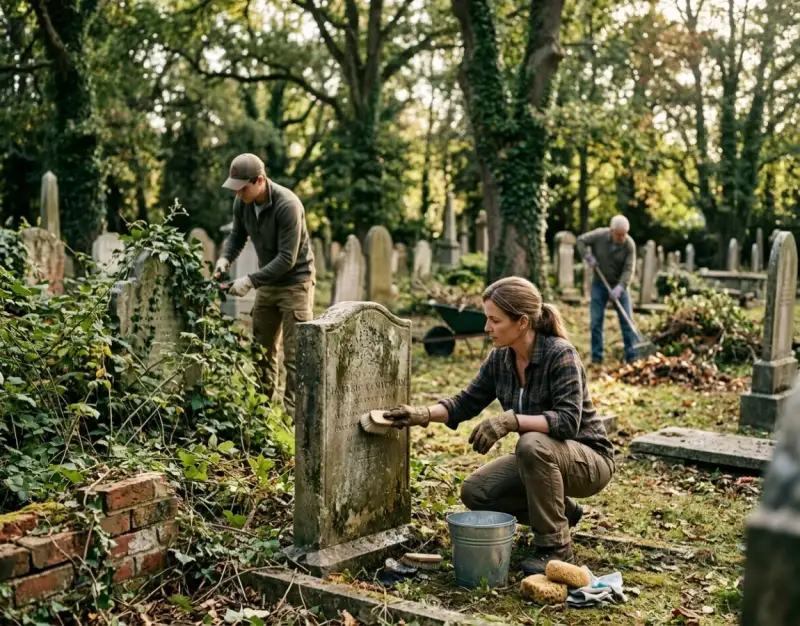
Deep within choked timberlands, behind suburban shopping plazas, or at the edges of forgotten farmland lie thousands of historic burial grounds stripped of human remembrance. Over decades of municipal annexation, economic shifts, and generational departure, these sanctified spaces fall prey to rampant ivy, fallen timber, subterranean root heave, and vandalizing weather. Headstones sculpted from fragile 19th-century marble tilt precipitously into encroaching brush, their chiseled inscriptions—names, birth dates, military ranks, and poetry—dissolving under aggressive lichen colonization. What remains is an alarming rupture in local history: human lives reduced to unreadable markers lost to time.
In recent years, a quiet, grass-roots renaissance has taken root across the globe. Thousands of independent researchers, local historians, military veterans, and digital preservationists are stepping into these abandoned spaces armed with soft-bristle brushes, specialized biological cleaners, geographic mapping tools, and deep reverence. This movement moves far beyond standard lawn maintenance. It represents a sophisticated convergence of historic preservation, forensic genealogy, and restorative community service. By rescuing abandoned graveyards, these stewards ensure that forgotten pioneers, marginalized communities, unmarked veterans, and infant casualties regain their rightful space within public memory.
This resurgence is further fueled by high-definition digital platforms and crowd-sourced genealogical databases. Where older preservation efforts remained isolated within local historical societies, modern volunteers document their restorations in real time, pairing headstone rehabilitation with archived census records, military muster rolls, and historic land deeds. The fundamental thesis of this movement is simple yet profound: a society’s ethical character is revealed in how it treats its dead. Restoring a forgotten grave is an act of historical justice, reclaiming stories that would otherwise be erased by environmental decay and systemic neglect.
Foundational Principles & Mechanics of Cemetery Preservation
Cemetery restoration requires a strict commitment to conservation ethics. Unlike routine property maintenance, working in historic burial grounds involves delicate material science, structural engineering, and legal nuances. Novice efforts executed without proper training frequently cause irreversible chemical and physical damage to historic stone monuments.
Every stone monument—whether carved from white marble, slate, red sandstone, fine granite, or cast zinc—interacts dynamically with environmental moisture, micro-organisms, and soil chemistry. Before striking a single root or applying a drop of water, preservationists must master four foundational concepts:
- Material Porosity and Chemistry: Historic stones, particularly 18th- and 19th-century marble and sandstone, are highly porous. Applying harsh acids, bleach, or high-pressure water forces moisture and abrasive agents deep into microscopic fissures, inducing interior sugar-crystallization (sugaring) and catastrophic spalling when freeze-thaw cycles occur.
- Reversibility and Breathability: All repairs, sealants, and resetting adhesives must be vapor-permeable and softer than the stone itself. Using modern Portland cement or non-porous industrial epoxies creates structural rigidity; when the surrounding soft stone expands or settles, the rigid cement shears the historic stone apart.
- Non-Invasive Structural Interventions: Unstable, leaning, or fallen monuments must be leveled using engineered aggregate bases, natural lime mortars, and stainless steel alignment pins rather than quick-set concrete poured directly around subterranean bases.
- Legal and Stewardship Frameworks: Historic graveyards fall under varying legal designations—including private family plots, abandoned municipal sites, church trusts, and tax-delinquent properties. True stewardship requires establishing legal right-of-entry, securing permissions from state historic preservation offices (SHPOs), and operating under high ethical standards. When engaging in community-led restorative projects, volunteers must maintain a high level of cultural humility and respect, ensuring their actions honor local legacy rather than impose intrusive overhaul—a discipline thoroughly outlined in How to Volunteer Abroad Ethically: Avoiding Savior Complex and Doing Real Good.
1. Legal Due Diligence, Ownership Mapping, and Ingress Rights
Identifying Title, Abandonment, and Local Burials Legislation
Before stepping onto an overgrown burial ground, volunteers must complete rigorous legal research. Cemeteries rarely exist in total legal vacuums; even sites untouched for a century possess recorded tax parcels, abandoned deed trusts, or state-mandated municipal oversight. Commencing physical work without identifying legal ownership exposes volunteers to civil trespass or criminal desecration charges.
Preservationists begin by searching county land registries, tax assessor maps, and historical plat books. In many jurisdictions, state burial laws dictate that when a cemetery company or church entity dissolves, maintenance duties default to the surrounding township or municipality. In other cases, property deeds contain perpetual access easements for descendants and preservation teams. Understanding these statutory distinctions ensures that all restoration activities remain compliant with regional historical resource acts.
Securing Property Access and Stakeholder Approvals
If a target site resides within private land boundaries, establishing open, transparent communication with property owners is vital. Volunteers present detailed work proposals outlining non-invasive clearing methods, liability waivers, insurance coverage, and scheduled timelines. Obtaining written, notarized permission guarantees unrestricted access while insulating property owners from liability concern.
Furthermore, consultation with descendant communities, local historical commissions, and tribal historic preservation officers (THPOs) is essential—particularly when restoring African American burial grounds, indigenous sites, or potter's fields. These advisory partnerships ensure that physical interventions honor cultural mourning customs and preserve sensitive archaeological features hidden beneath the topsoil.
2. Site Surveying, Digital Mapping, and Genealogical Archiving
Comprehensive Plot Layout, GPS Tagging, and Photogrammetry
Physical restoration must always be preceded by methodical documentation. Before vegetation is cleared or stones are shifted, volunteers conduct a comprehensive grid survey to establish a baseline spatial record of the cemetery. Using Real-Time Kinematic (RTK) GPS equipment or mobile mapping applications, teams log precise coordinates for visible markers, sunken bases, architectural perimeter fences, and potential unmarked depressions.
Photogrammetry—taking overlapping, multi-angle digital images—allows volunteers to construct 3D digital models of eroded, illegible headstones. High-contrast digital rendering techniques, such as Reflectance Transformation Imaging (RTI), reveal faint, weathered inscriptions without applying physical agents like chalk, flour, or shaving cream, which leave acidic residues that accelerate stone decay.
Cross-Referencing Census Data, Obituaries, and Public Records
A headstone is only one piece of an individual's historical record. Parallel to physical site mapping, research teams search digitized archival databases—including national census records, military service logs, probate inventories, church baptismal ledgers, and historic newspaper obituaries. This documentary work reconstructs incomplete or damaged inscriptions.
When a broken marker displays only a fragment—such as a partial name or death year—archival cross-referencing allows preservationists to accurately record full names, maiden lineages, military regiments, and familial relationships. These compiled findings are uploaded to open-access genealogical repositories like Find A Grave, BillionGraves, and state archives, restoring public visibility to individuals long erased from historical records.
3. Vegetation Management and Non-Invasive Site Clearing
Managing Invasive Roots, Vines, and Canopy Overgrowth
Overgrown vegetation poses the most immediate physical threat to historic grave monuments. Tree roots crack subsurface bases, while climbing vines like English Ivy and Poison Oak embed rootlets into microscopic porous cavities, pulling delicate marble slabs down as they expand. However, clearing growth requires careful, measured execution.
Volunteers rely strictly on manual hand tools—such as bypass hand pruners, loppers, folding pruning saws, and sickle hooks. Motorized string trimmers with heavy monofilament plastic lines are prohibited around stone bases; spinning lines strike historic marble, cutting gouges across soft inscriptions. Chainsaws are limited to overhead limb clearance by certified arborists, preventing fallen branches from crushing fragile tablets beneath.
Preventing Structural Disturbance to Below-Ground Vaults
In 19th-century and older cemeteries, many burials utilize brick-lined vaults, box tombs, or shallow earth interments lacking modern reinforced concrete vaults. Heavy machinery—such as skid-steer loaders, riding lawnmowers, or tractors—exerts high point-loads that risk collapsing subterranean vaults and damaging unrecorded surface burials.
Clearing teams establish strict walking corridors and utilize lightweight, manual haulage gear like canvas tarps and wheelbarrows with pneumatic tires. Root systems clinging directly to headstones are pruned flush at ground level rather than forcibly yanked; pulling stubborn roots dislodges buried bases or snaps weakened slate and marble tablets at their narrowest points.
4. Scientific Stone Cleaning Protocols and Preservation Chemistry
Safe Chemical Selection: D/2 Biological Solution vs. Harmful Household Solvents
Cleaning a historic grave marker is a delicate conservation treatment aimed at removing destructive biological growths—such as lichen, algae, mold, and moss—that secrete acidic compounds into the stone. Historically, well-meaning volunteers used household bleach, ammonia, wire brushes, or acidic masonry washes. These chemicals deposit soluble salts deep within the stone matrix, causing severe internal fracturing, yellow staining, and surface powdering.
Modern preservation standards dictate the exclusive use of quaternary ammonium, non-ionic biological cleansers—most notably D/2 Biological Solution. D/2 is non-toxic, biodegradable, zero-VOC, and specifically engineered to destroy sub-surface biological growth without leaching mineral salts into porous stone. Unlike bleach, D/2 continues working for 10 to 14 months post-application, using rainwater exposure to lift embedded spores out of deep stone pores.
Soft Scrubbing Techniques, Hydration, and Atmospheric Exposure
The cleaning protocol demands patience, generous water application, and minimal mechanical pressure. The stone is first thoroughly saturated with clean water to fill all microscopic pores, preventing the cleaning solution from absorbing too rapidly. Volunteers then gently brush away heavy surface moss using soft natural-bristle or Tampico fiber brushes, avoiding metal, nylon, or hard-plastic bristles.
D/2 Biological Solution is sprayed evenly over the stone, allowed to dwell for 10 to 15 minutes, and then scrubbed in smooth circular motions. The stone is rinsed thoroughly with low-pressure water from hand-pump sprayers. Biological growth lightens immediately, while deep-set lichen staining lifts naturally over subsequent weeks as atmospheric exposure activates the residual cleaner.
5. Structural Repair: Resetting, Leveling, and Mortar Selection
Building Gravel Foundations and Sub-Grade Support Frameworks
Over decades of freeze-thaw cycles, soil compaction, and animal burrowing, headstone bases routinely shift, tilt, or submerge entirely into ground level. Straightening a leaning headstone requires excavating a stable, well-draining subsurface foundation capable of bearing heavy loads without setting the stone in permanent concrete.
Volunteers carefully lift the stone and its base using tripod hoists or non-marring lifting straps. The subterranean trench is excavated slightly deeper than the stone's base, then backfilled with crushed aggregate base (such as washed gravel or crushed limestone gravel fine mix). The gravel layer is manually compacted in two-inch lifts, creating a leveling foundation that allows groundwater to drain freely away from the base while absorbing minor ground movement without cracking the monument.
Joining Fractured Monuments with Breathable Lime Mortar and Epoxy
When multi-piece monuments fracture due to structural impacts or tree strikes, repairing the stone requires high-performance adhesives matched specifically to the physical properties of historic masonry. Broken fragments are cleaned, dried, and dry-fit to ensure exact alignment along fracture lines.
Structural joins are secured using structural conservation-grade epoxies (such as Akemi or Tenax) applied sparingly to interior contact points, keeping the adhesive back from outer edges. For structural bedding joints between marble tablets and socket bases, preservationists use Natural Hydraulic Lime (NHL 2 or NHL 3.5) mortars. Lime mortar remains softer and more breathable than the surrounding stone, ensuring that if future ground movement occurs, the sacrificial mortar joint gives way rather than causing catastrophic breaks across historic marble.
6. Community Engagement, Youth Mobilization, and Long-Term Stewardship
Organizing Public Cleanup Days and Educational Workshops
Sustaining an abandoned cemetery requires building active local community networks. Independent preservationists foster long-term continuity by organizing recurring community cleanup events, combining hands-on labor with educational instruction on historic preservation, local history, and grave conservation ethics.
These initiatives frequently attract local historical societies, youth groups, scout troops, and civic organizations. To finance physical materials—such as D/2 solution, safety gear, timber tripod hoists, and lime mortar—preservation groups often partner with corporate sponsors or local philanthropists. These initiatives mirror the profound impact seen when benevolent corporate leaders invest in community well-being, such as the uplifting narrative of a Surprise Paycheck: The Boss Who Gifted His Entire Year-End Bonus to His Employees. Such private support provides non-profit preservation teams with the resources needed to scale their field operations.
Establishing Perpetual Maintenance Funds and Local Historical Societies
The ultimate goal of grave restoration is establishing perpetual stewardship so that cleaned cemeteries never revert to neglected wilderness. Preservation teams work with local government councils to establish perpetual care trust funds, clear title transfers, or register sites under municipal park management systems.
Moreover, modern community restoration projects offer profound emotional and social benefits for participating volunteers, fostering deep cross-generational bonds and personal purpose. These volunteer initiatives yield therapeutic benefits similar to the companionship experienced in animal service partnerships—a dynamic highlighted in From Shelter to Service: How Rescue Dogs Are Becoming Lifesaving Medical Alert Companions. Connecting people with historic outdoor spaces creates lasting community bonds anchored in shared service.
Real-World Case Studies & Preservation Scenarios
Analyzing real-world restorations highlights the contrast between scientific conservation methods and well-meaning but destructive interventions. The following comparative scenarios illustrate key methodologies, outcomes, and long-term impacts.
Scenario A: The Oakridge African American Pioneer Cemetery Restoration
Context: Established in 1854, a historic three-acre African American burial site containing over 300 documented interments fell into total neglect following the death of its last church trustee in 1972. Dense briars covered the terrain, soft marble markers were submerged under leaf mold, and over 40% of monuments suffered severe vertical tilt or fractures.
Strategy Executed: A coalition of local university historians, descendant families, and certified preservation volunteers established a formal non-profit preservation trust. They mapped the parcel using RTK GPS photogrammetry before clearing dense vegetation by hand with shears and scythes. Stones were treated exclusively with D/2 Biological Solution over two sessions, and fractured tablets were joined using conservation epoxy and natural hydraulic lime mortar. Socket bases were leveled on compacted crushed gravel beds.
Outcome: 214 headstones were fully cleaned and reset; 42 broken markers were structural reunited; and 68 previously unrecorded graves were identified and tagged. The trust partnered with the county to establish a permanent municipal park maintenance agreement, securing long-term care and historical landmark designation.
Scenario B: The Misguided Wire-Brush Civic Day Disaster
Context: A rural township historical committee organized a quick weekend cleanup of a neglected 18th-century pioneer cemetery, aiming to prepare the grounds for a municipal anniversary celebration.
Strategy Executed: Lacking training in historic material science, volunteers brought gasoline-powered pressure washers, wire-wheel drill attachments, industrial muriatic acid, and bags of standard Portland cement. They scoured soft sandstone headstones with wire brushes to quickly remove lichen, blasted brittle slate markers with 3,000 PSI water streams, and encased leaning marble bases in thick concrete collar rings.
Outcome: High-pressure water stripped carved relief inscriptions from 35 slate headstones. Wire brushes left severe metallic rust streaks and deep gouges across soft marble, destroying fine details. Within two winter seasons, freeze-thaw expansion caused the rigid Portland cement collar rings to shear 14 historic marble bases clean off at ground level, inflicting irreparable structural destruction across the site.
Critical Mistakes & How to Avoid Them
Preservation efforts must adhere strictly to professional standards. Avoiding high-risk practices protects both historic monuments and volunteer safety:
- Using Household Bleach, Acid, or Pressure Washers: Chlorine bleach deposits soluble sodium salts deep within porous stone, causing internal crystallization and severe surface spalling. Pressure washers blast away historic surface layers. Countermeasure: Use only low-pressure water sprayers (under 50 PSI) and specialized biological cleansers like D/2.
- Encasing Base Stones in Rigid Portland Cement: Modern concrete cures far harder and less porous than 18th- and 19th-century marble, limestone, or sandstone. Ground movement will cause the cement collar to snap the softer headstone. Countermeasure: Reset bases in permeable, compacted crushed aggregate gravel foundations that drain water and absorb ground heave.
- Applying Chalk, Flour, or Shaving Cream for Reading Inscriptions: These substances introduce organic sugars, oils, and acids directly into microscopic stone fissures, feeding aggressive biological decay. Countermeasure: Use off-camera LED side-lighting, raking sunlight mirrors, or digital photogrammetry (RTI processing) to enhance faint lettering non-invasively.
- Forcibly Extracting Deep Roots from Sub-Surface Masonry: Pulling mature tree roots embedded underneath headstones can collapse subterranean burial vaults or break brittle stone shafts beneath ground level. Countermeasure: Prune root systems flush with ground level using sharp hand shears, allowing the subsurface root structure to decompose naturally over time.
- Working Without Surveying Sub-Surface Vault Hazards: Sunken soil depressions often indicate structural failure of below-ground brick vaults or rotting wooden coffins. Walking unguided into these areas poses severe cave-in risks. Countermeasure: Probe suspect soil zones gently with non-conductive fiberglass soil probes before bringing heavy foot traffic or equipment onto the site.
Comprehensive Material & Strategy Comparison
The following table outlines standard tools, chemicals, structural repair strategies, and recording methodologies utilized in professional cemetery restoration versus outdated, harmful alternatives:
| Category | Recommended Professional Practice | Harmful Outdated Alternative | Impact on Stone & Preservation Integrity |
|---|---|---|---|
| Chemical Cleaning Agent | D/2 Biological Solution (Quaternary Ammonium) | Household Bleach, Ammonia, Muriatic Acid | D/2 lifts biological growth safely over time; bleach deposits harmful salts that crack porous stone. |
| Scrubbing Equipment | Soft Natural Tampico or Horsehair Brushes | Wire Brushes, Steel Wool, Nylon Grinding Wheels | Tampico fibers scrub without scratching stone; metal tools leave deep gouges and rust deposits. |
| Structural Repair Mortar | Natural Hydraulic Lime Mortar (NHL 2 / 3.5) | Standard Portland Cement / Quick-Set Concrete | Lime mortar is breathable and flexible; Portland cement forces soft historic stone to shear under stress. |
| Base Resetting Foundation | Compacted Crushed Aggregate Gravel Base | Solid Poured Concrete Collar Base | Gravel allows natural water drainage and ground shift; concrete traps moisture and accelerates freeze damage. |
| Inscription Enhancement | Raking Mirror Light, Off-Axis LED, Photogrammetry | Shaving Cream, Flour, Chalk, Rubbing Wax | Optical lighting methods leave zero chemical residue; creams and chalks introduce destructive acids and organic sugars. |
| Site Mapping & Logging | RTK GPS Tagging, GIS Software, Find A Grave | Unmapped Hand Sketches, Unindexed Notebooks | Digital tagging preserves geographic coordinates permanently for descendants worldwide; paper notes are easily lost. |
Frequently Asked Questions (FAQ)
Is it legal for private individuals to clean headstones in abandoned cemeteries?
Legal access depends entirely on regional property laws and the legal status of the cemetery. In many jurisdictions, abandoned cemeteries fall under municipal guardianship or state burial access laws, which grant permission for non-destructive maintenance and descendant visitation. However, volunteers must always verify parcel ownership through local tax assessor records, secure written permission from property owners or local cemetery boards, and notify state historic preservation offices before beginning work.
Entering private property without authorization can result in civil trespass charges. Furthermore, performing aggressive physical interventions without consulting local historical commissions may violate regional heritage preservation laws. Establishing clear communication and written agreements protects volunteers and respects legal ownership boundaries.
Why is household bleach so harmful to old marble and sandstone headstones?
Household bleach (sodium hypochlorite) contains aggressive chemical salts. When applied to porous historic stones like marble, limestone, or red sandstone, the fluid penetrates deep into microscopic capillary networks. As the water evaporates, salt crystals form inside the stone's pores (subflorescence).
These expanding salt crystals exert tremendous internal pressure, causing the surface layer of the stone to flake off, crumble into powder, or split along natural bedding planes. Additionally, bleach reacts with minerals in marble to produce unsightly yellow and orange staining that cannot be reversed. Specialized quaternary ammonium solutions like D/2 work safely without depositing harmful salts.
How do I read an inscription that has become completely unreadable due to weathering?
Illegible inscriptions should never be highlighted using shaving cream, flour, chalk, or graphite rubbings. These methods introduce acidic chemicals or organic food sources that feed lichen and accelerate physical weathering.
Instead, use non-invasive optical methods. Holding a large mirror to reflect sunlight across the face of the stone at a shallow, oblique angle (raking light) creates deep shadows inside carved lettering, making faint inscriptions readable instantly. Alternatively, taking multiple high-resolution photos under low-angle artificial lighting and processing them with free photogrammetry software (such as RTI) produces high-contrast 3D renderings that reveal faint text non-destructively.
What is the safest way to level a heavy headstone that is leaning dangerously?
Straightening a leaning headstone requires excavating around its base and creating a stable, well-draining sub-grade foundation. The stone should be carefully supported and lifted using a wooden gantry tripod or hoist with non-marring lifting straps to prevent chipping historic edges.
Once the stone is lifted, excavate the underlying trench deeper than the base and fill it with a compacted layer of crushed aggregate gravel (such as crushed stone fines). Compact the gravel in two-inch layers to form a firm foundation. Lower the base back onto the compacted gravel and check it with a bubble level. This approach allows groundwater to drain freely away while allowing minor ground movement without cracking the monument.
How can local volunteers organize a sustained graveyard restoration project?
Building a successful project begins by forming a clear organizational structure—such as a non-profit cemetery trust or historic preservation committee. Partnering with local historical societies, genealogical associations, and municipal authorities helps establish community credibility and access shared resources.
Organize public educational workshops led by experienced conservationists before holding wide-scale cleanup workdays. Establishing an online presence—such as a dedicated website or social media page—allows groups to share documented headstone records, publish historical biographies, coordinate volunteer shifts, and secure tax-deductible donations to fund preservation supplies like D/2 cleaner, gravel, and hand tools.
Strategic Roadmap & Final Takeaway
The field of cemetery restoration is undergoing a technological and cultural evolution. Over the next two to five years, rapid advancements in mobile LIDAR scanning, consumer-grade drone photogrammetry, and artificial intelligence transcription tools will revolutionize how abandoned burial grounds are surveyed and preserved. High-definition 3D spatial models will allow descendants around the world to virtually walk through restored historic cemeteries, inspecting fine details on repaired monuments from their personal devices.
Simultaneously, legislative trends indicate growing bi-partisan support for state and federal cemetery preservation grants, recognizing these sites as irreplaceable outdoor museums and vital historical assets. As urban development expands, protecting these quiet green sanctuaries becomes increasingly essential for preserving local history and community identity.
Restoring a forgotten grave is ultimately an enduring gift to future generations. By stepping into overgrown, forgotten spaces with reverence, proper tools, and scientific conservation methods, volunteers ensure that those who came before us are remembered with dignity, clarity, and respect.
Be the first to share a gentle reflection on this story.