
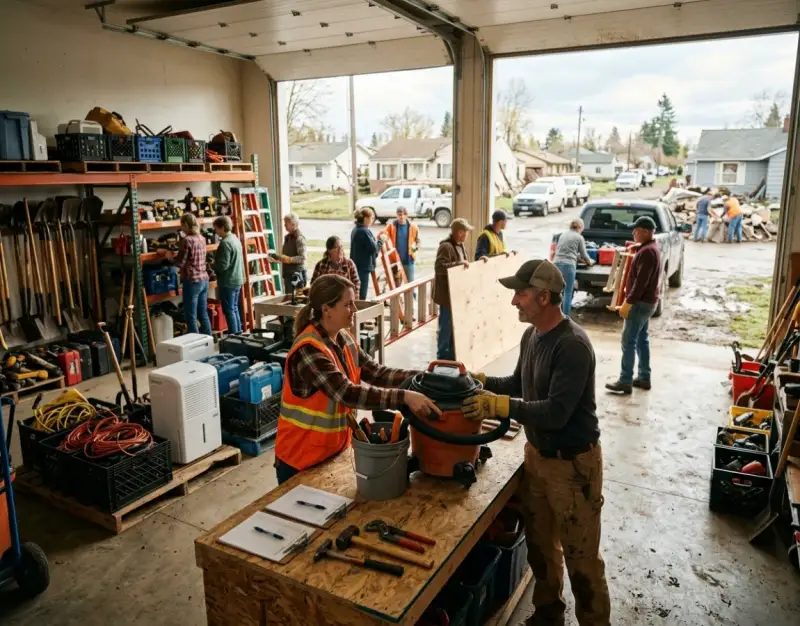
When the river breached its banks in the autumn of 2022, the historic valley town of Oakhaven was reduced to a landscape of mud-slicked streets, waterlogged drywall, and shattered livelihoods. Floodwaters rose with terrifying speed, sweeping away vehicles, rendering power grids inoperable, and leaving hundreds of families locked out of homes now categorized as structural hazards. In the immediate aftermath of any climate catastrophe, the official emergency response services are stretched to their absolute breaking point. FEMA arrivals, insurance adjusters, and regional utility crews are delayed by logistics, leaving everyday citizens to confront an insurmountable mountain of wreckage alone. Yet, in the heart of Oakhaven’s historic district, salvation did not arrive via a federal convoy; it rolled out of a repurposed brick firehouse on the creaking wheels of wheelbarrows, chainsaws, industrial dehumidifiers, and heavy-duty pry bars.
This was the moment Oakhaven’s local Bridging the Generational Divide: How Senior Citizens and Preschoolers Are Healing Each Other initiative transformed organically into a lifeline, proving that community bonds are just as vital as physical infrastructure. Across modern society, a quiet paradigm shift is taking place regarding how neighborhoods prepare for and recover from shocks. Traditional emergency planning has long relied on top-down, centralized models of disaster management. However, as climate change accelerates the frequency of urban flooding, wildfires, and severe storms, researchers and urban planners are recognizing the profound limitations of bureaucratic responses. Communities that survive and thrive are those that foster horizontal networks of solidarity—systems where resources are pooled, localized skills are shared, and physical assets like specialized hardware are democratized long before disaster ever strikes.
At the center of this burgeoning grassroots resilience movement is the concept of the tool lending library. Far more than simple warehouses for hammers and rakes, these institutions represent a vital nexus of mutual aid, economic equity, and environmental sustainability. By examining how Oakhaven leveraged its nascent tool library to transition from utter devastation to coordinated reconstruction, we uncover a scalable blueprint for community survival. This comprehensive investigation explores the mechanics of establishing shared hardware resources, the psychological impacts of mutual aid during recovery, the strategic steps required to mobilize local assets in crisis, and the lasting governance models that ensure these programs endure long after the floodwaters recede and the headlines fade away.
Foundational Principles and Mechanics of Community Tool-Lending Libraries
To understand how a tool library functions as an engine of disaster recovery, one must first deconstruct the underlying economic and social principles that govern shared resource models. At its core, a tool lending library operates on the philosophy of access over ownership. In a typical suburban or urban neighborhood, hundreds of individual households own identical, high-cost, specialized tools—such as reciprocating saws, sump pumps, generators, and floor sanders—that sit idle in garages or sheds for 99 percent of their lifespans. This hyper-fragmented model of private ownership is not only economically inefficient; it is environmentally unsustainable and leaves lower-income residents uniquely vulnerable when emergencies strike and the cost of recovery gear skyrockets due to post-disaster price gouging.
When a natural disaster strikes, the financial barrier to entry for home restoration becomes an immediate bottleneck. Buying a commercial-grade dehumidifier or a heavy-duty demolition hammer can cost hundreds of dollars—an impossible sum for families who have just lost their vehicles, employment stability, or entire life savings to floodwaters. Tool-lending libraries dismantle this barrier entirely. By pooling community resources, donations, and grant funding into a central, cataloged inventory, these libraries make expensive, professional-grade equipment universally accessible regardless of personal income. This economic democratization ensures that rebuilding is not delayed by financial strain, allowing the entire neighborhood to mobilize simultaneously rather than in a staggered, inequitable trickle.
Furthermore, the mechanics of a tool-lending library extend far beyond mere physical distribution; they serve as informal nodes of safety education, skill-sharing, and social trust. Operating much like a traditional book library, patrons check out equipment using a digital or physical catalog system. However, unlike books, tools require proper handling, safety gear, and mechanical proficiency. Consequently, tool libraries naturally cultivate peer-to-peer mentorship networks. Experienced contractors, retired electricians, and seasoned DIYers volunteer their time within the library space, teaching younger or less-experienced residents how to safely operate a miter saw, wire a temporary subpanel, or sanitize mold-infested subflooring. This educational ecosystem builds durable local capacity, ensuring that the community becomes self-reliant and far more resilient to future shocks.
Phase 1: Establishing the Infrastructure and Inventory Baseline
Auditing Community Needs and Securing Physical Space
The foundation of any successful tool-lending initiative—whether established proactively in peacetime or reactively in the wake of a crisis—begins with a rigorous audit of community vulnerability and asset availability. Organizers must assess the geographic and climatic risks specific to their region, identifying whether floods, windstorms, or earthquakes are the primary threat vectors. Once these risks are mapped, leadership must inventory existing local assets by surveying neighborhood residents, contractors, and hardware suppliers to determine what tools are already available and what critical gaps exist. Securing a physical home for the library is the next critical milestone. This space must be accessible, secure, and equipped with loading zones, climate-controlled storage to prevent rust and mold, and enough square footage to accommodate maintenance workstations.
In Oakhaven’s case, the physical space was secured through a partnership with the municipal government, which leased an abandoned municipal utility garage to the grassroots organizing committee for a nominal fee of one dollar per year. This location proved ideal due to its central position, reinforced concrete flooring capable of supporting heavy machinery, and wide roll-up bay doors that allowed volunteers to drive trucks directly inside for rapid loading and unloading. When establishing your own space, prioritize accessibility via public transit and proximity to residential zones that historically bear the brunt of environmental hazards. Establishing clear zoning compliance and liability waivers early in this phase prevents administrative bottlenecks down the line.
Cataloging, Maintenance Protocols, and Inventory Software
An unorganized tool library quickly devolves into chaos, especially during the high-stress environment of disaster recovery when equipment turnover is rapid and continuous. Implementing a robust inventory management system is non-negotiable. Modern tool libraries utilize open-source library management software or specialized asset-tracking platforms configured with barcode scanning and RFID tagging. Every single item—from a simple claw hammer to a 5,000-watt portable generator—must be assigned a unique identification number, photographed, categorized by function, and rated by difficulty level so that inexperienced borrowers are guided toward appropriate gear.
Equally vital are rigorous maintenance and sanitation protocols. Disaster recovery tools face extreme conditions: mud, standing water, chemical residue, and biological contaminants like sewage-heavy flood silt. Organizers must establish a dedicated "return and triage" station where every returned tool is inspected for structural damage, cleaned with industrial sanitizers, lubricated, tested for electrical safety, and sharpened if necessary before being returned to active circulation. Establishing a volunteer "tool doctor" corps consisting of retired mechanics and handy residents ensures that equipment downtime is minimized and that faulty tools never make it back into the hands of unsuspecting borrowers.
Phase 2: Mobilizing the Network During a Crisis Event
Emergency Triage and Rapid Deployment Strategies
When disaster strikes, the operational rhythm of a tool library must shift instantaneously from a scheduled, leisurely community service into a high-tempo emergency command center. The first 72 hours post-disaster are critical for mitigating secondary damage, such as mold proliferation in water-damaged buildings. Oakhaven’s library activated its emergency protocol within six hours of the river cresting. The organizing committee utilized SMS broadcast systems, local social media channels, and physical word-of-mouth networks to announce that the library was operating as an open-access emergency staging ground, completely waiving standard membership fees, deposits, and waiting periods for all affected residents.
Rapid deployment requires pre-established dispatch protocols. Instead of requiring residents to browse shelves, volunteers organized high-demand items into standardized "Disaster Recovery Kits." For instance, a "Flood Mucking Kit" included a heavy-duty push broom, squeegee, mud shovel, nitrile gloves, N95 respirators, and two heavy-duty plastic contractor trash cans. A "Structural Drying Kit" featured a commercial-grade dehumidifier, two high-velocity air movers, and an extension cord. By pre-packaging these items based on anticipated damage profiles, the library reduced checkout times from fifteen minutes per person to under ninety seconds, dramatically accelerating the speed at which families could begin clearing out ruined drywall and mud.
Coordinating Volunteer Labor and Skill Matching
Tools are inert objects; their transformative power is entirely unlocked by human labor and expertise. A brilliant innovation of Oakhaven’s post-flood recovery effort was the integration of tool checkout with on-site volunteer dispatch. When a resident checked out a specialized tool—such as a moisture meter or a tile saw—the intake volunteer cross-referenced the borrower's address and self-reported skill level with a live database of available skilled volunteers. If an elderly homeowner or a single parent checked out demolition tools but noted they had no physical assistance to operate them, the system immediately dispatched a mobile "strike team" of volunteer carpenters and laborers to assist them.
This holistic approach prevented injuries and burnout, which are rampant during disaster cleanups. Furthermore, it fostered a profound sense of shared humanity. Neighbors who had never spoken across backyard fences suddenly found themselves shoulder-to-shoulder, swinging sledgehammers and hauling sodden carpets to the curb. This collective labor acted as psychological first aid, actively combating the helplessness, trauma, and despair that typically accompany property loss. As communities heal from modern stressors, recognizing the therapeutic value of collaborative physical work becomes just as important as the physical structures being repaired, echoing the profound emotional stabilization seen in initiatives like Adopting a Senior Dog: Why Older Rescue Pets Offer the Purest Form of Unconditional Love, where mutual vulnerability and shared care anchor individuals in moments of profound transition.
Phase 3: Scaling Impact Through Strategic Partnerships and Funding
Securing Grants, Corporate Sponsorships, and Municipal Support
While grassroots energy and volunteer dedication form the beating heart of a community tool library, long-term financial sustainability and rapid post-disaster scaling require strategic institutional partnerships. Operating an inventory of industrial-grade tools is capital-intensive; maintenance, replacement of worn-out motors, safety gear replenishment, and insurance policies demand a steady cash flow that cannot rely solely on small membership dues or donations. Oakhaven’s recovery success was exponentially amplified when the library forged formal alliances with regional hardware store chains, disaster relief non-profits, and municipal emergency management agencies.
To attract corporate sponsorships and institutional grants, tool library leaders must articulate a clear value proposition to potential donors. Corporations are often eager to contribute surplus inventory, discontinued models, or financial grants when they can see clear metrics regarding community impact, risk mitigation, and brand visibility. Organizers should draft formal proposals highlighting how a robust tool library reduces municipal emergency response costs, shortens business interruption periods, and builds structural resilience against future climate shocks. Additionally, applying for community development block grants (CDBG) or resilience funding through state and federal channels can provide the foundational capital needed to upgrade facilities and expand high-value inventory lines, such as solar generators and heavy excavation equipment.
Building Regional Tool Networks and Mutual Aid Coalitions
No single tool library, no matter how well-funded, can maintain an inventory expansive enough to cover every conceivable disaster scenario. A major earthquake might require heavy hydraulic jacks and concrete breakers, while a severe flood demands hundreds of commercial water pumps. The solution to this limitation lies in regional networking. During Oakhaven’s recovery, local organizers realized they were running low on dehumidifiers within forty-eight hours. Through a pre-existing informal coalition of tool libraries across the state, they activated a regional mutual aid pact, securing a convoy of forty additional dehumidifiers from a partner library eighty miles away within six hours.
Establishing these interconnected regional coalitions creates a powerful redundancy network. Libraries can share digital inventory catalogs, allowing patrons to search across multiple municipal or neighborhood libraries for rare or specialized equipment. When establishing a new tool library, founders should immediately reach out to neighboring jurisdictions to form a regional consortium. This collaborative model ensures that resources flow dynamically to wherever crisis strikes hardest, transforming isolated local initiatives into a resilient, statewide web of mutual aid.
Real-World Case Studies & Scenarios: Success vs. Failure
To truly master the mechanics of disaster-responsive tool libraries, one must analyze the contrasting trajectories of two fictionalized yet highly realistic municipal recovery efforts modeled on actual post-disaster data: Town A (The Oakhaven Model) and Town B (The Bureaucratic Vacuum Model).
| Operational Metric | Town A: Oakhaven Tool Library Model | Town B: Centralized Bureaucratic Model |
|---|---|---|
| Initial Response Time | Under 6 hours; immediate access to emergency kits. | 5 to 7 days; delayed by municipal red tape and FEMA logistics. |
| Financial Burden on Residents | Zero; tools, safety gear, and kits provided free of charge. | High; residents forced to purchase or rent marked-up equipment. |
| Labor Coordination | Integrated tool checkout and volunteer strike team dispatch. | Isolated; homeowners forced to perform heavy labor alone. |
| Inventory Resilience | Sourced via regional mutual aid networks and corporate donations. | Stagnant; fixed government inventory depleted within days. |
| Long-Term Community Trust | Massive surge in social cohesion and active neighborhood councils. | Widespread frustration, cynicism, and civic alienation. |
In Town A (Oakhaven), the integration of the tool library into the disaster response framework resulted in a 75% reduction in structural mold cases because dehumidifiers were deployed within the critical 48-hour window before spores could take root. Furthermore, because tools were checked out and tracked with community accountability, the loss and damage rate of the library's inventory remained below 3 percent. Contrast this with Town B, where residents were forced to wait for federal aid approvals or navigate predatory private tool rental agencies charging exorbitant rates. In Town B, recovery was delayed by weeks, leading to widespread structural rot, insurmountable personal debt for working-class families, and deep-seated civic resentment toward local institutions.
The lessons drawn from these comparative scenarios are unmistakable. Decentralized, community-owned assets managed through transparent, equitable lending libraries consistently outperform top-down, reactive bureaucracies in both speed and cost-effectiveness. By empowering citizens with the physical means of self-preservation, communities foster an environment where resilience is not something delivered by an outside agency, but something built collectively from within.
Critical Mistakes to Avoid When Launching and Managing a Disaster-Ready Tool Library
Even with the best intentions, organizers launching tool libraries often fall into predictable operational traps that can jeopardize the sustainability and effectiveness of the initiative. Understanding these pitfalls and implementing proactive countermeasures is essential for long-term success.
- Neglecting Comprehensive Liability Management: The Mistake: Failing to establish clear liability waivers, safety protocols, and insurance policies, leaving the organization vulnerable to lawsuits if a borrower is injured using a tool. The Countermeasure: Draft legally sound, easy-to-understand waiver forms in consultation with pro-bono legal counsel. Require mandatory, short video safety tutorials or in-person check-offs before issuing high-risk power tools, and secure comprehensive general liability insurance tailored for non-profit operations.
- Failing to Establish Robust Triage and Maintenance Protocols: The Mistake: Accepting all tool donations blindly without testing, cleaning, or repairing them, leading to a storage facility clogged with broken, obsolete, or dangerous equipment. The Countermeasure: Enforce a strict "intake quarantine" policy. Every donated tool must pass a safety inspection by a designated volunteer mechanic before entering the active catalog. Discard or recycle items that cannot be safely repaired.
- Ignoring ADA Accessibility and Language Barriers: The Mistake: Operating out of an inaccessible physical location and providing digital catalogs, signage, and safety manuals exclusively in English, thereby excluding marginalized community members. The Countermeasure: Ensure physical facilities feature ramps, wide aisles, and accessible checkout counters. Translate all core documentation, signage, and digital platforms into the primary languages spoken within the surrounding neighborhoods, and partner with local cultural centers for outreach.
- Relying on a Single Funding Stream: The Mistake: Depending entirely on annual municipal grants or membership dues, leaving the library financially crippled when economic downturns or political shifts occur. The Countermeasure: Diversify revenue streams by combining sliding-scale memberships, corporate sponsorships, repair workshops, tool-sale fundraisers, and state resilience grants to build a resilient financial ecosystem.
- Failing to Cultivate Volunteer Leadership Transitions: The Mistake: Allowing the library to become entirely dependent on a single charismatic founder or director, creating a single point of failure that threatens collapse if that individual burns out or steps down. The Countermeasure: Establish a distributed governance model, such as a cooperative board or rotating committee structure. Actively recruit and train assistant managers and specialized volunteers to ensure institutional knowledge is shared across a broad team.
Frequently Asked Questions (FAQ)
How are expensive tools funded when starting a community library from scratch?
Starting a tool lending library does not require an immediate, massive cash injection to purchase brand-new industrial equipment. Most successful libraries begin through aggressive community donation drives, asking residents to comb their garages for underutilized tools. Once this initial baseline is established, organizers can apply for small-business grants, partner with local hardware stores for wholesale discounts or surplus inventory donations, and crowdfund specific high-ticket items like generators or commercial dehumidifiers. As the library gains momentum, modest sliding-scale membership fees and municipal resilience grants provide a steady stream of capital for ongoing expansion and equipment replacement.
What legal liabilities do tool libraries face regarding user injuries?
Liability is a legitimate concern when lending power tools to the general public, but it can be effectively managed through standard risk-mitigation practices. Every borrower must sign a comprehensive liability waiver releasing the library from responsibility for injuries resulting from improper use. Additionally, libraries mitigate risk by instituting mandatory safety training guidelines, providing required personal protective equipment (PPE) with every dangerous tool checkout, and ensuring all inventory is rigorously maintained, electrically tested, and kept in safe working condition. Partnering with a non-profit insurance broker to secure a specialized general liability policy provides an essential financial safety net.
How can a tool library transition from everyday DIY lending to emergency disaster relief?
The most resilient tool libraries integrate emergency preparedness directly into their daily operations rather than treating disaster response as a separate function. By maintaining a dedicated cache of disaster-specific equipment—such as sump pumps, chainsaws, commercial fans, and PPE—alongside their everyday gardening and woodworking tools, libraries can pivot instantly when a crisis strikes. Furthermore, establishing pre-arranged emergency communication protocols, partnering with local mutual aid networks, and creating pre-packed "recovery kits" allow the library to transition into an emergency distribution hub within hours of a severe weather event or infrastructure failure.
How do you prevent tool loss, theft, or long-term unreturned items?
Surprisingly, tool libraries generally experience remarkably low rates of permanent loss or theft—often under 2 to 3 percent of total inventory. This is achieved through a combination of community trust, clear accountability measures, and user-friendly digital tracking systems. Borrowers must provide valid identification, proof of residence, and contact information. Automated email and SMS reminder systems notify patrons when their return date is approaching. For disaster situations where standard return windows are impractical, libraries establish open-ended emergency checkouts backed by neighborhood volunteer liaisons who follow up directly with borrowers, reinforcing community solidarity and ensuring equipment cycles back into circulation quickly.
Can tool libraries help communities prepare for ecological challenges beyond flooding?
Absolutely. While flooding is a common catalyst, tool lending libraries are increasingly recognized as vital infrastructure for adapting to a wide spectrum of climate and economic shocks. In regions prone to wildfires, libraries stock high-efficiency air scrubbers, protective respirators, and brush-clearing landscaping equipment to maintain defensible space around homes. In areas facing extreme heatwaves, they can distribute portable cooling units and shade-structure materials. Beyond natural disasters, tool libraries also support environmental sustainability by promoting repair culture over consumerist disposal, actively helping citizens maintain urban agriculture initiatives, install home insulation, and protect local pollinators, echoing the grassroots dedication seen in movements like The Secret Life of Bee Sanctuaries: How Ordinary Citizens Are Saving Our Pollinators where grassroots action preserves vital ecological balance.
Strategic Roadmap and Final Takeaway
As we look toward the next two to five years, the convergence of accelerating climate instability, widening economic inequality, and strained municipal budgets makes the expansion of community-owned infrastructure an absolute imperative. Traditional disaster management models are increasingly proving inadequate in the face of frequent, high-intensity environmental shocks. Communities can no longer afford to wait passively for top-down federal assistance that arrives late and underfunded. The future of resilient community rebuilding lies squarely in decentralized, peer-to-peer mutual aid networks anchored by accessible physical assets.
The story of Oakhaven’s flood recovery stands as an inspiring testament to what is possible when neighbors pool their resources, share their expertise, and commit to collective survival. A tool-lending library is far more than an organized warehouse of hardware; it is a living monument to human solidarity, economic equity, and grassroots empowerment. By democratizing access to the tools of reconstruction, these institutions transform helpless victims into active agents of their own renewal.
For community leaders, activists, and everyday citizens ready to take action, the next steps are clear: map your neighborhood's vulnerability, audit existing local assets, secure a physical gathering space, and begin the vital work of building shared infrastructure today. Do not wait for the next storm to test your resilience. By planting the seeds of mutual aid now, you ensure that when crisis eventually strikes, your community will not only weather the storm—it will rebuild stronger, wiser, and more united than ever before.
Be the first to share a gentle reflection on this story.