
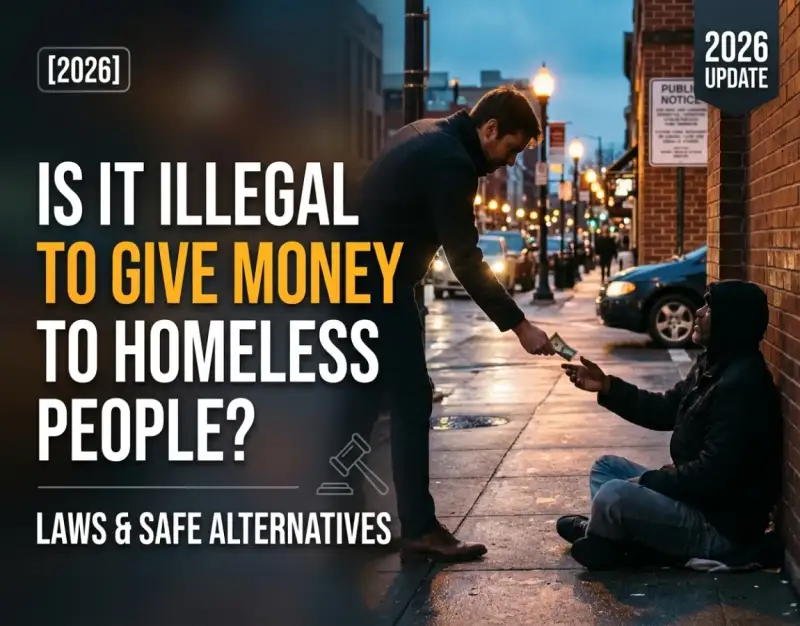
Few interactions in modern civic life evoke as much internal conflict as crossing paths with an unhoused individual asking for financial assistance. You reach into your pocket, your fingers graze your wallet, and a sudden wave of hesitation washes over you. You wonder not only about the direct impact of your generosity, but also about the legal framework governing the exchange. Is it illegal to give money to homeless individuals? Does passing a five-dollar bill through a car window violate municipal ordinances, or are laws strictly targeted at the act of asking rather than the act of giving? As urban landscapes evolve and local governments continually rewrite public space regulations, understanding the intersection of compassion, municipal law, and constitutional rights has never been more vital for everyday citizens.
Across the United States and various metropolitan regions globally, the legislative landscape surrounding homelessness, panhandling, and charitable giving has undergone profound shifts. Over the past decade, numerous municipalities have experimented with aggressive ordinances aimed at curbing public solicitation—frequently referred to as "anti-panhandling" or "quality-of-life" laws. While the vast majority of these legislative measures directly penalize the person *asking* for money—restricting soliciting near ATMs, transit hubs, or crosswalks—a growing ecosystem of local ordinances, distraction-based traffic laws, and targeted public awareness campaigns indirectly criminalize or discourage the act of *giving*. This has left well-meaning citizens profoundly confused, balancing a deep-seated human impulse toward empathy against the fear of municipal citations or contributing to systemic enforcement loops.
The core thesis of this comprehensive guide is simple yet nuanced: While direct cash handoffs are rarely illegal for the giver at the federal or state level, a web of hyper-local municipal ordinances, roadway safety codes, and aggressive solicitation bans can create complex legal and civic minefields. Navigating this landscape requires more than just good intentions; it demands an understanding of civil liberties, local code structures, and sustainable community interventions. Whether you are looking to master the legal parameters of urban giving, refine your approach to local philanthropy, or explore systemic solutions that address the root causes of poverty, this article provides the exhaustive, authoritative roadmap you need to make a meaningful, lawful difference.
Foundational Principles and Mechanics of Panhandling Legislation
To truly understand whether it is illegal to give money to unhoused individuals, one must first dissect the legal mechanisms that govern public solicitation. In constitutional law, particularly within the United States, asking for money—whether through spoken words, signs, or outstretched hands—has historically been classified as a form of protected speech under the First Amendment. The United States Supreme Court and various federal circuit courts have repeatedly struck down sweeping bans on panhandling, ruling that peaceful solicitation is a constitutionally protected expression of need. However, municipal governments retain the police power to regulate the *time, place, and manner* of speech to maintain public safety and traffic flow, creating a complex patchwork of localized restrictions.
When analyzing the mechanics of these laws, legal scholars distinguish between laws targeting the solicitor and laws targeting the donor. Virtually zero jurisdictions have statutes that explicitly make it a criminal offense for a pedestrian or motorist to hand cash to an unhoused person. The legal liability, if any, almost exclusively falls upon the recipient if the solicitation violates specific geographical or behavioral constraints—such as aggressive behavior, blocking pedestrian thoroughfares, or soliciting within a specified distance of schools, banks, or outdoor dining areas. Nevertheless, secondary enforcement mechanisms can ensnare donors, particularly when transactions occur in active roadways or obstruct public infrastructure.
Furthermore, the socioeconomic mechanics of urban poverty play a critical role in how these laws are enforced. Law enforcement agencies often utilize quality-of-life ordinances to clear visible encampments or discourage panhandling hubs, arguing that cash handoffs perpetuate long-term street dependency or create public safety hazards. Conversely, civil rights advocates argue that penalizing public solicitation criminalizes poverty itself. For citizens seeking to navigate this environment, understanding that the act of giving is generally lawful must be balanced against the practical safety hazards and unintended consequences of impromptu roadside transactions.
Decoding Municipal Ordinances: Where Giving Intersects with the Law
While handing a dollar bill to someone sitting peacefully on a public sidewalk is generally legal, the exact moment that transaction shifts location or context can trigger distinct legal violations. Municipalities have perfected the art of crafting ordinances that regulate public spaces, and understanding these boundaries is essential for any socially conscious citizen.
Roadway Solicitation and Median Safety Laws
The most common legal trap for individuals wanting to give money occurs at traffic intersections and highway off-ramps. Many cities and states have enacted specific "median safety ordinances" or pedestrian-in-roadway bans. These laws make it illegal for pedestrians to stand on medians that do not meet specific width requirements, or to step into active travel lanes to exchange items with vehicle occupants. In these scenarios, while the pedestrian may be cited for violating traffic codes, the driver can also face traffic citations for impeding traffic flow, opening doors into moving lanes, or making unsafe stops.
Law enforcement agencies frequently justify these roadway restrictions under the banner of traffic safety, citing collision statistics and distracted driving hazards. Consequently, even though the primary intent of the driver is charitable, conducting a transaction through a car window in a non-permitted zone can result in costly fines for both parties involved. It is vital to check local municipal codes before attempting to distribute cash or supplies from a vehicle.
Aggressive Solicitation vs. Passive Requesting
Another critical legal distinction lies in the manner in which funds are requested. Municipal codes routinely differentiate between passive panhandling—such as holding a sign or sitting quietly with a container—and aggressive solicitation, which may involve blocking a person's path, following someone, using profanity, or touching a passerby without consent. While giving money to someone engaged in passive panhandling is lawful, giving money in response to aggressive tactics can sometimes be misconstrued by law enforcement as encouraging or participating in disruptive public behavior.
Understanding this distinction helps donors assess the safety and appropriateness of an interaction. If an encounter feels volatile or pressures you into giving out of fear rather than genuine compassion, it is legally and personally safer to disengage. True philanthropic impact thrives in environments of mutual calm, respect, and safety for all parties involved.
Public Parks, Transit Hubs, and Private Property Rules
The location of the exchange dictates the applicable rules. Public transit stations, airports, and government-owned buildings often operate under strict federal, state, or transit authority regulations that ban all forms of unauthorized commerce and solicitation. Similarly, privately owned public spaces—such as shopping mall plazas, privately managed downtown walks, and restaurant patios—grant property owners and private security guards the legal authority to trespass individuals who are soliciting or distributing items.
If you attempt to hand money to someone on private property where solicitation is prohibited, property owners can ask both the panhandler and the donor to leave. Refusing to comply can lead to criminal trespassing charges. Therefore, public sidewalks remain the primary lawful domain for interpersonal exchanges, provided pedestrian traffic is not obstructed.
The Hidden Costs of Cash: Why Financial Donations Face Scrutiny
Beyond the legal statutes and municipal codes, civic leaders, social workers, and community organizers often debate the practical efficacy of giving cash directly to panhandlers. While cash offers immediate autonomy—allowing an unhoused person to purchase whatever they deem most urgent, whether food, socks, hygiene products, or temporary shelter—it also carries complexities that well-meaning donors frequently overlook.
One of the primary concerns raised by public health advocates is the prevalence of substance use disorders within unhoused populations. Studies consistently show that a significant percentage of chronically homeless individuals struggle with severe addiction or mental health challenges. Critics of cash handoffs argue that unfiltered monetary contributions can unintentionally fuel active addictions, sometimes leading to fatal overdoses or exacerbating cyclical health crises. Conversely, harm reduction specialists argue that withholding money based on moral judgments paternalistically strips unhoused individuals of their agency and dignity.
Another hidden cost is the disruption of broader community-building and support networks. When individuals rely solely on sporadic street-level cash donations, it can disincentivize engagement with structured, long-term social services, emergency shelters, and transitional housing programs. Comprehensive community health requires integrated approaches, much like how Fixing the Food Desert Crisis: How Urban Community Gardens Are Feeding the Future demonstrates that sustainable nourishment relies on systemic agricultural infrastructure rather than temporary food drops. Similarly, solving homelessness requires structural interventions rather than momentary financial band-aids.
Furthermore, cash transactions leave no paper trail and offer zero accountability regarding how funds are utilized, making it difficult for grassroots organizations to track community impact. Balancing the desire for immediate human connection with the necessity of sustainable, long-term empowerment remains one of the greatest challenges facing modern philanthropy.
Safe, Legal, and High-Impact Alternatives to Direct Cash Giving
If you want to help unhoused individuals without navigating the legal gray areas of street-corner transactions or worrying about the efficacy of cash, a robust array of safe, legal, and highly impactful alternatives exists. Shifting your giving strategy from ad-hoc street handoffs to structured community engagement maximizes your positive footprint.
Assembling and Distributing Care Packages
One of the most practical and legally unassailable ways to help is by assembling physical care packages or "blessing bags." Keeping these kits in your vehicle or home allows you to offer tangible aid directly when you encounter someone in need. Essential items to include are:
- Socks (preferably heavy-duty, moisture-wicking wool or cotton)
- Travel-sized hygiene products (toothbrush, toothpaste, wet wipes, deodorant)
- Non-perishable, easy-to-open food items (protein bars, peanut butter crackers, canned tuna with pop-tops)
- Bottled water and electrolyte packets
- Socks, hand warmers, and Mylar emergency blankets during colder months
Distributing these packages on public sidewalks is completely legal, highly appreciated by recipients, and directly addresses immediate physical survival needs without cash-related complications.
Supporting Local Shelters, Food Banks, and Day Centers
Monetary donations are exponentially more powerful when channeled through established non-profit organizations, shelters, and community health centers. These institutions possess the buying power, professional staff, and infrastructure to stretch a single financial contribution into comprehensive social support—funding addiction counseling, job training, mental health evaluations, and permanent housing placement.
To deepen your local impact, consider volunteering your time or partnering with neighborhood grassroots initiatives. Just as How to Build a Neighborhood Tool-Sharing Library: A Step-by-Step Community Guide emphasizes resource pooling and collective empowerment, effective homelessness support thrives when communities pool their financial and logistical resources into centralized, transparent organizations.
Practicing Human Connection and Active Listening
Financial assistance is only one facet of charity; human dignity is equally vital. Often, unhoused individuals speak of the profound pain of invisibility—being ignored, looked through, or actively avoided by passersby. Taking a moment to acknowledge someone with a warm greeting, asking their name, and treating them with basic human respect costs nothing and carries immense psychological value.
Mastering the nuances of interpersonal engagement requires patience and emotional intelligence. To build trust and communicate effectively in sensitive situations, embrace principles akin to The Art of Active Listening: How Deep Empathy Heals Loneliness and Rebuilds Trust. Listening without judgment validates human worth and bridges the emotional chasm between housed and unhoused populations.
Real-World Case Studies & Scenarios: Success vs. Failure
Examining real-world scenarios illustrates how different approaches to giving play out in practice, highlighting the lessons learned from both successful community interventions and common well-intentioned mistakes.
Scenario A: The Roadway Hand-Off vs. The Community Partnership
The Situation: In a bustling metropolitan suburb, a local business district experienced a sharp increase in unhoused individuals congregating near busy traffic intersections.
The Failed Approach: Well-meaning drivers frequently rolled down their windows at red lights to hand out five-dollar bills. Within three months, local police reported a 40% spike in near-miss pedestrian accidents, resulting in a strict crackdown. Drivers received $150 fines for impeding traffic, and solicitors were repeatedly displaced, creating a hostile environment that eroded community relations.
The Successful Pivot: Community leaders and local business owners partnered with a regional housing non-profit. They installed designated donation kiosks around the district, allowing citizens to contribute digital funds directly to local support services. Concurrently, businesses distributed physical care kits instead of cash. The result? Traffic accidents dropped to zero, panhandling decreased as individuals connected with permanent housing navigators, and local businesses reported a harmonious, safe environment.
Scenario B: Ad-Hoc Street Charity vs. Structured Shelter Support
The Situation: A downtown church group regularly prepared bulk hot meals and distributed them informally on public sidewalks without coordinating with municipal health departments.
The Failed Approach: Due to a lack of temperature-control monitoring and food safety compliance, several recipients fell ill with foodborne gastrointestinal issues. Furthermore, the unstructured distribution left behind significant litter, prompting neighborhood complaints and resulting in the city banning all unauthorized outdoor food distributions in public parks.
The Successful Pivot: The church group restructured their outreach by partnering with an established downtown soup kitchen. By volunteering inside a licensed commercial kitchen and utilizing professional distribution channels, they scaled their impact from feeding 50 people on a street corner to safely nourishing over 300 individuals weekly in a dignified, sanitary environment.
Top 5 Critical Mistakes When Giving to the Homeless (And How to Avoid Them)
Even with the best intentions, donors often make critical missteps that compromise safety, legal compliance, or the long-term well-being of unhoused individuals. Here are the top five mistakes and their exact countermeasures:
-
Distributing Cash from Vehicles in Active Roadways
The Mistake: Stopping in traffic lanes or medians to hand money through a car window.
The Countermeasure: Never engage in transactions from a moving vehicle. Pull safely into a parking lot or use care packages that can be handed over on a pedestrian sidewalk. -
Ignoring Local Ordinances and Private Property Rules
The Mistake: Soliciting or distributing aid inside transit hubs, shopping plazas, or posted private property.
The Countermeasure: Always verify that you are on public sidewalks where expressive activity and peaceful giving are protected by law. -
Sacrificing Personal Safety and Situational Awareness
The Mistake: Approaching unlit, isolated encampments alone late at night while carrying visible valuables.
The Countermeasure: Conduct outreach during daylight hours, remain in high-traffic public areas, and trust your instincts if an environment feels unsafe. -
Failing to Vet Grassroots Charities or Organizations
The Mistake: Donating money or supplies to unverified online fundraisers or informal groups with no track record of accountability.
The Countermeasure: Research organizations through charity evaluators (such as Charity Navigator or GuideStar) to ensure fiscal transparency and proven community impact. -
Enabling Dependency Instead of Fostering Independence
The Mistake: Providing endless short-term fixes without supporting pathways to permanent housing, employment, and healthcare.
The Countermeasure: Balance immediate compassion with long-term systemic support by donating to comprehensive shelter networks and transitional employment programs.
Comprehensive Comparison Table: Cash Giving vs. Structured Alternatives
To help you evaluate the most effective ways to channel your generosity, review the comparative breakdown of different giving methodologies below:
| Giving Method | Legal Risk Level | Immediate Impact | Long-Term Efficacy | Safety & Accountability |
|---|---|---|---|---|
| Street-Corner Cash Hand-Offs | Low to Moderate (High if on roadways) | High (Immediate purchasing power) | Low (Can encourage dependency or risk) | Low (No paper trail or safety assurance) |
| Physical Care Packages (Bags) | Very Low (On public sidewalks) | High (Meets survival needs instantly) | Moderate (Provides immediate relief) | High (Fully controlled by the donor) |
| Donating to Local Shelters & NGOs | Zero (Completely lawful) | Moderate (Scaled across populations) | High (Funds housing & rehabilitation) | Very High (Transparent, audited operations) |
| Community Resource Kiosks | Zero (Approved municipal installations) | Moderate (Direct digital funding) | High (Directly supports case management) | Very High (Managed by civic authorities) |
Frequently Asked Questions (FAQ)
Is it illegal to give money to a panhandler anywhere in the United States?
No federal or state law makes it illegal for an individual to give money directly to a panhandler. However, local municipal ordinances can restrict *where* and *how* the transaction occurs. For example, handing money to someone standing in the middle of a busy highway median or obstructing pedestrian traffic can lead to traffic citations or jaywalking fines for both parties.
Can I be arrested for giving food or money to someone experiencing homelessness?
You cannot be arrested purely for the act of giving charity. However, you can face legal citations if the transaction violates specific local health codes (such as unauthorized mass food distributions in public parks without health permits) or traffic laws (such as stopping your car in an illegal zone to pass items through a window).
What are the best items to include in a DIY care package?
The most effective care packages include weather-appropriate gear (socks, hand warmers, Mylar blankets), shelf-stable high-protein foods (peanut butter crackers, beef jerky, tuna pouches), personal hygiene essentials (wet wipes, toothpaste, deodorant, lip balm), and reusable water bottles. Always tailor your items to seasonal weather extremes.
How can I help unhoused individuals without encouraging substance abuse?
If you have concerns about cash contributing to addiction, the most effective approach is to offer direct material aid—such as food, clothing, and hygiene products—or to financial contributions directed toward professional rehabilitation centers, medical clinics, and permanent housing non-profits.
Are anti-panhandling laws constitutional?
The constitutionality of anti-panhandling laws is a frequent subject of legal battle in federal courts. Because peaceful solicitation is considered protected speech under the First Amendment, sweeping bans on asking for money are routinely struck down by federal judges. However, narrow regulations focused on public safety, obstruction, and aggressive behavior are generally upheld.
Strategic Roadmap and Final Takeaway
As we look toward the next two to five years, the cultural and legislative landscape surrounding homelessness and charitable giving will continue to evolve. Municipalities are increasingly shifting away from purely punitive measures toward integrated, housing-first models and digital community resource networks. Understanding whether it is illegal to give money to homeless individuals requires looking beyond the simplistic binary of legality and diving into the nuanced realities of public safety, municipal codes, and systemic efficacy.
Your ultimate strategic takeaway is clear: while direct cash handoffs on public sidewalks are generally lawful, they are rarely the most sustainable solution to urban poverty. By transitioning your philanthropic efforts toward assembling physical care packages, volunteering with audited local shelters, supporting permanent housing initiatives, and practicing compassionate active listening, you move beyond temporary fixes. Embrace a balanced approach that honors human dignity, respects local laws, and drives lasting systemic change in your community.
Be the first to share a gentle reflection on this story.