
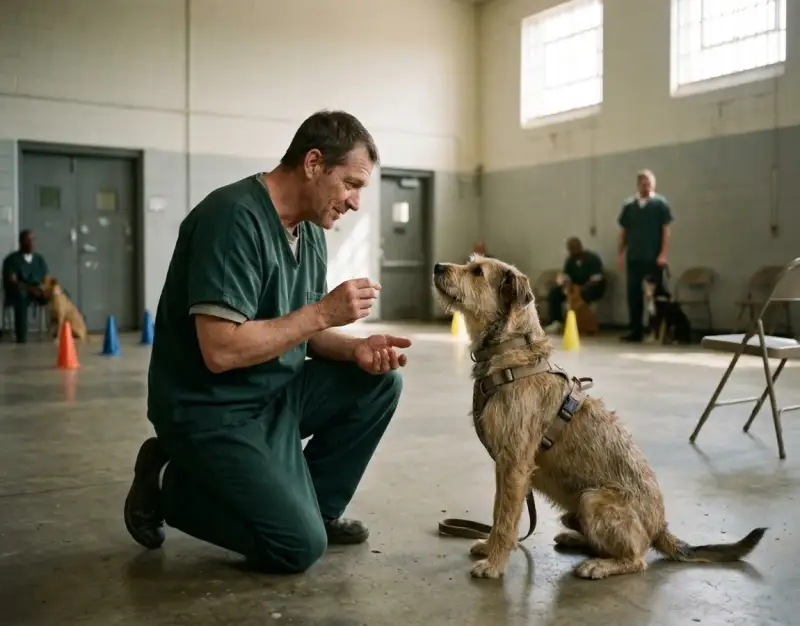
At 5:30 AM inside a maximum-security correctional facility, the standard sounds of heavy steel doors sliding shut and echoes across cold concrete walkways are punctuated by a startlingly gentle noise: the rhythmic thumping of a Golden Retriever’s tail against a cell wall. Inside the six-by-eight-foot room, a man serving a fifteen-year sentence kneels on the floor, holding a clicker in his left hand and a handful of freeze-dried liver treats in his right. He softly speaks a cue, waits for the dog to settle into an attentive lie-down position, clicks, and rewards. For both the man and the dog, this small interaction represents something that traditional correctional frameworks have long failed to provide: an authentic catalyst for psychological redemption, practical skill development, and absolute unconditional trust.
Across the United States and internationally, prison-based animal programs (PAPs)—specifically prison dog training programs (PBDTPs)—have evolved from novel therapeutic experiments into rigorous, evidence-based criminal justice and animal welfare interventions. Every year, municipal animal shelters euthanize hundreds of thousands of adoptable dogs due to behavioral challenges, lack of socialization, or severe overcrowding. Simultaneously, state and federal departments of corrections struggle with skyrocketing recidivism rates, institutional violence, and the profound challenge of turning punitive incarceration into meaningful human rehabilitation. PBDTPs bridge these two crises through a single, highly structured ecosystem that turns correctional institutions into centers of rehabilitation for both species.
What began decades ago as informal, unsanctioned animal care inside prison walls has transformed into a highly sophisticated discipline. Modern programs partner accredited service dog organizations, municipal animal rescues, professional animal behaviorists, and departments of corrections to train shelter dogs for companion roles, service dog placement for veterans with PTSD, or specialized search-and-rescue work. This comprehensive guide examines the operational mechanics, psychological underpinnings, empirical outcomes, and implementation strategies that make prison dog training programs one of the most effective dual-rehabilitation models in modern social reform.
Foundational Principles and Mechanics of Prison-Based Canine Programs
To evaluate the transformative impact of prison dog training programs, one must first understand the operational and psychological mechanics that govern them. At its core, a PBDTP operates by placing a shelter dog—often one facing euthanasia due to minor behavioral defects, high energy, or prolonged shelter stays—into the continuous 24/7 care of an incarcerated handler who has undergone extensive screening and educational preparation. This constant immersion changes the behavioral dynamic for both human and animal in ways that traditional weekly training classes or intermittent shelter volunteering cannot replicate.
The primary psychological mechanism at work is mutual co-regulation. Incarcerated individuals frequently experience chronic hypervigilance, emotional suppression, and relational trauma stemming from both past life experiences and the hostile environment of modern correctional facilities. Shelter dogs suffer from parallel psychological stressors, including kennel stress, isolation, hyper-reactivity, and attachment anxiety. When these two populations are paired under the supervision of certified animal behaviorists, a symbiotic healing process begins. The daily discipline required to train a canine using positive reinforcement (R+) forces the human handler to cultivate patience, emotional regulation, consistency, and empathy—attributes that are rarely encouraged within traditional prison subcultures.
"In animal rehabilitation, you cannot force genuine compliance through intimidation without causing behavioral fallout. The dog reflects your emotional state back to you like a mirror. If you bring anger, anxiety, or inconsistency into the room, the dog fails. To succeed as a handler, an incarcerated individual must first learn to master their own internal state."
This dynamic operates on principles similar to equine-assisted therapies, where large, sensitive animals act as immediate feedback mechanisms for human trauma responses. Much like the therapeutic frameworks detailed in The Healing Power of Equine Therapy: How Horses Help Trauma Survivors Find Their Voice, prison dog training leverages non-verbal communication, boundary setting, and mutual trust building to break through deeply entrenched emotional defense mechanisms.
1. Designing the Institutional Infrastructure and Partnership Architecture
Stakeholder Alignment: Security, Veterinary, and Shelter Integration
Establishing a sustainable prison dog training program requires building an airtight operational bridge between three traditionally distinct entities: correctional administration, animal rescue organizations, and professional veterinary providers. The foundational step involves executing a comprehensive Memorandum of Understanding (MOU) that outlines legal liability, chain of custody for the animals, emergency medical response protocols, and security veto powers. Correctional administration must maintain absolute security oversight, while the partner animal shelter retains final authority over dog adoption placements and welfare standards.
Program success relies on establishing a dedicated Steering Committee comprising the facility Warden, the Chief of Security, a Lead Certified Professional Dog Trainer (CPDT-KA), an attending Veterinarian of Record, and an Inmate Program Coordinator. This committee meets monthly to review program metrics, resolve operational friction, and evaluate handler performance. Clear boundaries prevent security protocols from compromising animal welfare, ensuring that cell inspections, lockdowns, and facility searches account for the safety and psychological well-being of the dogs.
Facility Retrofitting and Environmental Controls
Correctional environments are inherently loud, sterile, and sensory-depriving, presenting unique challenges for housing animals. Successfully introducing canine residents requires structural retrofitting to guarantee hygiene, safety, and acoustic management. Dedicated housing units—often referred to as "Dog Blocks"—are established where handlers and their assigned canines live in adjacent or shared cell accommodations. These units feature slip-resistant rubberized floor runners over concrete to protect canine joints, designated indoor grooming stations, secure food storage lockers equipped with pest-prevention measures, and double-gated outdoor exercise yards.
Acoustic insulation is installed along cell corridors to dampen metal-on-metal echoes and high-decibel intercom announcements that can cause severe noise phobias in rescue dogs. Waste management protocols must meet strict public health standards, including designated biohazard disposal zones, regular veterinary sanitization using non-toxic veterinary-grade disinfectants, and strict schedules for relief walks. By designing an environment tailored to canine health, the facility minimizes stress-induced behaviors like chronic barking, kennel reactivity, and gastrointestinal distress.
2. Inmate Handler Selection, Screening, and Rigorous Vetting
Multi-Phase Application and Psychological Screening
Participation in a prison dog program is a privilege earned through rigorous screening rather than an automatic entitlement. The handler selection process uses a multi-tier vetting system to ensure security compliance, safety, and long-term commitment. Applicants must submit a comprehensive written application detailing their motivation, past institutional conduct, educational goals, and emotional readiness. Eligibility guidelines strictly exclude individuals with histories of animal cruelty, sexual offenses, domestic violence, or violent institutional infractions within a mandatory 24-to-36-month window.
Following initial record clearing, candidates undergo a battery of psychological evaluations administered by facility mental health staff. These assessments evaluate emotional stability, impulse control, frustration tolerance, and capacity for empathy. The final phase involves an intensive oral interview before the Steering Committee. Successful candidates sign a behavioral code of conduct that stipulates automatic removal from the program for any security infraction, poor animal care, or lack of engagement with educational coursework.
The Tiered Mentorship and Apprentice Structure
To foster long-term program sustainability and internal leadership, top-tier PBDTPs utilize a progressive, multi-level hierarchy of handler roles. Incoming participants do not immediately receive full responsibility for a dog; instead, they enter as "Apprentice Handlers" under the direct supervision of experienced "Primary Handlers" and "Master Handlers." This structure ensures continuous peer-led education and immediate support when handling complex canine behaviors.
- Apprentice Handler (Months 0–6): Completes theoretical coursework in canine ethology, learning theory, and health mechanics. Responsible for kennel sanitation, grooming assistance, and observing live training sessions without direct handling authority.
- Secondary Handler (Months 6–12): Co-houses with a Primary Handler. Manages relief walks, basic feeding schedules, and executes basic obedience maintenance under direct supervision.
- Primary Handler (Months 12–36): Assumes full 24/7 care and training responsibility for an assigned rescue or service candidate dog. Executes individualized training plans and maintains daily logging logs.
- Master Handler / Peer Educator (36+ Months): Advanced trainers who have successfully graduated multiple dogs. Assists professional trainers in teaching coursework to Apprentices and oversees program operations during off-hours.
3. Canine Intake, Behavioral Assessment, and Matching Protocols
Shelter Selection and Temperament Evaluation
Not every dog in a municipal shelter is suitable for a correctional environment. Selection requires systematic temperament evaluations conducted by certified animal behaviorists inside partner shelters before intake. Candidates are evaluated using standardized testing batteries, such as the Volhard Dog Aptitude Test or SAFER (Safety Assessment for Evaluating Rehoming), modified for prison conditions. Evaluators look for high sociability toward humans, moderate-to-low environmental sensitivity, absence of resource guarding, and low impulse reactivity.
Dogs demonstrating unprovoked aggression toward humans, severe dog-on-dog aggression, or untreatable separation anxiety are excluded from standard programs. Ideal candidates include high-energy dogs that struggle in standard shelter kennels, animals needing long-term medical or physical rehabilitation, and rescue dogs demonstrating the baseline focus, drive, and biddability required for specialized service work (e.g., PTSD service dogs for military veterans).
Individualized Canine Education Plans (ICEP)
Upon entering the facility, every dog undergoes a mandatory 14-day quarantine and acclimatization period. During this time, the attending veterinarian conducts a comprehensive medical examination, while the Lead Trainer crafts an Individualized Canine Education Plan (ICEP). The ICEP establishes specific, measurable baseline goals for the dog's 12-to-24-week stay in the program.
The ICEP maps directly out from baseline markers to advanced skills, utilizing task-oriented milestones:
- Acclimatization Phase: Desensitization to mechanical door noises, uniform colors, keys jingling, and crowded concrete walkways. Establishing crate comfort and positive association with the primary handler.
- Basic Foundation Phase: Mastery of the American Kennel Club (AKC) Canine Good Citizen (CGC) skills, including loose-leash walking, sit-stay, down-stay, recall under distraction, and polite greeting.
- Specialized Track Phase: Advanced task training tailored to the dog’s designated outcome—whether that is adoption as a well-mannered family companion, entry into a service dog organization for post-traumatic stress tasking, or facility support work.
4. Curriculum Execution: Positive Reinforcement and Operant Conditioning
Scientific Methodologies and Marker Training
Modern prison dog training programs rely exclusively on force-free, positive reinforcement (R+) techniques based on behavioral science and operant conditioning. Aversive tools such as prong collars, choke chains, and electronic shock devices are strictly prohibited due to their potential to cause behavioral fallout, increase stress-induced aggression, and reinforce punitive power dynamics within the facility. Handlers receive extensive theoretical instruction on the four quadrants of operant conditioning, learning how to use clickers and verbal markers to capture, shape, and lure desired behaviors.
By learning how to break complex tasks down into incremental micro-steps, handlers develop critical cognitive skills. They learn to view behavior not through a lens of "dominance" or "stubbornness," but as a functional response to environmental antecedents and consequences. When a dog fails to perform a cue, the handler is taught to adjust their criteria, improve their timing, or change their reward delivery—a practice that translates directly into enhanced personal accountability and emotional maturity.
This systematic approach to human and animal transformation parallels grassroots social initiatives operating in other challenging environments. Just as dedicated community workers mobilize basic resources to preserve dignity on the streets—as observed in Midnight Soup Kitchens: The Invisible Workforce Keeping Our Houseless Neighbors Alive—prison dog programs leverage structured care and micro-interventions to restore value to lives that society has largely written off.
Desensitization and Environmental Exposure
A primary hurdle in preparing prison-trained dogs for civilian life or service work is the artificial nature of the prison environment. Facilities lack civilian sights and sounds like vehicle traffic, children playing, lawnmowers, glass doors, and varied floor textures. Program curricula incorporate systematic desensitization protocols to address these sensory gaps.
Handlers use audio soundboards featuring thunderstorms, sirens, and traffic noises paired with high-value food rewards during daily training sessions. Facilities often create specialized "exposure rooms" equipped with civilian furniture, carpeted surfaces, televisions, and stairs to simulate real-world home environments. Regularly scheduled "public access walks" within secure, non-residential areas of the facility—such as administrative offices, educational wings, and visitor centers—allow dogs to practice polite behavior around unfamiliar civilians, children, and varying environmental stimuli.
5. Transition Planning: Graduation, Adoption, and Reentry Systems
Graduation Ceremonies and Adoption Placement
The culmination of a 12-to-24-week training cycle is the formal graduation ceremony—an event of profound symbolic and practical importance for the handlers, facility staff, and broader community. Families of handlers, prospective adopters, media representatives, and correctional leadership gather inside the facility to witness handlers showcase their dogs' skills. Handlers present formal demonstrations of obedience, mobility tasks, or emotional support maneuvers before handing the dog’s leash over to their new adoptive family or service client.
This ceremony provides incarcerated individuals with a rare, public moment of redemption and positive recognition. Handlers craft detailed "transition journals" for the adopters, detailing their dog’s specific cues, daily routines, favorite reward items, quirky habits, and emotional triggers. This comprehensive transfer of knowledge ensures high adoption retention rates and minimizes post-adoption behavioral regressions.
The core ethos of converting overlooked shelter animals and marginalized human populations into high-value community assets reflects a broader societal shift toward sustainable resource recovery. This approach shares striking conceptual parallels with ecological circularity, such as the solutions featured in From Trash to Treasure: The Zero-Waste Innovators Cleaning Up the World's Oceans, where discarded materials are reclaimed and transformed into valuable environmental solutions.
Post-Release Vocational Pathways for Inmates
The ultimate goal of any correctional program is reducing post-release recidivism by equipping returning citizens with marketable skills and employment pathways. PBDTPs achieve this by offering formal, industry-recognized certifications to incarcerated handlers prior to release. Participants earn credentials such as the Certified Professional Dog Trainer (CPDT-KA) candidate status, American Kennel Club CGC Evaluator status, or certifications in commercial pet grooming and veterinary assistance.
Forward-thinking departments of corrections collaborate with national pet industry networks, veterinary hospitals, service dog foundations, and commercial boarding facilities to create direct employment pipelines for program graduates upon release. Reentry coordinators assist handlers with resume building, portfolio development detailing their handling hours, and apprenticeships with civilian professional trainers. By translating institutional time into verifiable professional expertise, returning citizens gain financial independence and a meaningful career path within the rapidly expanding multi-billion-dollar pet care sector.
Real-World Case Studies & Operational Scenarios
To understand the practical impact of these programs, we can look at two contrasting implementation scenarios: a highly successful, fully integrated program versus a poorly structured pilot program.
Case Study 1: The Horizon Correctional Canine Initiative (Successful Model)
Facility Context: Maximum-security state penitentiary housing 1,800 adult male residents.
Structure: Partnership with an accredited non-profit service dog organization and a regional open-admission municipal shelter. 30 primary handlers, 30 secondary handlers, 15 apprentice handlers.
Execution: Comprehensive 6-month pre-handling classroom curriculum, force-free training methodology, dedicated housing pod, weekly visits by CPDT-KA master trainers.
Outcomes Over 5-Year Period:
- 184 shelter dogs trained and placed in permanent homes or service roles (96% success rate).
- 0 violent misconduct reports within the dedicated housing unit over 60 consecutive months.
- Participating inmate 3-year recidivism rate dropped from state baseline of 44% down to 8.2%.
- 14 released handlers successfully secured full-time employment in pet care, training, or veterinary medicine within 90 days of release.
Key Insight: Success was achieved by maintaining strict handler selection standards, using positive-reinforcement methodologies, and establishing pre-arranged employment networks for returning citizens.
Case Study 2: The Unstructured Cell-Dog Pilot Program (Suboptimal Model)
Facility Context: Medium-security regional jail facility.
Structure: Informal arrangement with a local rescue; dogs placed directly into general population cells without formal staff training or dedicated behavioral supervision.
Execution: Minimal pre-screening of handlers, lack of standardized training curriculum, reliance on correction officers with no animal handling experience to resolve training issues.
Failures & Fallout:
- Resource guarding issues emerged in cells due to lack of handler education, resulting in minor dog bite incidents.
- Inconsistent training techniques between shifts caused severe canine confusion and increased anxiety-based barking.
- Facility staff viewed the program as an extra administrative burden rather than a security asset, leading to friction and eventual program suspension within 8 months.
Lessons Learned: PBDTPs cannot function as passive, unmonitored activities. They require professional behavioral leadership, staff buy-in, and clear protocols to maintain safety and efficacy.
Critical Mistakes and How to Avoid Them
Implementing a prison-based dog program presents operational challenges across security, animal welfare, and administration. Below are the five most costly mistakes programs make and the exact strategies to prevent them.
-
Bypassing Rigorous Inmate Screening for Speed:
The Mistake: Rushing the intake process to meet quotas, leading to the placement of dogs with individuals lacking emotional stability or facing unresolved disciplinary issues.
Countermeasure: Enforce a non-negotiable 90-day observation period for all applicants, multi-disciplinary review board sign-offs, and mental health screenings prior to handling duties.
-
Failing to Educate and Gain Buy-In from Correctional Officers:
The Mistake: Treating line officers as security monitors rather than valued stakeholders, leading to resentment, friction, and security delays.
Countermeasure: Conduct mandatory canine handling orientation for all staff working in dog-housing units. Allow officers to participate in handler graduation events and recognize their role in keeping the program safe.
-
Permitting Aversive or Dominance-Based Training Techniques:
The Mistake: Allowing physical corrections, alpha rolls, or choke chains, which can trigger defensive aggression in shelter dogs and reinforce coercive power dynamics in handlers.
Countermeasure: Mandate force-free positive reinforcement protocols. Conduct random checks during training sessions and immediately suspend handlers who use physical intimidation.
-
Ignoring Long-Term Reentry and Career Pipeline Planning:
The Mistake: Focusing exclusively on in-facility training without building civilian job pathways for handlers post-release.
Countermeasure: Partner with commercial pet brands, service dog agencies, and vocational schools to provide certified credentials, apprenticeship hours, and post-release job placements.
-
Inadequate Emergency Veterinary and Hygiene Protocols:
The Mistake: Failing to establish clear protocols for off-hours veterinary medical emergencies or contagious disease outbreaks (e.g., kennel cough, parvovirus).
Countermeasure: Maintain a 24/7 on-call agreement with an emergency veterinary hospital, establish an isolation cell for health quarantines, and mandate strict daily sanitation logs.
Comprehensive Comparison of Prison Dog Program Models
Different institutional environments require tailored program formats. The table below compares the four primary operational models used in modern corrections.
| Program Model | Average Duration | Primary Canine Target Outcome | Handler Recidivism Impact | Resource & Cost Intensity | Average Success Rate |
|---|---|---|---|---|---|
| Shelter-to-Home Companion (AKC CGC Track) | 8 to 12 Weeks | Adoptable companion animal with basic manners and social skills. | Moderate (15–20% reduction) | Low to Moderate | 88% – 95% Adoption Success |
| Advanced Service Dog Foundation (PTSD/Mobility) | 12 to 24 Months | Specialized service placement for veterans, first responders, or disabled individuals. | High (30–40% reduction) | High (Requires specialized CPDT-KA supervision) | 75% – 85% Placement Success |
| Vocational Grooming & Boarding Track | 16 to 24 Weeks | Commercial pet trade skill acquisition (grooming, handling, management). | Very High (Direct job placement match) | Moderate (Requires equipment investment) | 90% Employment Rate Post-Release |
| Short-Term Respite & Hospice Care | Variable (Ongoing) | Comfort and end-of-life care for elderly or medically fragile shelter animals. | Moderate (Focuses on empathy and emotional healing) | Low (Focuses on medical maintenance) | 100% Care Quality Compliance |
Frequently Asked Questions (FAQs)
How are incarcerated individuals selected for dog training programs, and what disqualifies them?
Incarcerated participants
Be the first to share a gentle reflection on this story.