
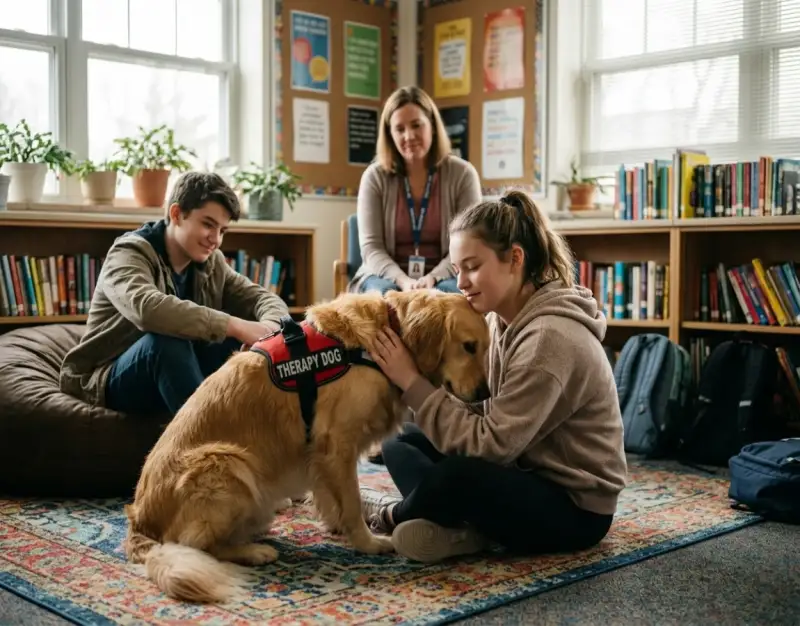
Walk into a modern secondary school today, and the invisible hum of adolescent stress is almost palpable. Students navigate an intricate labyrinth of high-stakes academic testing, relentless college admissions competition, peer pressure fueled by hyper-connected social media landscapes, and broader socio-economic uncertainties. Educational psychologists, counselors, and administrators have watched anxiety rates climb steeply over the past decade, transforming routine school environments into high-pressure incubators of emotional distress. Traditional intervention models—often relegated to periodic talk therapy sessions in distant guidance offices—frequently struggle to reach students before clinical crises manifest. Yet, in classrooms across the globe, a quiet, four-legged revolution is unfolding, proving that profound emotional healing often begins not with a clinical consultation, but with a warm nose, a wagging tail, and an unconditional presence.
The integration of canine companions into academic institutions represents a paradigm shift in how educational systems conceptualize student welfare. Rather than viewing mental health support as an isolated, reactive measure, forward-thinking schools are weaving animal-assisted interventions directly into the fabric of daily campus life. This movement goes far beyond a casual "bring your pet to school" day; it is a rigorously structured, evidence-based pedagogical and therapeutic framework. By harnessing deep-seated biological mechanisms that govern human animal bonds, schools are discovering that trained therapy dogs can bypass the emotional defenses of troubled youth, unlocking avenues for communication, emotional regulation, and academic resilience that conventional desks and textbooks simply cannot reach.
As this movement matures, the conversation has shifted from questioning whether dogs belong in schools to examining how to implement and scale these programs responsibly. Establishing a sustainable canine-assisted support ecosystem requires navigating complex logistical hurdles—ranging from allergy management and veterinary health protocols to handler certification and financial budgeting. Throughout this comprehensive exploration, we will dissect the physiological underpinnings, strategic implementation blueprints, real-world case studies, and critical pitfalls of bringing therapy dogs into educational spaces. Whether you are an educator, parent, or school administrator, understanding this dynamic intervention is the first step toward transforming student anxiety relief into an everyday reality.
The Neurobiological Foundation: How Canine Companions Alter Stress Responses
To fully appreciate the efficacy of therapy dogs in education, one must first examine the hard science operating beneath the surface of human animal bonds. When a student interacts with a calm, well-socialized canine, a cascade of rapid neurochemical shifts occurs within the human brain. The physical act of petting, stroking, or simply sitting in close proximity to a dog stimulates the release of oxytocin—often referred to as the "bonding hormone." This powerful neurotransmitter counteracts the physiological effects of cortisol and adrenaline, the primary chemical drivers of the human stress and fight-or-flight response.
The Chemistry of Calming: Oxytocin, Cortisol, and Heart Rate Variability
Clinical studies consistently demonstrate that spending as little as ten minutes with a therapy dog can significantly lower a student’s baseline blood pressure and stabilize heart rate variability. For adolescents grappling with generalized anxiety disorder or acute panic, this biological interruption of the stress cycle is life-changing. When cortisol levels drop, the prefrontal cortex—the brain region responsible for executive functioning, emotional regulation, and rational decision-making—reactivates, allowing students to step back from emotional overwhelm and engage constructively with their learning environment.
Furthermore, this physiological soothing occurs without the social stigma often attached to clinical interventions. Walking into a counselor’s office can carry an invisible weight for a teenager worried about peer perception. Conversely, walking a therapy dog down a hallway or sitting beside one during a reading lesson is universally celebrated. This normalization of mental health support dissolves apprehension, turning a clinical intervention into a welcoming, shared experience that builds trust and communal safety.
Breaking Through Communication Barriers via Animal-Assisted Interventions
For students on the autism spectrum, those experiencing selective mutism, or adolescents recovering from severe trauma, traditional verbal therapy can feel threatening and invasive. Therapy dogs act as a non-judgmental social bridge. Dogs do not evaluate, criticize, or misunderstand verbal slips. This unconditional acceptance allows hesitant learners to practice communication skills in a safe environment. Instructors often find that students who refuse to speak to adults will readily read aloud to a therapy dog, treating the animal as a patient, confidential audience.
This dynamic mirrors how we build deep empathy in other relational spheres. Just as The Art of Active Listening: How Deep Empathy Can Transform Broken Relationships teaches us to quiet our own internal noise to truly hear another person, interacting with a therapy dog forces humans to slow down, read subtle non-verbal cues, and practice mindful presence. The dog becomes a living masterclass in emotional attunement, teaching students how to listen with their hearts rather than just their ears.
Step-by-Step Blueprint: Designing a School Therapy Dog Program
Introducing a therapy animal into a bustling school cannot be left to chance. It demands a meticulous, multi-phase strategic planning process that protects the safety and well-being of both the students and the animal. Educational leadership must approach this initiative with the same rigor applied to any major curriculum overhaul, establishing clear goals, operational policies, and evaluation metrics before a single paw enters the building.
Phase One: Needs Assessment, Stakeholder Buy-In, and Policy Formation
The foundational step of any successful program is conducting a thorough school-wide needs assessment. Administrators must evaluate specific metrics: Where is student anxiety manifesting most acutely? Are attendance rates dropping in specific grades? Which classrooms or counseling suites would benefit most from animal-assisted support? Gathering this baseline data ensures that the therapy dog program targets genuine pain points rather than merely following a trendy educational fad.
Once data is compiled, securing buy-in from all stakeholders—teachers unions, school board members, parents, and custodial staff—is paramount. Town hall meetings should be held to address common concerns head-on, including allergies, phobias, religious objections, and sanitary protocols. Clear, comprehensive policies must be drafted, outlining precisely where the dog is permitted to go, who is authorized to handle the animal, and what steps will be taken if a student experiences an allergic reaction or displays an unmanaged fear of dogs.
Phase Two: Selecting the Right Dog and Certified Handler Team
Not every friendly family pet is cut out for the dynamic, unpredictable environment of a modern school. School support animals require specialized temperament testing. Ideal candidates exhibit high frustration tolerance, resilience in loud or chaotic environments (such as crowded hallways during class changes), and absolute gentleness when interacting with children of varying sizes and temperaments. Breeds commonly utilized include Labrador Retrievers, Golden Retrievers, Standard Poodles, and various meticulously bred mixed-lineage dogs.
Equally important is the certification of the handler. Whether the handler is a school counselor, psychologist, or a dedicated volunteer, they must hold current credentials from reputable organizations such as Pet Partners, Therapy Dogs International (TDI), or the Alliance of Therapy Dogs. The handler must be capable of reading the dog's subtle stress signals—such as yawning, lip-licking, or excessive panting—ensuring the animal never works past its endurance threshold.
Integrating Dogs into Special Education and Behavioral Intervention Plans
While school-wide presence boosts general campus morale, therapy dogs deliver some of their most profound breakthroughs within specialized education settings. Students with Individualized Education Programs (IEPs) or Behavioral Intervention Plans (BIPs) often experience intense daily dysregulation. Incorporating structured canine interactions into these specialized frameworks yields measurable improvements in behavioral compliance, emotional self-control, and academic engagement.
Targeted De-Escalation and Sensory Regulation Strategies
When a student begins to spiral into a behavioral crisis—exhibiting aggression, defiance, or profound withdrawal—standard disciplinary measures often escalate the situation. By contrast, the introduction of a trained therapy dog provides an immediate somatic anchor. Trained intervention specialists utilize a protocol known as "mindful anchoring," where the distressed student is invited to sit quietly with the dog, focus on the animal's rhythmic breathing, and practice tactile grounding by brushing its coat.
This process lowers physiological arousal within minutes, redirecting volatile energy into focused, nurturing attention. Teachers report that students who previously required prolonged removal from the classroom via in-school suspensions are able to self-regulate and return to academic tasks much faster when animal-assisted de-escalation is integrated into their BIPs.
Motivating Reluctant Learners and Enhancing Attendance
Chronic absenteeism is one of the most stubborn challenges facing educational institutions today. Schools implementing therapy dog programs frequently report a noticeable uptick in morning attendance, particularly among students who suffer from school refusal driven by severe anxiety. Knowing that "Barnaby" or "Luna" is waiting by the front entrance to greet them provides a powerful, positive psychological pull that motivates anxious learners to cross the school threshold.
Furthermore, teachers leverage the presence of the therapy dog as an incentive for academic effort. Completing complex math problems, participating in group discussions, or finishing reading assignments can be tied to earning "read-with-the-dog" time. Just as Kindness in Action: We Surprised a Overworked Nurse With the Ultimate Day of Relaxation demonstrates the restorative power of unexpected appreciation, rewarding struggling students with undivided canine companionship validates their hard work and reframes school as a place of joy rather than pressure.
Addressing Health, Safety, and Logistical Challenges
Skeptics often raise valid logistical concerns regarding cleanliness, allergies, and safety when considering animals in schools. Dismissing these concerns is a critical error; instead, they must be met with rigorous, proactive management protocols that satisfy public health standards and community peace of mind.
Sanitation, Hygiene, and Allergen Management Protocols
Maintaining a pristine school environment while hosting animals requires strict adherence to veterinary and sanitary guidelines. Therapy dogs must be on rigorous parasite control regimens, undergo regular veterinary health checks, and maintain up-to-date vaccinations. Grooming routines—including weekly baths and daily brushing—minimize shedding and dander accumulation.
Schools should designate specific "dog-free zones" (such as designated severe allergy classrooms or specific dining halls) for students with medical exemptions. Additionally, HEPA air purifiers can be installed in counseling offices or reading rooms where the dog spends extended periods, ensuring indoor air quality remains uncompromised for sensitive asthmatic students.
Liability Insurance and Risk Mitigation Frameworks
Administrative due diligence requires robust legal preparation. School districts must consult with legal counsel and insurance providers to review existing liability policies. Many established therapy dog registries provide supplemental liability insurance that covers certified handler-dog teams while volunteering or working in public facilities. Ensuring these policies are active before program launch protects the school district against unforeseen liability claims.
It is also essential to implement an "opt-out" mechanism for families. While the vast majority of students and parents embrace therapy dogs enthusiastically, families must be given clear notification and the simple right to opt their child out of direct physical contact with the animal if cultural, religious, or personal preferences dictate.
Measuring Success: Data Collection and Program Evaluation
To secure long-term funding, administrative backing, and community trust, school leaders must move beyond anecdotal success stories and gather empirical data proving the value of their therapy dog initiatives. Quantifying the impact of human animal bonds requires a multi-faceted evaluation matrix combining qualitative feedback with hard quantitative metrics.
Tracking Academic, Behavioral, and Attendance Metrics
Effective program evaluation begins by tracking key performance indicators (KPIs) before and after program implementation. Administrators should monitor:
- Attendance Rates: Compare chronic absenteeism numbers for targeted cohort groups before and after dog-assisted interventions were introduced.
- Disciplinary Referrals: Measure reductions in office referrals, in-school suspensions, and behavioral outbursts among participating students.
- Standardized Testing Anxiety Scores: Utilize validated psychological instruments (such as the Revised Children's Manifest Anxiety Scale) to measure pre- and post-test anxiety levels during high-stakes testing windows.
Qualitative Feedback Loops: Student, Teacher, and Parent Surveys
Numbers tell only part of the story; qualitative insights capture the emotional climate of the school. Distributing bi-annual surveys to teachers, students, and parents provides rich context regarding perceived classroom climate improvements, stress reduction, and overall community satisfaction. When teachers report calmer transitions between classes and students express a greater sense of belonging, the qualitative data reinforces the quantitative metrics, creating an unassailable case for program expansion.
Real-World Case Studies: Triumphs and Pitfalls in Educational Settings
Examining practical applications across diverse school districts illuminates the fine line between transformative success and operational failure. Real-world implementations offer invaluable lessons for administrators embarking on this journey.
Case Study A: Oakridge High School’s Comprehensive Wellness Program
At Oakridge High School, a sprawling suburban campus facing rising rates of adolescent depressive disorders, administrators introduced a three-year-old golden retriever named Winston alongside the head school counselor. Rather than restricting Winston to the counseling office, the administration designed a rotational schedule where Winston spent mornings greeting students at the main entrance and afternoons embedded in special education classrooms.
The Results: Over two academic years, Oakridge recorded a 28% drop in unexcused absences among chronically truant students. Furthermore, counselor-initiated conflict mediations dropped by 42%. The presence of Winston provided a neutral focal point that de-escalated peer disputes before they erupted into physical altercations. The key takeaway? Integrating the dog into everyday transit corridors maximizes visibility and community-wide emotional grounding.
Case Study B: A Cautionary Tale of Unstructured Implementation
Conversely, a mid-sized middle school attempted to fast-track a therapy dog program without adequate preparation, allowing a teacher to bring an uncertified, young family dog to school without formal temperament testing or clear administrative protocols. Within three weeks, the experiment collapsed.
The Breakdown: The dog, overwhelmed by the chaotic shifting of middle school hallways, became reactive, barked aggressively at startled students, and accidentally knocked over a student carrying hot lunch trays. The incident triggered parent complaints, insurance anxieties, and immediate cancellation of the program. The Lesson: Skipping professional certification, skipping stakeholder consultation, and utilizing an unverified animal invites disaster. Rigorous preparation is not bureaucratic red tape; it is the essential protective armor of a successful program.
Comprehensive Comparison Table: Traditional Counseling vs. Canine-Assisted Intervention
To help educational leaders and mental health professionals evaluate support methodologies, the following semantic comparison table contrasts traditional counseling models with integrated canine-assisted intervention frameworks.
| Evaluation Metric | Traditional Counseling Model | Canine-Assisted Intervention Model |
|---|---|---|
| Student Approachability | Often viewed with stigma or reluctance due to fear of being labeled. | Universally welcomed; perceived as non-judgmental and prestigious. |
| Physiological Impact | Relies primarily on verbal cognitive processing; slower physiological calming. | Immediate release of oxytocin; rapid reduction of cortisol and blood pressure. |
| Engagement Speed | Requires multiple sessions to build baseline trust and rapport. | Accelerates rapport-building almost instantly through physical touch. |
| Reach & Scalability | Confined strictly to 1-on-1 or small group office settings. | Scalable across entire hallways, classrooms, and school-wide events. |
| Truancy & Attendance | Indirect impact on morning motivation to arrive at school. | Provides a direct, magnetic incentive for anxious learners to arrive early. |
Top 5 Critical Mistakes in School Therapy Dog Programs and How to Avoid Them
Even well-intentioned administrators can stumble when launching animal-assisted programs. Avoiding these five critical missteps ensures your initiative remains safe, sustainable, and impactful.
1. Failing to Screen for Animal Burnout and Stress
The Mistake: Treating the therapy dog as an endless, tireless machine that can work eight continuous hours surrounded by noise, crowds, and high-stress adolescents.
The Countermeasure: Establish mandatory rest periods in a quiet, locked administrative room every 60-90 minutes. Train handlers to read subtle canine stress signals and advocate fiercely for the animal's downtime.
2. Neglecting Comprehensive Community Communication
The Mistake: Springing the therapy dog on students and parents on day one without prior notification, triggering surprise, fear, or unaddressed allergy concerns.
The Countermeasure: Launch a transparent community awareness campaign months prior, offering meet-and-greet sessions, educational materials on human animal bonds, and clear opt-out protocols.
3. Utilizing Uncertified Pets or Informal Handlers
The Mistake: Relying on a teacher's friendly pet without formal obedience certification, liability insurance, or behavioral evaluation.
The Countermeasure: Mandate official registration through recognized bodies like Pet Partners or TDI, ensuring both dog and handler possess documented competency certifications.
4. Lacking Clear Behavioral and Spatial Boundaries
The Mistake: Allowing the dog to roam the school unmonitored or enter cafeterias and science labs where sanitation hazards exist.
The Countermeasure: Enforce strict spatial mapping. The dog must remain under the direct physical or verbal control of its certified handler at all times and be barred from designated food prep and severe allergy zones.
5. Failing to Collect Data to Justify Program Longevity
The Mistake: Running the program purely on "good feelings" without tracking attendance, disciplinary, or anxiety metrics, leaving it vulnerable to budget cuts.
The Countermeasure: Implement a robust data collection matrix from day one, tracking KPIs to demonstrate clear return on investment to school boards and financial stakeholders.
Frequently Asked Questions (FAQ)
What specific breeds make the best school therapy dogs?
While breed alone does not guarantee suitability, Labrador Retrievers, Golden Retrievers, Standard Poodles, and calm mixed-breed rescue dogs are most commonly selected due to their high emotional intelligence, biddability, and stable temperaments. The individual dog's personality, resilience, and socialization history matter far more than pedigree.
How do schools handle students with severe dog allergies or phobias?
Comprehensive safety protocols always include advanced notification and clear opt-out mechanisms. Schools designate specific allergen-free classrooms and install HEPA air purifiers where necessary. If a student has a severe allergy or diagnosed cynophobia (fear of dogs), the therapy dog is strictly restricted from their learning spaces, ensuring their health and emotional comfort are never compromised.
Are therapy dogs covered under school district insurance policies?
Most standard school district liability policies do not automatically cover live animals. Administrators must coordinate with insurance brokers to secure appropriate riders or utilize certified handlers whose national registry organizations (such as Pet Partners) provide supplemental professional liability insurance coverage while volunteering in educational facilities.
How do handlers prevent therapy dogs from becoming exhausted or stressed?
Animal welfare is the top priority in any reputable program. Handlers monitor their dogs continuously for signs of fatigue or sensory overload, such as excessive panting, yawning, sluggish response times, or avoidance behaviors. Mandatory quiet-time breaks in a private, secure office are scheduled throughout the day to allow the dog to decompress.
Can therapy dogs assist students with severe learning disabilities or autism?
Yes. Therapy dogs excel in special education environments. They provide non-judgmental social companionship, act as tactile calming anchors during sensory meltdowns, and motivate reluctant learners to engage in reading, speech therapy, and collaborative classroom activities.
Strategic Roadmap and Final Takeaway
As we look toward the next two to five years, the integration of therapy dogs into educational institutions is poised to transition from an innovative novelty to a gold-standard pillar of holistic student wellness. Educational policy is increasingly recognizing that academic excellence cannot be divorced from emotional well-being. By harnessing the profound, scientifically validated power of human animal bonds, schools are dismantling the barriers of adolescent anxiety and replacing them with environments rooted in trust, safety, and unconditional acceptance.
The path forward requires unwavering commitment to rigorous standards: certified handler-dog teams, meticulous safety and sanitation protocols, data-driven evaluation, and deep respect for animal welfare. For school administrators, educators, and communities willing to invest the necessary planning and care, the rewards are immeasurable. When a stressed teenager drops their shoulders, breathes deeply, and smiles while resting their hand on a gentle companion's head, the entire educational ecosystem heals. Embrace this movement, plan with precision, and watch your school transform into a sanctuary where students truly thrive.
Be the first to share a gentle reflection on this story.