
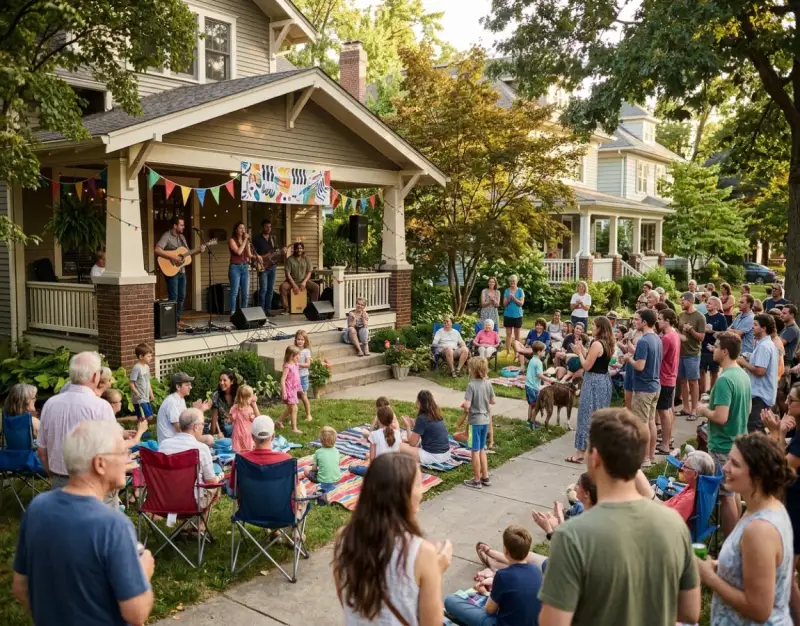
In an era defined by rapid urbanization, digital hyper-connectivity, and an unprecedented epidemic of social isolation, modern neighborhoods frequently suffer from a persistent deficit of meaningful interpersonal interaction. While suburban sprawl and high-rise developments have expanded the physical footprint of human settlement, they have simultaneously eroded the organic social fabric that historically bound neighbors together. The front porch—once a ubiquitous architectural bridge between private domesticity and public civic life—spent decades relegated to a decorative after-thought. However, a quiet yet potent cultural renaissance is currently reclaiming this transitional space. The porch fest movement has emerged as one of the most remarkable grassroots catalysts for uplifting communities, converting ordinary residential streets into vibrant, decentralized performance spaces that restore social cohesion through shared musical experiences.
What began in 2007 in the historic Thompson Park neighborhood of Ithaca, New York—conceived by residents Gretchen Hildreth and Lesley Greene—has blossomed into an international phenomenon. Today, hundreds of towns and cities across North America and beyond host annual neighborhood music festivals built upon this elegant, low-barrier paradigm. Unlike commercial music festivals characterized by expensive ticketing, rigid perimeter fencing, corporate sponsorship, and security checkpoints, Porch Fest operates on principles of radically democratic access, gift economics, and spatial hyper-locality. The mechanics are elegantly simple: local musicians perform unamplified or minimally amplified sets on front porches, verandas, lawns, and driveways, while neighbors and visitors stroll from yard to yard, lawn chairs and picnic blankets in hand, taking in diverse artistic expressions.
The profound success of Porch Fest lies not merely in its entertainment value, but in its ability to fundamentally alter how individuals perceive and experience their immediate geography. By temporality recalibrating public rights-of-way—turning asphalt streets into pedestrian boulevards and private yards into public auditoriums—the event breaks down long-standing social barriers. It incentivizes face-to-face dialogue among multigenerational residents, fosters deep-seated neighborhood pride, and creates an environment where civic trust can flourish naturally. This article serves as an authoritative, exhaustive blueprint for civic organizers, urban planners, block association leaders, and passionate residents seeking to launch, scale, and sustain a transformative Porch Fest in their own municipalities.
Foundational Principles & Mechanics of the Porch Fest Movement
To successfully organize a neighborhood Porch Fest, one must first master the underlying socioeconomic and spatial principles that govern these events. Porch Fest is not simply a series of outdoor concerts; it is an exercise in tactical urbanism and relational infrastructure. At its core, the framework relies upon four foundational pillars: Spatial Democratization, Acoustic Decentralization, Micro-Venue Economics, and Hyper-Local Social Capital.
Spatial Democratization refers to the intentional shifting of cultural power from centralized, commercial venues (such as arenas, bars, or corporate amphitheaters) into residential spaces accessible to all community members regardless of socioeconomic status. When a front porch is designated as a stage, the traditional hierarchy between performer and spectator collapses. The physical elevation of the porch provides sightlines without creating emotional or financial distance, transforming passersby into an active, welcoming audience.
Acoustic Decentralization ensures that sound is distributed across a broad geographical grid rather than concentrated in a single, high-decibel focal point. By scattering dozens of low-volume performances across multiple blocks, organizers eliminate the overwhelming auditory strain of traditional festivals. This layout creates an ambient, walking-scale soundscape where acoustic folk, jazz ensembles, indie rock bands, classical string quartets, and spoken-word artists can coexist harmoniously within a few city blocks of one another.
Micro-Venue Economics operates primarily on a volunteer and gift-economy basis. Hosts donate the temporary use of their porches and electrical outlets; musicians donate their artistic talents or perform for crowdsourced tips and merchandise sales; and organizers provide administrative logistics without charging admission fees. This non-commercial ethos shields the festival from speculative financial interests, preserving its authentic, community-first identity.
Finally, Hyper-Local Social Capital serves as both the fuel and the primary yield of the event. Sociological research demonstrates that high-trust communities exhibit lower crime rates, greater disaster resilience, and higher overall well-being. Porch Fest generates social capital by facilitating "weak ties"—casual, low-stakes interactions between acquaintances and neighbors who might otherwise live in isolated proximity. Over time, these weak ties solidify into robust support networks that enhance long-term community resilience.
Phase 1: Community Mapping and Stakeholder Coalition Building
Identifying Neighborhood Geography and Host Venues
The inaugural phase of planning requires a thorough spatial analysis of the target neighborhood. Organizers should select a geographical area that is densely built, highly walkable, and rich in residential structures featuring front porches, elevated decks, or spacious stoops. Historic districts, late-19th-century streetcar suburbs, and bungalow neighborhoods are ideal candidates due to their compact lot sizes and intimate setback distances from the sidewalk.
Begin by establishing a digital mapping team to plot potential host properties. Walk or bike the neighborhood streets to assess physical attributes: sidewalk width, tree canopy shade, street slope, sightlines, and proximity to major vehicular arteries. Properties located on quiet side streets or residential cul-de-sacs are preferred over high-traffic corridors, as they afford greater pedestrian safety and lower ambient traffic noise. Ensure that host porches are structurally sound and capable of supporting musical equipment and band members safely.
Engaging Local Artists and Performing Talent
A successful Porch Fest reflects the rich, multifaceted cultural tapestry of its surrounding area. Curation should prioritize radical inclusion over commercial polish, welcoming amateur student groups, garage bands, senior choirs, and seasoned professional artists alike. Open registration portals should be launched at least four to six months prior to the event date, allowing artists to submit their genre, technical setup requirements, and preferred time slots.
Organizers must actively reach out to historically underrepresented musical traditions within the city, ensuring that the lineup features genres ranging from hip-hop and bluegrass to traditional folk, gospel, classical, and world music. Recognizing the intrinsic value of artistic labor, organizers should encourage attendees to tip performers generously via digital QR codes displayed at each porch and direct cash contributions. Highlighting stories of localized creative impact—much like the inspiring narrative detailed in Kindness in Action: We Bought a Dream Musical Instrument for a Talented Street Musician—reinforces the core mission of uplifting local talent through direct, community-driven support networks.
Phase 2: Permitting, Municipal Coordination, and Risk Management
Navigating Local Ordinances, Sound Bypass, and Street Closures
While Porch Fest champions a grassroots DIY aesthetic, seamless execution requires rigorous coordination with municipal authorities. Organizers should initiate formal conversations with municipal departments—including Parks and Recreation, Public Works, Transportation, and City Planning—at least six months in advance. The central legal objective is securing appropriate special event permits, amplified sound permits, and temporary street closure authorizations.
When presenting the event concept to city councils or police boards, frame Porch Fest as a low-impact, high-benefit civic initiative that enhances municipal reputation and drives local tourism. Work directly with traffic engineering departments to establish temporary "Pedestrian Priority Zones" or complete road closures for key festival corridors. Closing streets to vehicular traffic dramatically increases pedestrian safety, accommodates mobility devices and strollers, and prevents traffic congestion caused by gawking motorists.
Implementing Comprehensive Public Safety and Insurance Protocols
Risk management is an indispensable aspect of event stewardship. Organizers must secure an umbrella Commercial General Liability (CGL) insurance policy tailored for community-wide outdoor events. This policy should explicitly cover bodily injury, property damage, and spectator liability across both public rights-of-way and private residential spaces participating in the festival.
In addition to insurance, establish a robust public safety plan in consultation with local emergency services. Designate clear emergency vehicle access lanes along closed streets, deploy certified volunteer first-aid monitors equipped with basic medical kits and communication radios, and establish centralized information hubs equipped with lost-and-found services, hydration stations, and emergency contact registries.
Phase 3: Acoustic Engineering and Spatial Scheduling
Decibel Staggering and Sound Bleed Mitigation
One of the most complex logistical challenges in executing a high-density neighborhood music festival is acoustic management. Sound bleed—when audio from one stage bleeds into and disrupts a neighboring performance—can ruin the listener experience and frustrate performing artists. Mitigating this issue requires a meticulous spatial layout and strict decibel limits.
Implement a minimum geographical buffer distance between active stages, ideally placing acts at least three to four houses apart (approximately 150 to 200 feet). Furthermore, angle porch stages strategically: if Host A's porch faces directly east, Host B's porch (located across or down the street) should face north or south to direct sound waves away from each other. Limit amplification to low-wattage PA systems, portable acoustic amplifiers, or strictly unamplified acoustic instrumentation wherever possible.
Algorithmic Timetable Optimization Across Neighborhood Zones
To maintain balanced crowd movement and prevent overwhelming overcrowding on specific blocks, organize the festival schedule into structured time blocks (e.g., 1-hour performance slots running from 12:00 PM to 6:00 PM). Avoid scheduling two high-profile, high-attendance acts on adjacent porches during the same time block.
Utilize a staggered scheduling pattern where odd-numbered blocks host performances during the top of the hour (e.g., 1:00 PM - 2:00 PM) while even-numbered blocks host performances on the half-hour (e.g., 1:30 PM - 2:30 PM). This creates natural pedestrian flow as crowds migrate organically between performance nodes, distributing foot traffic evenly across the entire festival footprint.
Phase 4: Volunteer Mobilization and Grassroots Logistics
Establishing Block Captains and Neighborhood Liaisons
Decentralized leadership is the key to scaling a Porch Fest without burning out core organizers. Divide the festival boundary into geographical clusters of 4 to 8 blocks, assigning a dedicated "Block Captain" to each sector. Block Captains serve as localized operational hubs, managing porch host logistics, supporting artists during setup, and monitoring neighborhood conditions in real time.
Block Captains conduct pre-event briefings with porch hosts to review guidelines regarding electrical safety, crowd management on lawns, trash removal, and decibel compliance. On event day, they wear high-visibility branded vests and serve as the primary point of contact for emergency responders, municipal inspectors, lost attendees, and local residents.
Logistics of Sanitation, Hydration, and Accessibility
Mass gatherings generate logistical demands that require proactive infrastructure. Organizers must deploy temporary portable restroom facilities—including ADA-compliant, wheelchair-accessible units—distributed strategically at 300-yard intervals throughout the festival area. Contract with municipal sanitation departments or private vendors to provide additional recycling and compost receptacles alongside standard trash bins.
Hydration stations are equally critical. Partner with local municipal water authorities or community organizations to install free water-refilling units, reducing single-use plastic waste. Ensure that all primary pedestrian pathways maintain a minimum 36-inch clear path to accommodate wheelchair users, mobility scooters, and strollers, fulfilling the commitment to inclusive community access.
Phase 5: Digital Promotion, Interactive Mapping, and Audience Engagement
Building Geo-Located Mobile Maps and Digital Schedules
In the digital age, attendee navigation relies heavily on real-time, interactive tools. Develop a mobile-responsive web platform or integrate custom Google Maps layers containing real-time schedule information, artist bios, porch addresses, genre filters, and accessibility indicators.
Attendees should be able to filter the online map by genre (e.g., "Jazz," "Folk," "Kids/Family"), accessibility features (e.g., "Wheelchair Accessible Lawn"), or performance time slot. Print physical pocket maps on recycled paper for distribution at info booths, catering to demographics who prefer analog navigation or wish to limit smartphone usage during the event.
Cultivating Inclusive Outreach and Civic Participation
A truly transformative Porch Fest reaches beyond artistic aficionados to actively engage youth, marginalized populations, and civic groups. Integrate youth leadership teams to assist with event logistics, stage management, and digital content creation. This intergenerational model reflects modern trends in civic infrastructure where youth empowerment and restorative community principles converge.
By offering young people meaningful roles in neighborhood governance and event production, organizers build long-term civic capacity. This philosophy mirrors the transformative principles explored in Social Change Agents: How Student-Led Restorative Justice Is Replacing School Suspensions, demonstrating how decentralized, youth-empowered frameworks cultivate deep ownership, empathy, and collective responsibility within local ecosystems.
Phase 6: Post-Event Stewardship and Year-Round Community Building
Measuring Social Impact and Resident Feedback Loops
The conclusion of performance hours marks the beginning of the post-event evaluation phase. Immediately following the festival, launch a comprehensive multi-stakeholder survey targeting porch hosts, performing artists, local business owners, residents, and general attendees. Quantitative metrics should measure total attendance, local merchant revenue lift, artist tips earned, and volunteer retention rates.
Equally critical are qualitative indicators of social capital development: Did residents interact with neighbors they had never met before? Do attendees feel a heightened sense of belonging and safety in their neighborhood? Collect detailed narrative feedback to identify pain points, operational bottlenecks, or geographic areas requiring refined sound management in subsequent years.
Transforming Temporary Magic into Permanent Infrastructure
A single day of music should serve as the launchpad for sustained community transformation. Use the momentum generated by Porch Fest to establish permanent neighborhood initiatives, such as seasonal street block parties, community gardens, tool-sharing cooperatives, or public art installations.
Just as pioneering sustainable developments repurpose local resources to construct lasting civic monuments—exemplified by Global Goodness: The School Built entirely From Recycled Plastic Bottles—community organizers can leverage the social infrastructure of Porch Fest to champion permanent urban greening, traffic calming, and accessible public assembly spaces that enrich civic life year-round.
Real-World Case Studies & Scenarios
To illustrate the practical application of these theoretical and logistical frameworks, let us analyze two contrasting real-world operational scenarios: baseline community success versus severe operational failure.
Scenario A: The Exemplary Model (Ithaca, NY & Napa, CA Strategies)
In Scenario A, a mid-sized community organizing committee spent nine months preparing for an annual Porch Fest covering 30 residential city blocks. The committee prioritized decentralization, securing 85 host porches and 140 musical acts spanning diverse genres. Streets were fully closed to vehicular traffic under a city-approved Pedestrian Priority Permit. Decibel levels were capped at 85 dB at host property lines, monitored by Block Captains equipped with digital sound level meters.
Outcome: Over 12,000 attendees participated throughout the day with zero reported safety incidents, zero vehicular conflicts, and zero formal noise complaints filed with local police. Local businesses within a three-block radius reported a 240% increase in daily retail and food sales compared to average weekends. Participating musicians collected an estimated average of $180 per hour in direct tips and merchandise sales. Post-event surveys indicated that 94% of resident respondents felt a stronger connection to their community.
Scenario B: The Unregulated Commercialization Trap
In Scenario B, an informal organizing group attempted to launch a Porch Fest in a dense urban neighborhood without municipal permits, designated street closures, or decibel guidelines. High-profile rock bands were scheduled on adjacent front porches simultaneously, utilizing concert-grade amplification systems powered by commercial generators. Organizers failed to engage local municipal authorities or coordinate public safety services.
Outcome: Gridlocked vehicular traffic backed up into residential side streets, blocking an emergency vehicle responding to a medical call on an adjacent avenue. Excessive sound bleed (exceeding 105 dB at the curb) created an uncomfortable auditory environment, prompting over 40 noise complaints to emergency dispatchers. Overcrowding led to damaged private landscaping, trash accumulation, and conflict between hostile property owners and festival attendees. The city council subsequently issued an emergency injunction banning unsanctioned street festivals, severely damaging local civic trust.
Critical Mistakes & How to Avoid Them
-
Mistake: Over-Amplification and Sound Bleed Clashes
The Hazard: Allowing performers to bring arena-sized PA speakers or unattenuated drum kits creates an abrasive wall of noise that degrades the pedestrian experience and irritates neighboring property owners.
Countermeasure: Enforce strict acoustic limits in artist contracts. Mandatory maximum decibel output (e.g., 85 dB at 30 feet) must be enforced by roving Block Captains. Encourage acoustic, semi-acoustic, or battery-powered micro-amplifiers. -
Mistake: Neglecting Pedestrian Priority & Traffic Safety
The Hazard: Allowing motor vehicles to navigate crowded residential streets while pedestrian density is high creates severe safety risks for children, elderly residents, and individuals with disabilities.
Countermeasure: Secure formal municipal street closure permits for high-density corridors. Deploy clear barricades, signposted detour routes, and volunteer traffic marshals to redirect non-resident vehicular traffic safely around the festival zone. -
Mistake: Over-Commercialization and Corporate Highjacking
The Hazard: Allowing major corporate logos, heavy product placements, and commercial vendors to dominate private yards turns a grass-roots gift economy into an unpleasant commercial strip.
Countermeasure: Establish strict sponsorship guidelines. Prioritize hyper-local community partners, non-profit organizations, and local independent merchants. Restrict promotional signage to small, understated acknowledgement banners located strictly at information hubs. -
Mistake: Inadequate Sanitation and Waste Management Infrastructure
The Hazard: Underestimating waste generation leads to overflowing trash cans, littered residential lawns, and strained municipal cleanup crews.
Countermeasure: Implement a "Pack-It-In, Pack-It-Out" zero-waste campaign. Pair every landfill bin with clearly labeled recycling and organics streams. Deploy temporary portable restrooms at a minimum ratio of one unit per 250 anticipated attendees. -
Mistake: Failing to Build Broad Civic and Municipal Coalitions
The Hazard: Planning the festival in an insulated bubble without consulting city officials, neighborhood associations, or long-term elderly residents creates friction, legal pushback, and community division.
Countermeasure: Host public town halls six months prior to the event. Provide written informational flyers directly to every mailbox in the festival zone, offering dedicated direct phone lines for resident questions or accommodations.
Comprehensive Comparison Table
The following semantic table provides a comparative breakdown of key operational metrics, costs, and social outcomes across three distinct models of community music events.
| Operational Metric | DIY Neighborhood Porch Fest | City-Funded Civic Festival | Commercial Gated Festival |
|---|---|---|---|
| Primary Strategic Goal | Hyper-local community bonding & civic trust | Municipal tourism & civic celebration | Maximizing ticket revenue & corporate profit |
| Average Ticket Cost to Public | $0 (Free, Open Access) | $0 - $25 (Subsidized Public Access) | $150 - $500+ per attendee ticket |
| Venue & Spatial Setup | Decentralized residential porches & lawns | Centralized city parks, plazas, or main streets | Enclosed private arenas or gated festival grounds |
| Permitting & Legal Complexity | Moderate (Street closure, sound bypass permits) | High (Inter-departmental city coordination) | Extremely High (Private security, commercial zoning) |
| Performer Compensation Model | Tips, merch sales, gift economy, micro-stipends | Fixed municipal performance contracts | Guaranteed artist fees & performance guarantees |
| Social Capital Yield | Exceptionally High (Long-term neighbor ties) | Moderate (General civic pride) | Low (Transactional entertainment consumption) |
| Environmental Footprint | Minimal (Walkable, minimal carbon output) | Moderate (Centralized transit, public waste) | High (Mass transit traffic, heavy waste production) |
Frequently Asked Questions (FAQ)
1. How do organizers convince residents to donate their front porches for festival stages?
Convincing residents to participate as porch hosts begins with transparent communication and clear expectation setting. Organizers should host informal neighborhood informational sessions (such as coffee meetups or evening porch chats) several months before the event to answer questions, address safety concerns, and explain the positive impact of the festival. Emphasize that porch hosts retain total authority over their private property, including setting ground rules for lawn usage and choosing the genre of music performed on their porch.
Highlight the joy of hosting live music, connecting with neighbors, and participating in a celebrated community tradition. Furthermore, provide hosts with support packages that include liability coverage under the main festival insurance policy, volunteer assistance for lawn cleanup, clear yard signage, and direct access to Block Captains on event day to address any unforeseen issues quickly.
2. What steps should be taken to manage sound levels and prevent noise complaints?
Managing acoustic levels requires establishing clear decibel limits, monitoring equipment, and scheduling performances thoughtfully. Set an enforceable sound limit—typically between 80 and 85 decibels measured at the curb or property boundary line—and include these limits in artist agreements. Discourage heavy drum kits, large subwoofers, and high-wattage amplifiers in favor of acoustic instruments, unamplified vocals, or small portable amplifiers.
Assign Block Captains equipped with calibrated smartphone decibel-meter apps or professional sound level meters to perform regular checks across active performance zones. If a stage exceeds decibel limits, the Block Captain politely requests that the performer adjust their volume. Additionally, notify local emergency dispatchers and police departments of the permitted event hours so that any incoming inquiries are routed directly to festival organizers rather than resulting in police intervention.
3. How is a Porch Fest funded if admission is completely free to the public?
Because Porch Fests leverage decentralized private spaces and volunteer labor, operational overhead is significantly lower than that of conventional festivals. Primary expenses typically include insurance policies, municipal permitting fees, temporary restroom rentals, print materials, website hosting, and event signage. Funding can be raised through a combination of micro-grants, hyper-local business sponsorships, community crowdfunding campaigns, and official festival merchandise sales (such as posters, T-shirts, and tote bags).
Local business improvement districts (BIDs), neighborhood associations, and city arts councils often offer small grant opportunities specifically designed for community-building projects. Transparency is crucial: publicize financial statements open-source to show neighbors that all raised funds go directly toward operational expenses, safety equipment, and artist stipends.
4. What measures ensure accessibility for elderly residents and individuals with disabilities?
Universal accessibility must be integrated into every phase of event planning. When mapping host locations, ensure that performative areas are readable from flat, paved sidewalk surfaces, allowing individuals using wheelchairs, walkers, or mobility scooters to enjoy the music comfortably without navigating steep lawns or steps. Designate accessible parking zones near main festival entry points and ensure all temporary portable restrooms include ADA-compliant units.
Digital and printed maps should clearly highlight accessible viewing areas, gentle terrain routes, and rest stations equipped with seating and shade. Organizers should encourage porch hosts to set aside reserved seating on level ground for elderly neighbors and provide clear sign language interpretation or audio description services for main promotional events whenever feasible.
5. How can organizers prevent severe overcrowding on quiet residential streets?
Managing audience density relies on effective spatial distribution and smart scheduling. Rather than concentrating popular, high-profile musical acts in one central cluster, scatter featured performers across the entire geographical perimeter of the festival. Stagger set times so that neighboring stages perform at alternating hours, encouraging attendees to walk continuously rather than gathering in one location for hours at a time.
Use interactive digital maps to display real-time crowd density warnings, guiding visitors toward quieter blocks featuring lesser-known acoustic acts. If certain streets reach maximum pedestrian capacity, trained volunteer marshals can temporarily redirect foot traffic along adjacent parallel streets, maintaining a comfortable, safe environment for everyone.
Strategic Roadmap & Final Takeaway
As urban environments continue to grow denser and daily life becomes increasingly mediated by screens, the need for tactile, hyper-local human connection will only become more vital. Over the next two to five years, the porch fest movement is poised to evolve from an emerging grassroots trend into a widely recognized tool for urban planners, municipal leaders, and civic activists. Future iterations will likely integrate smart mobile mapping technologies, expanded micro-grant programs for participating artists, and deeper collaborations with municipal sustainability initiatives.
Ultimately, the profound power of Porch Fest lies in its simple, human-
Be the first to share a gentle reflection on this story.