
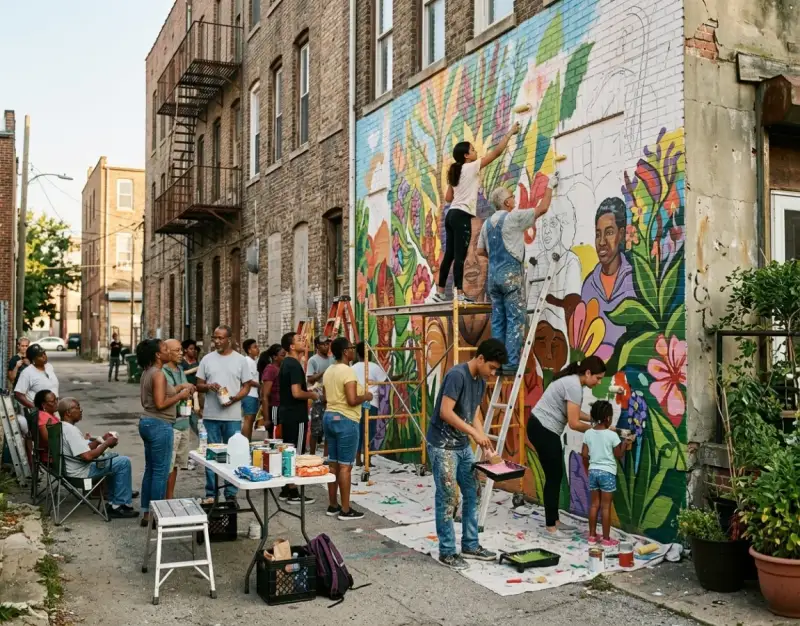
Walk down any historically disinvested urban corridor, and the psychological weight of structural neglect is instantly palpable. Chipped lead paint on decaying brickwork, boarded-up storefronts, and vast expanses of grey, concrete walls quietly communicate a devastating message to the residents who call these areas home: you have been forgotten. For decades, urban planning models treated these symptoms strictly through the cold lens of economic zoning, policing, and municipal code enforcement, repeatedly failing to address the deep-seated emotional and social fractures eating away at the community's core. Yet, a silent, colorful revolution has been quietly dismantling this paradigm from the ground up, proving that paint and collective human agency can heal places that traditional bureaucracy abandoned years ago.
Across the globe, a profound paradigm shift is redefining how neighborhoods combat urban decay, placing the paintbrush directly into the hands of the people. This phenomenon—driven by grassroots organizers, local artists, and resilient residents—goes far beyond mere cosmetic beautification. It is an assertive act of public art activism that reclaims public space, tells suppressed historical narratives, and actively heals collective trauma. When neighbors stand shoulder-to-shoulder on scaffolding, dipping rollers into vibrant acrylics to transform a towering, graffiti-scarred wall into a breathtaking landscape of cultural heritage and shared hope, something extraordinary happens. Strangers become collaborators, fear is replaced by civic pride, and blighted environments morph into vibrant canvases of resilience, fundamentally uplifting communities in ways that concrete infrastructure projects alone can never achieve.
As cities grapple with compounding crises of economic inequality, social isolation, and urban blight, understanding the rigorous mechanics of community muralism has never been more vital. This comprehensive investigative guide explores the anatomy of public art activism, examining how grassroots mobilization can radically alter the destiny of a neighborhood. Just as we have documented grassroots environmental efforts in initiatives like Social Change Agents: How Grassroots Clean-Up Crews Are Revitalizing Urban Rivers, true urban revitalization demands community-led action. Here, we unpack the foundational principles, step-by-step strategic blueprints, real-world case studies, and critical pitfalls associated with turning blank, decaying walls into monuments of enduring community triumph.
Foundational Principles and Mechanics of Community Muralism
To truly grasp why community murals act as powerful catalysts for social change, one must look past the visual aesthetic and examine the underlying socio-spatial dynamics at play. Urban blight is not merely an architectural failure; it is a spatial manifestation of social disenfranchisement. When public spaces fall into disrepair, they lower collective efficacy—the shared belief among residents in their ability to exert social control and affect positive change. Community muralism directly counteracts this psychological erosion by turning passive consumers of urban space into active producers of public culture.
At its core, the mechanics of successful muralism rely on participatory design, cultural preservation, and environmental psychology. Environmental psychologists have long established that the physical color palette, lighting, and visual complexity of an urban environment directly influence human stress hormone levels, perceived safety, and social cohesion. By replacing monotone concrete with rich, culturally resonant imagery, mural projects lower ambient anxiety and foster a sense of place attachment. Furthermore, when the design process itself is entirely democratic—involving town hall meetings, youth workshops, and historical listening sessions—the resulting artwork becomes a mirror reflecting the community's authentic soul, aspirations, and collective identity.
Step 1: Grassroots Mobilization and Stakeholder Alignment
Identifying the Target Wall and Securing Legal Permissions
The journey of a transformative mural always begins with site selection and navigating the complex maze of property ownership. Organizers must conduct a comprehensive neighborhood audit to pinpoint blighted, highly visible blank walls that serve as psychological bottlenecks or focal points of urban decay. Once a prime canvas is identified, the arduous process of legal clearance commences. This requires researching property tax records, contacting absentee landlords, or coordinating with municipal departments if the wall is public infrastructure like an underpass or retaining wall.
Securing permissions requires diplomatic tenacity. Organizers must draft clear, legally binding agreements—often called wall-use licenses or surface leases—that protect both the building owner and the artist collective for a minimum guaranteed lifespan (typically 5 to 10 years). Building owners are often hesitant due to concerns over liability, maintenance, or vandalism. Overcoming these objections involves presenting comprehensive portfolios, insurance options, and demonstrating how the project will actually increase local property value and deter unwanted tagging through community stewardship.
Forming a Core Steering Committee and Youth Advisory Board
A mural born from a top-down artistic mandate rarely achieves true community healing. Sustainable public art activism demands a decentralized leadership structure anchored by a dedicated steering committee. This committee should be composed of diverse neighborhood stakeholders: block club leaders, local historians, business owners, youth representatives, and resident artists. By intentionally including marginalized voices—such as unhoused individuals, immigrant elders, and at-risk youth—the project immediately establishes deep roots of trust and authenticity within the neighborhood.
Establishing a Youth Advisory Board is particularly critical for long-term impact. When young people from the neighborhood are empowered to co-design the mural, they transition from potential sources of neighborhood conflict to proud guardians of the public art. Workshops should be structured to teach youth basic art history, design theory, and community organizing skills, transforming the mural site into an open-air classroom where generational knowledge is freely exchanged.
Step 2: Community Engagement and Collaborative Design Thinking
Hosting Inclusive Town Halls and Storytelling Circles
Before a single sketch is drawn, the community must be invited to tell its story. Organizers should host a series of interactive storytelling circles, open mic nights, and neighborhood visioning sessions in accessible local spaces like public libraries, community centers, or neighborhood churches. These gatherings are designed to extract raw emotional data: What are the neighborhood's proudest historical moments? Which local heroes deserve memorialization? What struggles have residents collectively overcome?
To ensure maximum participation, these events must break down cultural and linguistic barriers. Providing translation services, childcare, and food transforms a formal planning meeting into a celebratory community gathering. The stories, photographs, and oral histories gathered during these circles form the foundational conceptual DNA of the mural design, ensuring that every brushstroke later applied to the wall carries authentic cultural weight and personal resonance for the residents walking past it every day.
Translating Narrative Data into Visual Metaphors
Once the qualitative data is collected, the lead muralist or design team faces the complex challenge of synthesizing disparate community desires into a cohesive visual narrative. This requires advanced mastery of visual metaphor, color theory, and spatial composition. A single wall must often balance multiple complex themes—such as industrial heritage, civil rights struggles, ecological resilience, and hopeful futures—without descending into visual clutter or chaos.
Iterative design feedback loops are essential during this phase. The design team should return to the community with multiple rough concepts, inviting public critique, voting, and fine-tuning. This transparent process guarantees that residents see their direct input reflected in the final rendering. When a neighborhood resident points to a completed mural and says, "That flower represents my grandmother's garden," the artwork has achieved its ultimate purpose of profound personal connection and validation.
Step 3: Fundraising, Resource Mobilization, and Material Sourcing
Building Diversified Funding Streams for Public Art
Art is free in spirit, but high-grade exterior masonry primer, UV-resistant acrylic murals paints, scaffolding rentals, and artist stipends require robust financial backing. Relying solely on municipal grants is a recipe for project delays and administrative burnout. Successful community mural initiatives deploy a diversified capital-raising strategy that combines municipal arts funding, state cultural council grants, corporate social responsibility (CSR) sponsorships from local businesses, and grassroots crowdfunding campaigns.
Crowdfunding campaigns, in particular, serve a dual purpose: they raise necessary capital while simultaneously generating pre-launch buzz and emotional investment. When hundreds of local residents contribute small amounts—ranging from $5 to $50—they acquire an emotional stake in the project's success. Additionally, partnering with local hardware stores for material donations or architectural firms for scaffolding safety checks drastically reduces overhead costs while embedding local enterprise directly into the fabric of the grassroots movement.
Sourcing Professional-Grade Exterior Materials
Nothing breaks the heart of a community faster than investing weeks of grueling labor into a stunning mural, only to watch it blister, fade, or peel within eighteen months due to substandard material choices. Exterior masonry walls are notoriously unforgiving canvases, subject to rising dampness, alkaline efflorescence, extreme thermal expansion, and intense ultraviolet radiation. Mastering the technical chemistry of mural application is non-negotiable for any serious public art initiative.
Practitioners must begin with a thorough pressure washing and surface remediation, treating any mold or mildew with fungicidal washes. Next, applying a breathable, high-performance masonry primer (such as an acrylic-alkyd or elastomeric sealer) is vital to block moisture migration from the brickwork. For the painting phase, artists must utilize heavy-body, lightfast exterior acrylic paints or specialized mural-grade silicate paints that form a mineral bond with the masonry, ensuring the artwork withstands decades of weathering, acid rain, and urban pollution.
Step 4: Inclusive Paint Days and Public Execution
Structuring Safe, Joyful, and Inclusive Paint Days
The physical painting phase is where private design transforms into public spectacle and collective catharsis. However, organizing hundreds of community members—ranging from toddlers to octogenarians—onto a multi-tier scaffolding setup requires meticulous logistical planning and rigorous safety protocols. Organizers must establish clear zoning: complex, high-detail focal points are executed by professional lead muralists, while expansive background fills, geometric patterns, and color-blocking are delegated to community volunteers using the "paint-by-number" grid method.
Safety is paramount. Every volunteer must undergo a brief safety orientation covering ladder stability, sun protection, hydration, and proper handling of non-toxic, low-VOC exterior paints. Music, food trucks, and celebratory banners should transform the work site into a vibrant street festival. This energetic atmosphere lowers social barriers, allowing neighbors who might otherwise never interact to bond over shared physical labor, creating a palpable wave of collective joy that revitalizes the entire streetscape.
Fostering Intergenerational Mentorship on the Scaffold
One of the most profound, yet underreported, secondary benefits of community mural execution is the spontaneous mentorship that occurs between master artists and neighborhood youth. As an experienced muralist guides a trembling young hand to steady a paintbrush along a complex sightline, an invaluable transfer of skill, confidence, and vision takes place. This direct mentorship demystifies the creative process, proving to disengaged youth that artistic expression is a legitimate, powerful vehicle for personal agency and social commentary.
Furthermore, elderly residents who watch from lawn chairs sharing oral histories of the neighborhood with younger painters bridge the generational divide that often plagues modern urban environments. The mural wall becomes a living archive where the neighborhood's past, present, and future collide in a colorful symphony of shared humanity. Just as acts of spontaneous generosity can transform local spaces—much like the inspiring community efforts detailed in Kindness in Action: We Left $100 Tips for Struggling Single Parents at a Local Diner—these shared creative acts restore faith in community resilience.
Step 5: Conservation, Maintenance, and Long-Term Stewardship
Applying UV-Protective Clear Coats and Anti-Graffiti Coatings
The unveiling ceremony—complete with local politicians, ribbon cuttings, neighborhood barbecues, and press coverage—is a euphoric milestone, but it is not the end of the mural's lifecycle. Exterior murals live in harsh, dynamic urban ecosystems. Without proactive conservation, even the finest mural will succumb to solar degradation, atmospheric grime, and opportunistic tagging. Protecting the investment requires the immediate application of industrial-grade, UV-blocking clear topcoats.
Additionally, applying a sacrificial anti-graffiti coating (such as a water-based polyurethane or fluoropolymer barrier) is a mandatory insurance policy for urban murals. If unauthorized taggers deface the artwork, the anti-graffiti layer allows municipal maintenance crews or trained youth stewards to wash away the vandalism with warm water or mild solvents without damaging the original paint layers underneath. This resilience protects the community's emotional and financial investment for years to come.
Establishing Neighborhood Mural Maintenance Guilds
Long-term success relies on institutionalizing stewardship through neighborhood-run maintenance guilds. Relying on the original artist to drive out and touch up every minor scrape or hairline crack is unsustainable. Instead, training local youth and block club members in basic color-matching, touch-up techniques, and seasonal washing protocols ensures the artwork remains a source of pristine pride.
These maintenance guilds should conduct quarterly inspection walks, checking for efflorescence, water pooling, hairline masonry cracks, or vandalism. By framing mural maintenance not as a chore, but as an ongoing ritual of neighborhood care and self-determination, the community ensures that the revitalizing energy sparked by the initial project continues to ripple outward, inspiring subsequent phases of local activism and urban renewal.
Real-World Case Studies & Scenarios
To fully understand the mechanics of uplifting communities through public art, we must examine real-world applications where these methodologies were rigorously tested against systemic urban decay. The following two contrasting case studies illustrate the stark divergence in outcomes between a poorly executed vanity project and a deeply rooted, highly structured community mural initiative.
Case Study A: The Top-Down Vanity Mural (The Cost of Exclusion)
In 2018, a rapidly gentrifying Midwestern city council allocated $50,000 in discretionary arts funds to revitalize a severely disinvested industrial corridor plagued by high crime and vacancy rates. Instead of engaging local residents, the city commissioned an internationally renowned, out-of-town hyper-realism muralist to paint a massive, abstract portrait of a historical figure completely disconnected from the neighborhood's actual demographic makeup.
The Execution & Breakdown: The artist completed the mural in two weeks with zero community consultation, utilizing private assistants. The local residents viewed the sleek, expensive artwork as an alien imposition—an aesthetic harbinger of displacement and gentrification rather than a celebration of their identity. Within seventy-two hours of completion, the mural was heavily defaced with political protest graffiti. The city responded by installing expensive security cameras and threatening fines, further alienating residents. The project became a flashpoint for social tension, proving that aesthetics without equity is merely cosmetic window dressing.
Case Study B: The "Roots of Resilience" Project (A Masterclass in Engagement)
Conversely, in 2021, a grassroots coalition in a historically marginalized coastal neighborhood launched the "Roots of Resilience" mural initiative on a crumbling 120-foot brick wall facing a neglected community park. Partnering with local organizers, they spent four months conducting over thirty storytelling circles, youth art workshops, and neighborhood assemblies.
The Execution & Triumph: The resulting design—co-created by local youth and a resident muralist—wove together imagery of indigenous flora, maritime history, and portraits of neighborhood elders. Over three hundred community members participated in community paint days, supported by local business food donations. The local youth were trained in maintenance and appointed as official park stewards. Three years later, the mural remains pristine, graffiti-free, and has spurred a 40% increase in local park foot traffic, new small business openings, and a measurable drop in localized vandalism. This triumph demonstrates the undeniable power of authentic public art activism.
| Strategic Dimension | The Top-Down Vanity Approach | The Grassroots Community Approach |
|---|---|---|
| Decision-Making | Dictated by outside officials and visiting artists. | Democratic, participatory design through town halls. |
| Cultural Resonance | Generic, abstract, or culturally disconnected themes. | Deeply rooted historical narratives and local representation. |
| Community Buy-In | Low; perceived as an imposition or gentrification signal. | Extremely high; fosters profound civic pride and ownership. |
| Vandalism Rates | High vulnerability; frequently tagged or protested. | Extremely low; protected by local youth stewardship. |
| Long-Term Impact | Temporary visual fix with lingering social resentment. | Lasting social cohesion, economic uplift, and leadership growth. |
Critical Mistakes and How to Avoid Them
Embarking on a public art initiative is a complex undertaking fraught with logistical, social, and political hazards. Even well-intentioned organizers can unintentionally trigger community backlash or operational failure if they fall into common tactical traps. Recognizing these pitfalls before breaking ground is essential for ensuring your project successfully uplifts your neighborhood.
- Mistake 1: Failing to Secure Air-Tight Legal Wall Rights. Launching a mural without a legally binding, long-term wall-use agreement signed by the legal property owner is catastrophic. If the building is sold or the owner changes their mind midway through execution, the project can be painted over overnight. Countermeasure: Always retain a pro-bono real estate attorney to draft a 5-to-10-year surface lease agreement that survives property title transfers.
- Mistake 2: Ignoring Surface Chemistry and Material Quality. Using cheap interior latex paint or failing to treat masonry efflorescence and dampness guarantees peeling, blistering, and fading within months. Countermeasure: Invest in professional exterior masonry primers, lightfast acrylic/silicate mural paints, and protective UV/anti-graffiti topcoats without exception.
- Mistake 3: Imposing Outsider Art Without Community Consultation. Dropping an abstract or culturally tone-deaf mural into a neighborhood without local engagement breeds resentment, distrust, and immediate vandalism. Countermeasure: Mandate a rigorous community listening phase, establishing steering committees and participatory design workshops from day one.
- Mistake 4: Neglecting Long-Term Maintenance Planning. Treating the mural as a "one-and-done" project without budgeting for touch-ups or training local stewards leads to rapid deterioration when weather or taggers strike. Countermeasure: Establish a neighborhood maintenance guild and apply sacrificial anti-graffiti clear coats immediately upon completion.
- Mistake 5: Overlooking Scaffold Safety and Liability Insurance. Allowing untrained volunteers to work on multi-tier scaffolding without fall protection, hard hats, or proper liability insurance exposes the organization to catastrophic legal and physical risks. Countermeasure: Hire certified scaffolding professionals, enforce strict OSHA-compliant safety gear rules, and secure comprehensive event liability insurance.
Frequently Asked Questions (FAQ)
How do community murals directly impact local crime and neighborhood safety?
Community murals combat crime primarily through the psychological mechanism of collective efficacy and the principles of Crime Prevention Through Environmental Design (CPTED). When a blighted, abandoned wall is transformed into a vibrant, meticulously maintained work of art, it signals to the community and potential bad actors that the space is actively cared for and monitored by residents. Studies consistently show that public art installations reduce petty crime, loitering, and illegal dumping by increasing foot traffic, fostering natural surveillance, and replacing the visual cues of urban decay with symbols of community pride and social order.
What is the typical cost breakdown for a mid-sized community mural project?
While costs vary widely based on wall square footage, surface condition, and artist fees, a standard 1,000-square-foot exterior brick mural typically ranges from $10,000 to $25,000. The budget generally breaks down as follows: 40-50% for professional artist design and labor stipends; 15-20% for scaffolding rental, safety equipment, and professional installation; 15-20% for high-grade masonry primers, exterior paints, and protective anti-graffiti topcoats; and 10-15% for community engagement workshops, permitting, and marketing materials. These costs are frequently offset through in-kind material donations, volunteer labor, and local business sponsorships.
How can organizers handle graffiti or vandalism on a completed community mural?
The best defense against vandalism is proactive preparation during the execution phase. By applying an industrial-grade, sacrificial anti-graffiti clear coat immediately after the mural is finished, organizers ensure that any unauthorized tagging sits on top of a protective barrier rather than sinking into the paint. When vandalism does occur, local maintenance guilds or youth stewards can easily wash it away using warm water, mild soap, or specialized safe solvents without harming the underlying artwork. Furthermore, involving local youth in the initial painting process drastically deters taggers, as peer respect prevents young artists from defacing work created by their own friends and neighbors.
How do you secure legal permission from difficult or absentee landlords?
Winning over absentee landlords or hesitant property owners requires shifting the conversation from abstract art to concrete property value. Organizers should present a comprehensive proposal highlighting how the mural will eliminate existing graffiti maintenance costs, deter illegal dumping, increase building security, and enhance overall property curb appeal. Offering a legally binding contract that protects the owner from liability, guarantees structural maintenance, and provides a professional render of the uplifting imagery usually dissolves hesitation. In cases where landlords are unreachable, partnering with city code enforcement or local business improvement districts (BIDs) can help unearth ownership records or leverage municipal blight ordinances productively.
Can community murals trigger gentrification and displace long-term residents?
Yes, if not managed consciously, public art activism can sometimes act as a visible marker of neighborhood "improvement" that attracts speculative real estate investment, driving up property taxes and rents—a phenomenon known as "art-washing." To prevent this, mural initiatives must be paired with broader housing justice and anti-displacement advocacy. Grassroots organizers should ensure that the mural reflects the authentic, permanent working-class culture of current residents, rather than catering to incoming affluent buyers, and work alongside community land trusts and tenant unions to protect neighborhood stability.
Strategic Roadmap and Final Takeaway
As we look toward the next two to five years, the landscape of urban revitalization is undergoing a radical, irreversible decentralization. Municipalities are increasingly recognizing that top-down urban planning models are insufficient for healing the complex social and psychological trauma embedded within disinvested neighborhoods. Public art activism is transitioning from a fringe tactical intervention into an essential cornerstone of progressive urban policy. Emerging technologies—such as augmented reality (AR) murals that bring historical narratives to life through smartphones, and eco-friendly air-purifying paints that actively absorb urban carbon emissions—are expanding the technical boundaries of what community murals can achieve.
The core takeaway for community leaders, activists, and change-makers is clear: transforming blighted neighborhoods requires more than economic investment; it demands the restoration of human agency, collective joy, and cultural dignity. By following a rigorous, community-led strategic blueprint—from inclusive storytelling circles and legal wall permissions to professional material application and generational stewardship—you can turn a symbol of urban neglect into an enduring monument of neighborhood triumph. Pick up the rollers, rally your neighbors, and begin painting the vibrant future your community deserves.
Be the first to share a gentle reflection on this story.