
The dawn breaks pale and cold across an asphalt alleyway, casting long, fractured shadows over a labyrinth of rusted dumpsters and stacked wooden pallets. Beneath a discarded sheet of corrugated steel, a low, rasping hiss breaks the morning stillness. A pair of luminous, wide-set emerald eyes peers out from the darkness—not fierce, but paralyzed by an instinctive, primordial terror. This is the world of the unsocialized feline, where every shadow threatens survival and human hands are viewed not as providers of comfort, but as agents of lethal peril. Fostering feral kittens represents one of the most demanding yet profoundly transformative frontiers in modern animal rescue, requiring a delicate balance of behavioral science, boundary respect, and unyielding emotional endurance.
In recent years, the landscape of animal sheltering and rescue operations has shifted dramatically. Driven by progressive municipal policies and the widespread adoption of Trap-Neuter-Return (TNR) initiatives, shelters across the globe are moving away from outdated, zero-return models toward sophisticated community cat management programs. Simultaneously, the cultural understanding of the human animal bonds has deepened. Society no longer views companion animals merely as property, but as sentient partners capable of profound emotional healing. Yet, bridging the chasm between a wild-born kitten and a domesticated lap cat remains an intricate art form. It demands that human caregivers suppress their natural desire for instant affection, learning instead to communicate through the subtle, unspoken vocabulary of feline body language and patience.
At its core, the thesis of this comprehensive guide is simple yet radical: feral kittens are not "broken" cats; they are wild animals operating under an entirely rational survival code. Transforming them into cherished household companions is not about breaking their spirit, but about patiently rewriting their evolutionary programming through positive reinforcement and predictable, safe environments. Whether you are an experienced foster coordinator, an emergency shelter volunteer, or a compassionate community member stepping into the world of fostering feral cats for the first time, this manual provides the exhaustive, step-by-step methodologies required to navigate the journey from fear-driven hostility to unbreakable trust.
Foundational Principles and Mechanics of Feline Socialization
To successfully navigate the process of socializing stray kittens, a foster caregiver must first understand the biological and psychological framework governing feral behavior. Feral kittens (*Felis catus*) are the offspring of unsterilized outdoor cats that have had little to no positive human contact during their formative developmental window. Unlike domesticated kittens who are handled by humans from birth, feral kittens learn from their mothers to associate humans with mortal danger. Understanding the mechanics of feline neurology, sensory perception, and critical developmental stages is the foundational bedrock upon which all successful rehabilitation strategies are built.
The Critical Socialization Window and Neurobiology
The single most influential factor in determining the success of fostering feral kittens is their chronological age. Felines possess a highly defined critical socialization window that typically spans from approximately two weeks to roughly seven to nine weeks of age. During this neurological window, the kitten’s brain is uniquely plastic, rapidly forming synaptic connections that categorize environmental stimuli into "safe" or "dangerous." Kittens handled and exposed to humans frequently during this window readily accept them as part of their social group. Once this window closes—usually around the eighth or ninth week—fear pathways in the amygdala solidify. While older feral kittens and adult cats can certainly be tamed, the process shifts from effortless neural imprinting to intensive behavioral modification and counter-conditioning.
Neurobiologically, a feral kitten’s immediate response to human proximity is governed by the sympathetic nervous system—the classic "fight, flight, or freeze" response. When cornered, an unsocialized kitten will flatten its ears, hiss, spit, strike out with unsheathed claws, or freeze in absolute terror. These are not malicious displays of aggression; they are physiological stress reactions triggered by a surge of cortisol and adrenaline. A master foster parent recognizes that these defensive postures are protective mechanisms. By understanding that the kitten is acting out of pure, unadulterated fear rather than malice, the caregiver can maintain emotional equilibrium, avoiding punitive reactions and staying focused on systematic desensitization.
Decoding Feline Body Language and Stress Signals
Effective communication across species lines requires absolute fluency in feline semiotics. Misreading a feral kitten’s signals can destroy days of careful trust-building in a matter of seconds. When evaluating a kitten’s emotional state, caregivers must look at the gestalt of the animal: ear position, tail carriage, pupil dilation, and vocalizations. A relaxed kitten displays forward-facing, upright ears, soft and almond-shaped pupils (depending on ambient light), and a loose, fluid posture. Conversely, a stressed or fearful feral kitten will exhibit pinned-back or swiveled "airplane" ears, dilated pupils taking up the majority of the iris, a stiffened or crouched body, and a tail tucked tightly against the body or thrashing erratically.
Furthermore, vocalizations provide critical diagnostic data regarding the kitten's arousal level. A sharp hiss or explosive spit indicates a defensive boundary being established; it is a warning that the kitten feels overwhelmed and requires space. A low, vibrating growl signals imminent escalation from defense to offensive striking. By respecting these warning signals rather than pushing past them, the foster caregiver establishes a crucial baseline of predictability and safety. When a kitten realizes that its warning signs are heeded and that humans do not force unwanted contact, the foundation for genuine trust is quietly poured.
Step 1: Environmental Setup and Spatial Containment
The physical environment plays a disproportionate role in the early stages of animal rescue guide implementation. Releasing a feral kitten into an open-plan home, a spacious bedroom, or a chaotic living room is a catastrophic mistake. To a wild-born kitten, vast open spaces represent immense vulnerability to airborne and ground predators. The first rule of setting up a foster station is controlled confinement: reducing the universe to a manageable, secure micro-environment where the kitten can process stimuli at its own pace.
Choosing and Preparing the Sanctuary Room
The ideal sanctuary space is a small, quiet, low-traffic room—such as a bathroom, walk-in closet, or a dedicated spare bedroom. This space must be meticulously kitten-proofed. All electrical cords must be bundled and elevated, toxic houseplants removed, gaps behind heavy furniture blocked, and vents secured. In this small room, the kitten’s sensory load is dramatically reduced, allowing it to acclimate to ambient human sounds (voices, footsteps, television, appliances) without the immediate terror of direct physical confrontation.
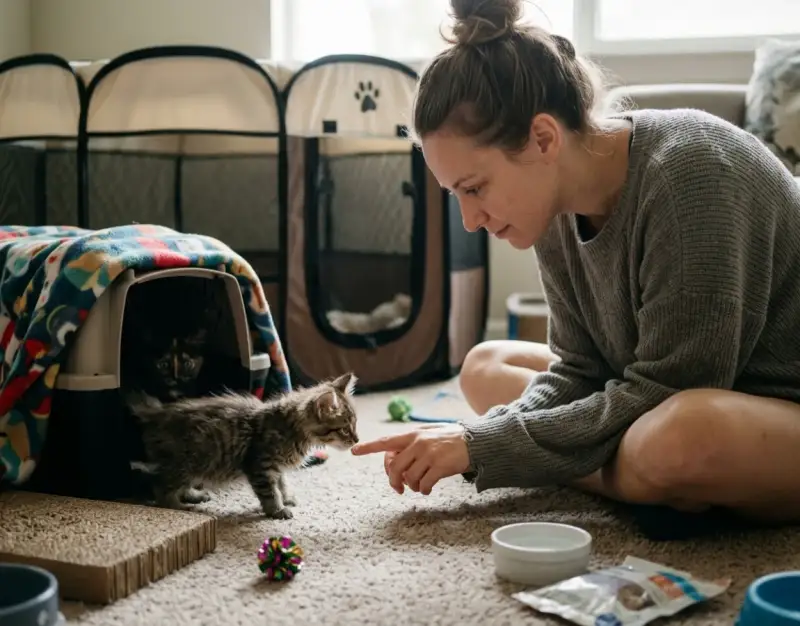
Within this sanctuary, the placement of resources is strategic. Food, water, and the litter box should be positioned at a reasonable distance from one another, mimicking natural feline behaviors where elimination areas are separated from feeding sites. However, the most critical element of the sanctuary room is the inclusion of multiple secure hiding spots. Rather than allowing the kitten to wedge itself behind a water heater or underneath heavy cabinetry—where access is impossible and medical monitoring is hindered—the caregiver should provide designated hideaways, such as airline crates with the doors removed, sturdy cardboard boxes with peek-a-boo holes cut into them, or specialized cat tunnels.
The Power of Vertical Space and Covered Dens
Feral kittens derive immense psychological security from elevation and concealment. Providing vertical options—even low-profile cat trees or secure shelving units—satisfies their evolutionary drive to observe perceived threats from a position of safety. When a kitten can look down upon its human caregiver from a secure, elevated perch, the dynamic shifts: the kitten transitions from a position of trapped helplessness to one of observer autonomy.
Additionally, draping a lightweight towel or blanket partially over the front of the kitten’s primary hiding den creates a comforting "cave" effect. This semi-permeable barrier muffles the harsh realities of the room while allowing olfactory and auditory cues to filter through safely. The kitten learns to associate the scent of the human caregiver with the safety of its den, paving the way for progressive, voluntary interactions.
Step 2: Calming Pheromones, Diet, and Resource Control
Biology and chemistry can be powerful allies when attempting to bridge the gap between human and feline. Feral kittens live in a world driven heavily by olfactory and chemical signals. By deliberately manipulating the sensory environment through synthetic feline pheromones and high-value nutritional incentives, foster parents can artificially induce a state of physiological calm, accelerating the trust-building process.
Utilizing Synthetic Feline Pheromones
The use of feline facial pheromone analogs (such as Feliway Classic) can dramatically reduce baseline anxiety in newly rescued feral kittens. Mother cats deposit facial pheromones by rubbing their cheeks against objects in their territory, marking those areas as safe, familiar zones. Diffusers plugged into the sanctuary room continuously release these synthetic analogues, signaling to the kitten’s limbic system that the environment is secure and devoid of existential threat. Combined with calming botanical extracts or soothing, species-specific music designed for cats (which features frequencies and tempos matching feline purrs and suckling sounds), this sensory immersion creates an ambient atmosphere conducive to behavioral rehabilitation.
Nutrition also serves as a potent behavioral modifier. In the wild, securing the next meal is a high-stakes, unpredictable endeavor. In the foster environment, food becomes the primary currency of trust. Feeding schedules should be regular and predictable, establishing a reliable temporal anchor that the kitten can anticipate. Hand-feeding high-value, aromatic delicacies—such as warm kitten formula, meat-only human baby food (chicken or turkey without garlic or onion), or pureed lickable treats—creates a direct, positive neural association between human presence and immense physical pleasure.
The Art of Scheduled Feeding vs. Free-Feeding
While many traditional shelters practice free-feeding (leaving dry kibble out continuously), foster parents working with feral kittens should strictly utilize scheduled, interactive feeding protocols. By feeding the kittens three to four times a day and sitting quietly nearby while they eat, the caregiver inserts themselves into the positive feedback loop of sustenance. Initially, the caregiver may need to place the plate down, step back several feet, and avoid direct eye contact.
Over successive days, the caregiver gradually moves the food plate closer to their seated body, eventually holding the plate, and finally introducing hand-feeding via a long spoon or directly from a gloved (and later bare) fingertip. This gradual reduction of physical distance teaches the feral kitten that human hands do not inflict pain or capture; rather, they are the source of life-affirming nutrition and comfort. This precise methodology represents the operational heart of successful fostering feral cats.
Step 3: Tactile Desensitization and The "Burrito" Method
Once a feral kitten is reliably eating in the presence of the human caregiver and no longer hissing or panicking at a distance of a few feet, the next critical phase begins: physical contact. For a wild-born cat, tactile touch is the most terrifying hurdle. Skin-to-skin or fur-to-skin contact violates their primary defensive boundary. Therefore, tactile desensitization must be approached with scientific precision, utilizing specific handling tools to protect both the human handler and the emotional well-being of the kitten.
The Mechanics of Safe Handling and the Cat Burrito
When an unsocialized kitten is cornered or grabbed hastily, it will instinctively deploy its claws and teeth, leading to severe scratches for the human and deep psychological trauma for the feline. To circumvent this cycle of fear and injury, experienced rescue workers rely on the "purrito" or towel-swaddling technique. A soft, lightweight fleece or flannel blanket is wrapped securely—but not too tightly—around the kitten’s body, pinning its legs gently against its torso while leaving the head exposed. This mimics the secure swaddling used for human infants, instantly lowering the kitten’s heart rate and preventing defensive thrashing.
While securely swaddled in the towel burrito, the kitten can be held close to the caregiver’s chest, where it is exposed to the steady rhythm of a human heartbeat and the warmth of a human body. During this confined state, the caregiver should employ soft, rhythmic petting using a single finger along the bridge of the nose, behind the ears, and under the chin. These areas correspond to feline scent glands; stimulating them triggers natural grooming and bonding responses. If the kitten begins to tremble or panic, the swaddle provides a safe holding boundary until the adrenaline subsides.
Transitioning from Tools to Bare Hands
As sessions progress, the reliance on towels and thick leather handling gloves must be systematically phased out. Feline tactile perception is remarkably acute; cats use specialized nerve endings in their fur and skin to map their environment. Thick gloves can distort the tactile feedback the kitten receives, making human hands feel clumsy or alien. Once the kitten tolerates swaddling and gentle stroking with gloves, caregivers should transition to thin cotton gloves, and finally to bare hands.
The transition to bare skin should be accompanied by scent-swapping. Rubbing a clean cloth or gauze pad against the caregiver’s cheeks and hands and leaving it in the kitten’s resting area allows the feline to process human scent in a non-confrontational context. When bare hands finally stroke the kitten’s fur, the animal already recognizes the signature scent, translating the physical touch into an experience of safety, warmth, and eventual affection.
Step 4: Socialization Multipliers and Environmental Enrichment
Isolating a feral kitten in a sanctuary room is essential during the initial stabilization phase, but prolonged isolation can stunt the socialization process. To achieve true domestic readiness, the kitten must be exposed to the vibrant, complex tapestry of a busy household. Environmental enrichment and the strategic introduction of socialization multipliers—such as peer animals and diverse human handlers—accelerate the cognitive development required for a seamless transition into permanent adoption.
The Role of Confident Feline Mentors (The "All-Star" Cat)
One of the most powerful catalysts in the rehabilitation of a feral kitten is the introduction of a confident, hyper-socialized adult cat or an older, already-tamed foster kitten. Cats are consummate observational learners. A feral kitten watching a resident cat approach a human for ear scratches, knead a blanket in pure contentment, and accept treats without fear undergoes a profound cognitive shift. Mirror neurons fire in the kitten’s brain, planting the evolutionary seed of imitation.
However, introductions must be managed with absolute biosecurity and behavioral caution. The mentor cat must be fully vaccinated, tested negative for feline leukemia (FeLV) and feline immunodeficiency virus (FIV), and possess an unflappably stable temperament. Initial interactions should occur through a secure mesh barrier or a tall baby gate. Once both animals display relaxed body language—such as mutual blinking, scent-rubbing against the barrier, and calm resting—supervised physical integration can commence. The confident mentor demonstrates daily that humans are benevolent providers, shortening the taming timeline by weeks or even months.
Expanding Horizons: Sound Desensitization and Human Variety
Beyond feline mentors, feral kittens must be exposed to the diverse auditory and visual stimuli of human domestic life before their critical socialization window closes. Leaving a radio playing softly at low volume during the day, followed by progressive exposure to the hum of vacuum cleaners, the clatter of kitchen utensils, and the chime of doorbells, prevents the development of chronic noise phobias.
Furthermore, socialization must not be limited to a single human caregiver. If only one person handles the kitten, the animal may imprint exclusively on that individual, exhibiting extreme fear and avoidance when confronted with strangers, veterinarians, or different family members. Introduce multiple handlers into the sanctuary room gradually—starting with quiet, calm adults, followed by older children (under strict supervision), and diverse visitors wearing different clothing items, hats, and glasses. This multi-handler exposure builds psychological resilience, ensuring the kitten develops into an adaptable, confident companion.
Step 5: Medical Protocols, Parasite Management, and Wellness
It is impossible to separate behavioral rehabilitation from physical health. A feral kitten suffering from untreated medical conditions—such as severe upper respiratory infections, ear mites, flea anemia, intestinal parasites, or ocular inflammation—will exhibit defensive, aggressive behaviors driven entirely by chronic pain and systemic illness. Comprehensive veterinary care is not merely an adjunct to the socialization process; it is an absolute prerequisite.
Navigating the Veterinary Landscape with Feral Cats
Transporting an unsocialized, semi-feral kitten to a veterinary clinic requires meticulous logistical planning. The unfamiliar noises, chemical disinfectant smells, and chaotic energy of a busy veterinary waiting room can instantly shatter weeks of painstaking trust-building, sending the kitten into a blind panic. To mitigate this, foster parents should utilize secure, top-loading hard plastic carriers draped with a pheromone-sprayed towel. When arriving at the clinic, caregivers should request to wait in their vehicle or a quiet back exam room rather than sitting in a crowded lobby surrounded barking dogs and yowling cats.
During the examination, veterinary staff must be briefed on the kitten’s behavioral status. Whenever possible, Fear-Free handling techniques should be employed. Chemical restraint—such as light sedation using transmucosal gabapentin administered prior to the appointment—can be a transformative tool. Gabapentin reduces autonomic nervous system arousal, allowing veterinarians to perform critical diagnostic testing (fecal analysis, snap tests for FeLV/FIV, blood panels) and administer initial vaccinations without inflicting severe psychological trauma that could reverse socialization gains.
Parasite Eradication and Nutritional Recovery
The vast majority of rescued feral kittens arrive heavily burdened with parasites. Fleas can cause severe anemia in small kittens within days; ear mites cause intense pruritus (itching) and secondary bacterial infections; and intestinal worms (roundworms, coccidia, giardia) sap vital nutrients, stunting growth and inducing chronic gastrointestinal distress.
Implementing a rigorous veterinary-approved deworming and parasite prevention protocol is paramount. As parasites are eradicated and nutritional deficiencies corrected, foster parents will witness an astonishing behavioral transformation. A kitten that is no longer plagued by a bloated, worm-filled belly or the maddening itch of ear mites becomes remarkably more receptive to human touch, play, and affection. Physical wellness unlocks psychological expansion, paving the final stretch toward true domesticity.
Real-World Case Studies and Scenarios
To ground these theoretical principles in reality, examining concrete case studies from the field illuminates the divergent outcomes of proper execution versus common procedural failures.
Case Study A: The Strategic Triumph of "Barnaby"
Barnaby was an estimated five-week-old black kitten pulled from a rural agricultural property alongside three siblings. Upon intake, Barnaby was the most reactive of the litter: striking out, hissing, and refusing food in the presence of humans. The foster coordinator implemented the rigorous protocols outlined in this guide: Barnaby was placed in a dedicated bathroom sanctuary fitted with a Feliway diffuser and a covered cat crate.
Rather than forcing interaction, the foster parent utilized scheduled, high-value feedings of meat baby food delivered via a long spoon, accompanied by soft reading aloud in a monotone voice. By day four, Barnaby accepted food without hissing. On day seven, the caregiver introduced the "purrito" method, wrapping Barnaby in a soft fleece towel and stroking his forehead for five minutes twice daily. Within three weeks, Barnaby was sleeping on the foster parent's chest, purring vibrantly. He was adopted by a quiet suburban family within a month of hitting the adoption floor—a textbook example of successful feral rehabilitation.
Case Study B: The Pitfalls of Over-Immersion with "Scout"
In stark contrast, consider the case of Scout, a six-week-old tabby rescued from an urban alleyway by a well-meaning novice volunteer. Eager to show affection, the volunteer skipped the sanctuary room phase, immediately placing Scout in the center of a bustling family living room containing two dogs and three children. Overwhelmed by sensory input, Scout bolted underneath a heavy sectional sofa, wedging herself into an inaccessible crevice.
When the family attempted to pull her out by hand, Scout suffered a severe panic attack, biting through the volunteer’s finger and retreating deeper into the wall cavity. For the next two weeks, Scout refused to eat in the presence of humans, cowering in terror whenever footsteps approached. The rescue organization had to intervene, removing Scout from the chaotic environment, placing her in a quiet bathroom sanctuary, and restarting the socialization protocol from square one. This costly delay added six weeks to Scout’s rehabilitation timeline, demonstrating the absolute necessity of spatial containment and methodical pacing.
Critical Mistakes to Avoid When Fostering Feral Kittens
Navigating the delicate path of feline socialization is fraught with potential pitfalls. Even experienced animal rescuers can make critical missteps if they rely on intuition rather than behavioral science. Here are the top five most costly mistakes practitioners make, along with the exact countermeasures required to prevent them.
- Mistake 1: Skipping the Sanctuary Room and Giving Too Much Space Too Soon. Releasing a feral kitten into an open home or large bedroom triggers intense vulnerability, driving the cat to hide indefinitely. Countermeasure: Strictly confine every new feral rescue to a small, controlled bathroom or walk-in closet with secure hiding dens until consistent trust is established.
- Mistake 2: Forcing Physical Contact and Ignoring Hissing Boundaries. Grabbing, cornering, or petting a terrified kitten against its will validates its belief that humans are predators, resulting in defensive aggression. Countermeasure: Respect every hiss and defensive posture. Let the kitten dictate the pace of physical proximity, using food and scent-swapping as primary bridges.
- Mistake 3: Relying Solely on Free-Feeding Dry Kibble. Leaving a bowl of dry food out continuously eliminates the powerful behavioral modifier of scheduled, positive reinforcement feeding. Countermeasure: Implement scheduled, interactive feedings using high-value aromatic treats, anchoring your presence directly to positive nourishment.
- Mistake 4: Isolating the Kitten from Multi-Sensory Household Exposure. Keeping a kitten locked away in total silence until the day of adoption ensures that normal household noises will cause severe trauma later. Countermeasure: Introduce ambient radio sounds, diverse human handlers, and gradual noise desensitization well before the socialization window closes.
- Mistake 5: Neglecting Prompt Veterinary Care for Underlying Illnesses. Assuming a kitten's feral defensiveness is purely behavioral while ignoring chronic pain from parasites, infections, or injuries sabotages rehabilitation. Countermeasure: Partner with a veterinarian immediately upon intake to establish aggressive parasite control, nutritional recovery, and Fear-Free medical handling.
Comprehensive Comparison Table: Socialization Strategies
To assist foster caregivers in selecting the most effective methodologies at various stages of the rehabilitation journey, the following comparative matrix breaks down traditional versus advanced evidence-based approaches across key operational metrics.
| Strategic Metric | Traditional / Outdated Approach | Advanced / Evidence-Based Approach |
|---|---|---|
| Initial Containment | Free-roaming in a standard house or large spare bedroom to "let them explore." | Strict confinement in a low-traffic sanctuary room (bathroom/closet) with secure dens. |
| Feeding Protocol | Free-feeding dry kibble left out continuously in a corner. | Scheduled, interactive hand-feeding of high-value wet foods to build positive human association. |
| Handling Techniques | Forced snuggling and direct petting whenever the kitten is spotted. | Systematic desensitization using the "purrito" swaddle, scent-swapping, and respecting hissing boundaries. |
| Sensory Enrichment | Total silence and isolation to avoid startling the animal. | Strategic use of synthetic feline pheromones (Feliway), calming music, and gradual ambient noise exposure. |
| Medical Management | Handling feral cats roughly with heavy leather gauntlets in chaotic clinical lobbies. | Utilizing Fear-Free veterinary protocols, pre-visit anxiolytics (gabapentin), and quiet exam spaces. |
Frequently Asked Questions (FAQ)
Can an older feral kitten (over 12 weeks old) ever be successfully socialized?
Yes, absolutely. While kittens between two and eight weeks of age undergo rapid neurological imprinting that makes socialization feel almost effortless, older feral kittens and even fully mature feral cats can indeed be rehabilitated. However, the process shifts significantly in methodology and timeline. Instead of relying on effortless neural plasticity, caregivers must engage in intensive, systematic counter-conditioning and desensitization. This requires immense patience, often spanning months rather than weeks. Older cats may never become lap cats demanding constant attention, but many develop into deeply devoted, indoor-only companions who relish quiet companionship with their trusted human caregivers.
What should I do if a feral kitten bites or scratches me deeply?
Cat scratches and bites carry a high risk of bacterial inoculation (such as *Pasteurella multocida*) due to the anatomy of feline mouths and claws. If you experience a deep puncture wound or severe scratch, immediately wash the affected area thoroughly with antibacterial soap and warm water for at least five minutes. Apply an antiseptic solution and consult a healthcare professional promptly, as prophylactic antibiotics are frequently required for cat bites. From a behavioral standpoint, do not punish the kitten or react with anger, as this only confirms its fear. Review your handling protocols to ensure you did not violate the kitten’s spatial boundaries, and temporarily step back to non-contact feeding and scent-swapping before resuming tactile work.
How do I know when a feral kitten is ready for full adoption placement?
A feral kitten is ready to transition to the adoption floor or a permanent home when specific behavioral milestones are consistently met. These indicators include: actively seeking out human attention (rubbing against legs, soliciting head scratches, purring when approached), eating reliably in the presence of humans without hiding, using the litter box consistently, and displaying relaxed body language (forward ears, soft eyes, loose tail carriage) when visitors or unfamiliar sounds occur in the home. Rushing this transition before these benchmarks are solidified can cause behavioral regression.
Is it cruel to keep a feral cat indoors for the rest of its life?
Quite the contrary. In modern animal welfare science, transitioning a feral cat into an indoor-only lifestyle is considered an act of profound preservation and compassion. Outdoor feral cats face immense existential perils, including vehicular strikes, infectious diseases (FIV, FeLV, feline infectious peritonitis), predation by coyotes and large raptors, extreme weather events, and human cruelty. Once a feral cat’s fear of domestic environments is successfully dismantled, they thrive in the safety, thermal comfort, and predictable abundance of an indoor home, living significantly longer, healthier lives.
Strategic Roadmap and Final Takeaway
As we look toward the next two to five years of animal rescue and community cat management, the landscape of feral kitten care is poised for remarkable evolution. Driven by advancements in telemedicine, accessible veterinary pharmacology (such as long-acting injectable sedatives), and a broader cultural appreciation for the nuances of the human animal bonds, shelters and rescue groups are refining their protocols to be increasingly efficient and humane. Municipalities embracing progressive TNR programs are seeing dramatic reductions in shelter intake numbers, allowing organizations to redirect vital resources toward the intensive rehabilitation of vulnerable neonatal and juvenile populations.
The journey of fostering feral kittens is undeniably demanding. It requires an investment of emotional resilience, physical labor, and unwavering patience that tests the limits of even the most dedicated animal advocates. Yet, there are few experiences in the realm of animal rescue that rival the transcendent moment when an animal, born in the crucible of the wild and conditioned to view humanity as a mortal threat, finally rests its head against your palm and begins to purr. That quiet purr is more than a sound; it is a testament to the transformative power of patience, trust, and unconditional love—a living bridge built across the divide between the wild and the domestic.
Be the first to share a gentle reflection on this story.