
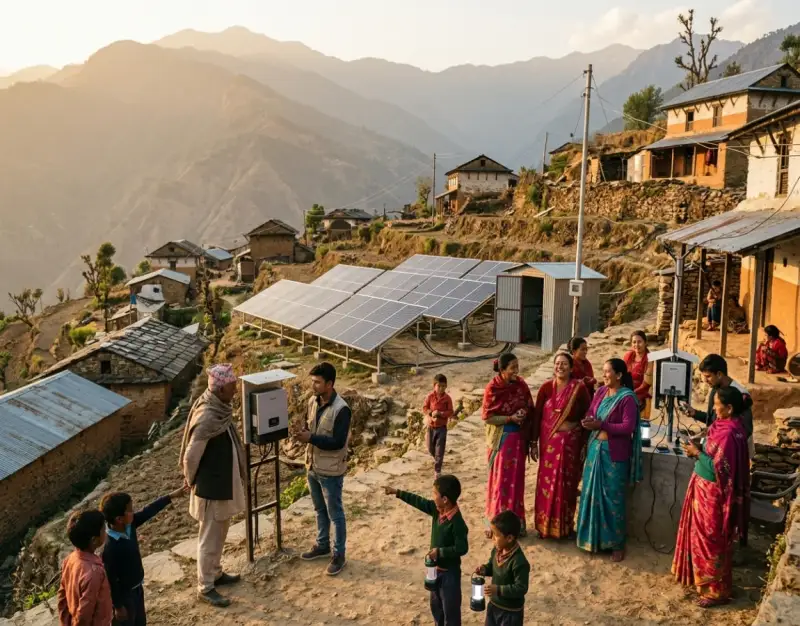
Across the high-altitude plateaus of the Himalayas, the sun-scorched plains of Sub-Saharan Africa, and the remote river basins of Southeast Asia, a quiet revolution is illuminating the dark. For generations, over a billion people lived without access to stable electricity, relying instead on kerosene lamps, diesel generators, and wood-burning stoves. These traditional energy sources carried profound human and environmental tolls, from toxic indoor air pollution and chronic respiratory illnesses to crippling economic stagnation and carbon-heavy footprints. Today, however, a wave of global goodness is sweeping across these isolated regions, redefining what is possible for marginalized populations through decentralized infrastructure.
At the beating heart of this transformation is the rapid evolution of community solar power. Unlike massive centralized utility grids that require billions of dollars in transmission lines and complex bureaucratic frameworks, community solar grids are localized, highly resilient, and scalable. They harness the infinite abundance of daylight and channel it directly into local microgrids, empowering entire villages to generate, manage, and distribute their own clean power. This shift is not merely technological; it is deeply socio-economic. By integrating these renewable energy projects into the daily fabric of rural communities, local leaders are discovering that energy independence is the foundational catalyst for better education, advanced healthcare, and sustainable livelihood generation.
Examining current industry trends reveals a fascinating convergence of falling photovoltaic panel costs, exponential improvements in lithium-iron and flow battery storage, and the rise of mobile-payment micro-utilities. These technological leaps have fundamentally changed the economics of rural electrification. Where extending national grids across impassable mountains or dense jungles was once deemed economically unviable, modular solar arrays can now be deployed in a matter of weeks. As we explore the mechanics, strategies, and real-world impact of these community-driven installations, we witness a profound alignment between technological innovation and human empathy—proving that small, calculated acts of engineering and community collaboration can literally heal the world, much like how The Hidden Psychology of Random Acts of Kindness: Why Small Gestures Heal the Brain demonstrates how minor inputs yield monumental emotional transformations.
Foundational Principles and Mechanics of Community Solar Microgrids
To fully grasp the magnitude of modern rural electrification, one must understand the underlying physics and system architecture that make community solar grids function autonomously. At its core, a community solar microgrid operates independently or semi-independently from a primary national grid, utilizing a localized network of solar photovoltaic (PV) panels, charge controllers, advanced battery banks, and intelligent distribution lines known as distribution microgrids.
Understanding the balance of generation and storage is critical for project success. During peak daylight hours, photovoltaic modules convert sunlight into direct current (DC) electricity. Because rural villages have fluctuating load profiles—peaking in the early morning and evening hours—this DC electricity is routed through high-efficiency inverter systems to convert it into alternating current (AC) for household and commercial appliances, while simultaneously charging utility-scale battery banks for overnight usage.
The Architecture of Decentralized Power Generation
Decentralized generation eliminates the massive transmission losses associated with moving electricity across hundreds of miles of high-voltage cables. By siting solar arrays directly adjacent to the communities they serve, efficiency rates skyrocket. Furthermore, decentralization ensures fault tolerance. If a localized storm or mechanical failure damages one sector of the microgrid, the rest of the village remains powered, preventing catastrophic, wide-scale blackouts.
Engineers design these systems with modular expansion in mind. A village might start with a 20-kilowatt array sufficient to power basic LED lighting, water pumps, and a community clinic. As economic activity grows—spurred by small business creation and micro-enterprises—additional solar panels and battery modules can be plugged directly into the existing DC busbar without requiring a total system redesign or massive capital reinvestment.
Energy Storage Innovations and Load Management
The historical Achilles' heel of solar energy has been intermittency—the sun does not shine at night, and cloud cover drastically reduces output. Modern community solar projects solve this through sophisticated battery energy storage systems (BESS) paired with smart metering technology. These lithium iron phosphate (LiFePO4) batteries offer thousands of deep-discharge cycles, long operational lifespans, and high thermal stability, making them ideal for harsh rural climates.
To optimize these storage assets, microgrid operators implement demand-response protocols and smart load management. During periods of low solar generation, the control system automatically throttles non-essential loads, such as community water heaters or agricultural drying fans, while prioritizing critical infrastructure like refrigeration for vaccines and nighttime school lighting. This delicate balancing act ensures uninterrupted power delivery even during prolonged monsoons or winter overcast conditions.
Strategic Blueprint for Implementing Rural Solar Projects
Executing a successful community solar initiative in a remote village requires far more than technical engineering; it demands deep cultural competency, meticulous logistical planning, and robust financial structuring. Below is an exhaustive, step-by-step strategic blueprint designed to guide project developers, NGOs, and community leaders through the lifecycle of a sustainable rural electrification initiative.
Phase 1: Comprehensive Community Needs Assessment and Energy Auditing
Before a single solar panel is ordered, project stakeholders must conduct an exhaustive energy audit and sociological assessment of the target village. This involves quantifying baseline energy consumption, identifying peak load requirements, and understanding the socio-economic priorities of the residents. Are women spending hours gathering firewood instead of attending school? Is the local health clinic losing perishable medicines due to a lack of refrigeration?
Insider tip: Never impose a top-down technological solution. Form a village energy committee composed of diverse local stakeholders—including elders, women's group leaders, and local entrepreneurs—to co-design the project parameters. This participatory approach fosters immediate local ownership and guarantees that the installed capacity directly addresses the most pressing community pain points, mirroring the grassroots empowerment seen in initiatives focused on economic upliftment, much like those explored in Inside the Micro-Lending Movement That Is Lifting Entire Neighborhoods Out of Poverty.
Phase 2: Site Selection, Engineering Design, and Environmental Impact
Once energy requirements are established, engineers must evaluate potential physical sites for the solar array and battery housing. The site must be secure from seasonal flooding, proximal enough to the village to minimize low-voltage distribution losses, and completely unobstructed by shadows from surrounding mountains, tall trees, or future construction.
The engineering design must also account for extreme weather resilience. In cyclone-prone coastal areas or high-wind mountain passes, mounting structures must be engineered with reinforced galvanized steel and deep concrete footings capable of withstanding category-four wind loads. Additionally, soil testing is mandatory to determine the optimal grounding strategy, protecting both equipment and villagers from lightning strikes and electrical surges.
Phase 3: Financial Modeling, Funding Acquisition, and Payback Structures
Rural electrification projects require creative financial engineering. Because remote villagers rarely possess the upfront capital to purchase multi-thousand-dollar microgrid systems, developers must leverage a mix of international climate grants, impact investment funds, philanthropic donations, and innovative pay-as-you-go (PAYG) financing models.
Implementing a PAYG tariff system using mobile money platforms allows households to purchase small increments of electricity via SMS text messages. This mimics the flexibility of purchasing prepaid mobile phone airtime, making electricity accessible to day-laborers and subsistence farmers. A portion of these micro-payments is automatically escrowed into a dedicated long-term maintenance fund, ensuring that replacement batteries and inverter repairs can be financed locally when components reach end-of-life.
Phase 4: Procurement, Supply Chain Logistics, and Local Assembly
Transporting heavy solar panels, inverters, and multi-ton battery banks across unpaved roads, jungle tracks, or mountain trails is one of the most perilous phases of rural solar deployment. Developers must establish strategic regional warehousing and partner with local logistics providers who understand seasonal weather barriers.
Whenever possible, source components that are modular, lightweight, and repairable. Furthermore, procurement strategies should mandate the hiring and training of local technicians for assembly and installation. This not only slashes logistical labor costs but also seeds vital technical skills within the village, transforming passive energy consumers into active system maintainers and local technological ambassadors.
Phase 5: Commissioning, Operations, Maintenance, and Capacity Building
System commissioning is the rigorous testing phase where engineers verify electrical continuity, voltage stability, grounding integrity, and inverter synchronization. However, the project is far from complete once the switch is thrown. The ultimate determinant of long-term success is the ongoing operations and maintenance (O&M) framework established before project handover.
Comprehensive capacity building must be delivered in the local language, utilizing visual, hands-on training materials. Local operators are trained to perform routine preventative maintenance—such as clearing dust and bird droppings from photovoltaic glass surfaces, checking terminal connections for corrosion, and monitoring battery state-of-charge via remote IoT monitoring dashboards linked to cellular networks.
Real-World Case Studies: Triumph Versus Collapse
To understand the fine margins between enduring global goodness and catastrophic project failure, examining empirical field data from actual rural electrification deployments is essential. Real-world case studies provide undeniable proof of what works—and what happens when critical socioeconomic and technical realities are ignored.
Case Study A: The Solar Microgrid Triumph in Sub-Saharan Agropastoralist Communities
In a remote semi-arid district of East Africa, a collaborative initiative installed a 50kW community solar microgrid powering 150 households, a grain mill, a community cold-storage facility, and a primary school. The project was co-funded by an international climate fund and managed by a locally elected cooperative.
Execution Strategy: Prior to installation, the cooperative established a tiered tariff system: basic lighting was heavily subsidized for low-income families, while commercial enterprises—such as the grain mill and cold-storage facility—paid commercial rates that subsidized the microgrid's operational costs. Results: Within two years, local agricultural yields increased by 40% due to solar-powered drip irrigation, youth literacy rates doubled with nighttime school lighting, and women who previously spent four hours daily collecting firewood launched micro-enterprises sewing school uniforms and baking bread. The project achieved full financial self-sustainability within 18 months.
Case Study B: The Anatomy of a Failed Island Microgrid Installation
Conversely, in a remote island fishing village in Southeast Asia, an international NGO donated a state-of-the-art 30kW solar system without conducting a local capacity assessment or establishing a community governance structure.
Execution Failures: The equipment was installed by foreign technicians who departed immediately after commissioning. No local operators were trained. When a lightning surge fried the central inverter after eight months, the villagers had no technical knowledge to diagnose the issue, no spare parts, and no maintenance fund. Furthermore, because no ownership structure was established, wealthier villagers hoarded power by unauthorized wire-tapping, causing chronic system overloads and total battery depletion. Within a year, the entire multi-thousand-dollar installation sat rusting and abandoned, viewed by locals as a broken foreign promise.
Critical Mistakes to Avoid in Rural Solar Deployment
Learning from past failures is the hallmark of professional excellence in international development and renewable energy engineering. Here are the five most costly mistakes practitioners make, along with actionable countermeasures to ensure project longevity.
-
Neglecting Cultural Context and Community Buy-In: Imposing Western design paradigms without consulting village elders leads to immediate alienation and project rejection.
Countermeasure: Always conduct participatory rural appraisals and establish a village-led energy committee before drawing up architectural schematics. -
Failing to Plan for End-of-Life Battery Disposal and Replacement: Assuming batteries will last indefinitely without a replacement fund guarantees sudden system collapse after 5 to 8 years.
Countermeasure: Build a mandatory equipment depreciation and replacement levy directly into the daily or monthly consumer tariff structure from day one. -
Underestimating Environmental and Climatic Stressors: Standard urban-grade electrical components often fail rapidly in high-humidity, high-salinity, or extreme-dust rural environments.
Countermeasure: Specify IP65-rated weatherproof enclosures, corrosion-resistant aluminum mounting hardware, and marine-grade wiring for all outdoor installations. -
Ignoring Local Technical Training and Capacity Building: Relying permanently on remote, foreign engineers for basic troubleshooting creates unacceptable downtime and unsustainable operating costs.
Countermeasure: Mandate the certification of at least three local technicians during the installation phase as a strict contractual prerequisite for project sign-off. -
Overlooking Productive Use of Energy (PUE) Integration: Designing systems solely for passive household lighting fails to generate the local economic activity necessary for villagers to afford electricity tariffs.
Countermeasure: Intentionally integrate income-generating loads—such as solar water pumps, refrigeration, and grain mills—into the initial grid design to stimulate local economic growth.
Comprehensive Comparison of Rural Electrification Strategies
Evaluating the optimal approach to rural electrification requires weighing capital expenditure, operational complexity, scalability, and long-term sustainability. The semantic table below contrasts traditional diesel generation, individual solar home systems (SHS), and community solar microgrids.
| Metric / Feature | Traditional Diesel Generators | Individual Solar Home Systems (SHS) | Community Solar Microgrids |
|---|---|---|---|
| Capital Expenditure (CapEx) | Low initial cost, exorbitant lifetime fuel costs | Low to moderate upfront cost per household | High initial capital investment, very low marginal operating cost |
| Carbon Footprint | Extremely high greenhouse gas emissions | Zero direct emissions | Zero direct emissions, highly scalable clean energy |
| Productive Economic Use | Possible, but fuel price volatility limits business growth | Limited to very low-wattage appliances (phone charging, lighting) | High capacity supports commercial machinery, healthcare, and water pumping |
| Maintenance & Resilience | Requires constant mechanical repairs and fuel supply chains | Dependent on individual homeowner upkeep | Managed centrally by trained local technicians with remote monitoring |
| Community Scalability | Difficult to scale without purchasing larger generators | Inflexible; adding capacity requires buying entirely new units | Highly modular; panels and batteries easily added to the busbar |
Frequently Asked Questions About Community Solar Grids
How do remote villages finance expensive solar microgrid systems?
Financing typically involves a blended capital stack combining international climate grants, impact investment capital, philanthropic donations, and government subsidies to cover initial CapEx. To ensure operational sustainability, these projects utilize pay-as-you-go (PAYG) digital micro-payment platforms. Villagers purchase small amounts of electricity using mobile money services on their phones, which not only provides convenient access but automatically funnels a percentage of revenue into a localized reserve fund for future battery replacements and maintenance.
What happens to community solar grids during extended periods of cloudy or stormy weather?
Modern community solar microgrids are engineered with robust battery energy storage systems (BESS) designed to provide multiple days of autonomy, known as "days of storage," without any solar generation. Additionally, smart microgrid control systems implement automated demand-response protocols during prolonged overcast conditions. These systems temporarily throttle non-essential loads—such as community water heating or agricultural drying—while fiercely prioritizing critical life-safety loads like hospital refrigeration and nighttime security lighting.
Can community solar grids be upgraded as a village grows economically?
Yes, modular scalability is one of the primary engineering advantages of decentralized community solar systems. Microgrids are built on DC/AC busbar architectures that allow additional photovoltaic panels, inverters, and battery modules to be seamlessly integrated as village electricity demand increases. This modularity enables communities to start small with basic lighting and water pumping, and progressively scale up to support heavier commercial enterprises, cottage industries, and public infrastructure.
How are local community members trained to maintain high-tech solar equipment?
Capacity building is embedded as a non-negotiable phase of every reputable rural electrification project. During installation, international engineering teams work side-by-side with locally appointed technicians, providing hands-on training in local languages using visual and practical modules. Once commissioned, local operators are taught routine maintenance tasks, such as cleaning photovoltaic glass panels, inspecting cable terminals for corrosion, and monitoring system health via user-friendly smartphone applications connected to remote IoT monitoring nodes.
How do community solar projects foster broader social development beyond electricity?
Electricity is a foundational enabler rather than an isolated end goal. When a remote village receives reliable power, the ripple effects transform society. Schools can offer evening adult literacy classes and digital education; healthcare clinics can safely store life-saving vaccines and blood plasma; women and children are liberated from the drudgery of gathering firewood and toxic indoor smoke; and local entrepreneurs can establish refrigeration, milling, and internet connectivity businesses. Much like the collaborative bonds built when creators align their talents—similar to the principles outlined in Why Social Media Influencers Should Work Together—community solar projects unite diverse villagers around a shared vision of collective prosperity and resilience.
Strategic Roadmap and Final Takeaway
As we look toward the next two to five years, the landscape of rural electrification and global goodness is poised for breathtaking acceleration. Emerging innovations in artificial intelligence-driven load forecasting, solid-state battery chemistry, and peer-to-peer blockchain energy trading will further decentralize and democratize power generation. Remote villages will no longer be viewed as isolated pockets of scarcity, but as self-sustaining, technologically empowered nodes of resilience.
The definitive takeaway for policymakers, impact investors, and humanitarian engineers is clear: true sustainable development cannot be achieved through top-down charity alone. It requires deep listening, rigorous technical execution, inclusive community governance, and a steadfast commitment to productive economic integration. By deploying community solar power with empathy and precision, we dismantle energy poverty at its root—illuminating homes, empowering human potential, and proving that the greatest technological marvels are those that lift humanity together.
Be the first to share a gentle reflection on this story.