
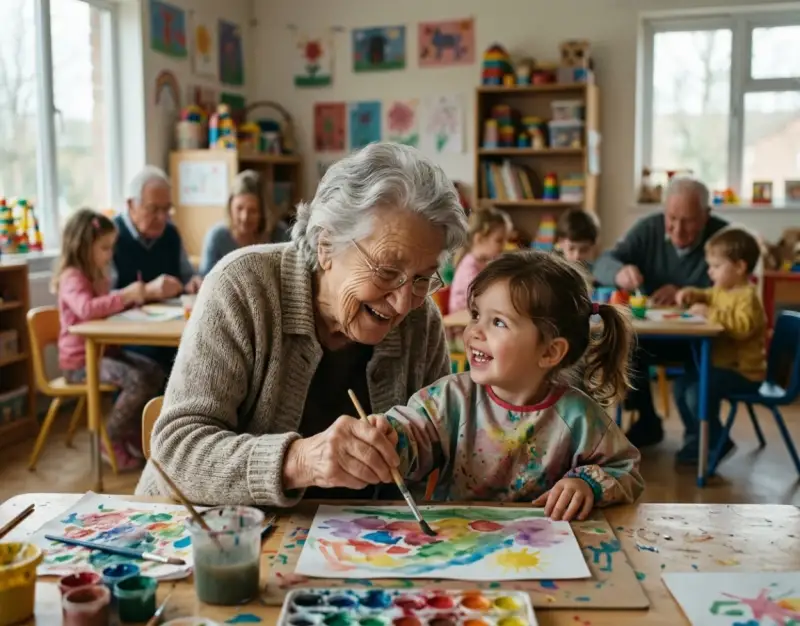
In modern Western society, a quiet spatial and social segregation has taken root. Older adults are frequently institutionalized in specialized care facilities isolated from the broader community, while young children spend their formative daylight hours in early learning centers tailored exclusively to their developmental peer group. This hyper-specialization of human environments, while intended to optimize clinical and educational efficiency, has inadvertently fractured an ancient, interdependent social architecture. The consequences of this divide are profound: an unprecedented epidemic of chronic loneliness among senior citizens, paired with a developmental deficit among young children who lack contact with the wisdom, patience, and unhurried presence of older generations.
Recent developments in urban planning, geriatric medicine, and early childhood education have sparked a transformative paradigm shift: intergenerational co-location. Rather than operating as isolated silos, innovative care centers around the globe are physically merging senior living communities with preschools and kindergartens. In these shared environments, toddlers and octogenarians break bread together, engage in structured art projects, read stories, and navigate shared garden spaces. The resulting dynamic is far more than a heartwarming human-interest narrative—it is a clinically validated, mutually therapeutic intervention that fundamentally alters the bio-psycho-social health trajectory of both populations.
As healthcare systems struggle with the escalating costs of cognitive decline, depression, and social isolation, and as educational systems search for holistic methods to cultivate empathy and emotional regulation in young children, intergenerational programs have emerged as a golden standard for community welfare. This definitive publication examines the mechanics, clinical evidence, architectural blueprints, and operational frameworks required to build, sustain, and scale intergenerational shared sites capable of bridging the age gap and healing modern communities.
Foundational Principles & Neurobiological Mechanics
To understand why intergenerational programming produces such profound clinical and developmental breakthroughs, one must first examine the neurobiological and psychological mechanisms triggered during interactions between aging adults and young children. Human evolution has long relied on alloparenting—the shared caring of young by non-parental group members, particularly elders. When society strips elders of this generative role, both ends of the age spectrum experience systemic vulnerability.
From a psychological standpoint, Laura Carstensen’s Socio-Emotional Selectivity Theory explains that as individuals age and perceive their temporal horizon shrinking, their motivations shift dramatically away from knowledge acquisition and status-seeking toward emotional fulfillment, meaningful connection, and present-focused relationships. Preschoolers naturally exist in this exact socio-emotional state. Unlike working-age adults, who are constantly constrained by time and economic productivity, young children operate in an experiential, present-tense sensory world. This alignment creates a psychological resonance between elders and toddlers that is rarely replicable in standard adult interactions.
"When an eighty-five-year-old with moderate dementia sits across from a four-year-old building blocks, the social expectations of the adult world vanish. The child does not care about forgotten names or repeated stories; they care about the block tower. In that shared space, the elder shifts from a passive recipient of care back into an active, competent social participant."
Biologically, engagement in intergenerational spaces triggers a cascade of neurochemical responses. Interactive play, shared laughter, and tactile engagement stimulate the production of oxytocin and dopamine while simultaneously suppressing cortisol—the body's primary stress hormone. Lowering chronic stress levels directly impacts physical immunity, systemic inflammation, and cardiorespiratory health. Indeed, the psychological benefits of compassionate engagement are well-documented across human longevity studies; as explored in depth in The Compassion Contagion: Why Doing Good for Others Boosts Your Own Immune System, performing prosocial acts and experiencing genuine empathetic connection activates immune-enhancing genetic pathways, directly bolstering cellular defense mechanisms in vulnerable older adults.
For children, the biological and developmental dividends are equally pronounced. Interacting with older adults who exhibit slower conversational pacing and deep attentiveness provides rich linguistic input and emotional stabilization. Children in integrated centers demonstrate accelerated vocabulary acquisition, superior emotional self-regulation, reduced anxiety around aging and disability, and heightened levels of prosocial empathy compared to peers in age-segregated settings.
1. Physical Spatial Architecture and Ergonomic Co-Location
Zoning and Micro-Environment Design
Designing a dual-use facility that accommodates both frail elderly residents and hyperactive preschoolers requires a nuanced approach to architecture. Facilities cannot simply append a preschool classroom to a nursing home corridor; the physical environment must be designed from the ground up to facilitate spontaneous yet controlled micro-interactions. Master planners must establish clear functional zones: dedicated adult quiet areas, dedicated early childhood play areas, and a fluid, highly accessible central "collision zone" where both cohorts meet daily.
Collision zones should feature flexible furniture layouts, low-pile anti-glare flooring to prevent slip-and-fall hazards for seniors while accommodating messy play for children, and multi-height work surfaces. For example, art tables with adjustable hydraulic mechanisms allow wheel-chair bound seniors and standing four-year-olds to work side-by-side at equal eye levels. Natural lighting, non-institutional acoustics, and biophilic design elements—such as indoor living walls and accessible sensory gardens—further reduce sensory stress and promote organic social cross-pollination.
Acoustic Mitigation and Ergonomic Adaptations
One of the most persistent operational hurdles in co-located environments is acoustic incompatibility. Young children generate high-decibel, high-frequency auditory input during unstructured play, which can trigger agitation, distress, or cognitive overload in older adults—particularly those with presbycusis (age-related hearing loss) or neurodegenerative conditions like Alzheimer’s disease. Conversely, excessive background noise in senior care corridors can impede a toddler's auditory discrimination during language acquisition.
To overcome this challenge, modern facilities utilize advanced architectural acoustics. Strategic installation of sound-dampening acoustic baffles, micro-perforated ceiling tiles, and heavy textile wall hangings reduces reverberation time without dampening the vital energy of the space. Ergonomically, handrails must be installed at dual heights (one at 24 inches for toddlers and another at 36 inches for seniors). Pathways must remain entirely step-free, utilizing subtle grade transitions and color-contrast door frames to assist both developing childhood vision and aging eyes experiencing diminished spatial depth perception.
2. Integrated Curriculum Development and Milestones Matrix
Cognitive and Motor Skill Synergies
An effective intergenerational program goes far beyond casual, unstructured visits; it relies on a meticulously planned, co-designed curriculum that aligns early childhood developmental milestones with senior cognitive maintenance and physical therapy goals. Activities must be engineered to provide reciprocal therapeutic value. For example, a fine motor skill exercise for a four-year-old learning to manipulate safety scissors and clay directly aligns with occupational therapy exercises for a stroke survivor or arthritis patient attempting to maintain manual dexterity.
Program facilitators should implement daily combined sessions built around structured micro-goals. In music therapy modules, seniors playing light percussion instruments practice hand-eye coordination and rhythmic memory, while children improve gross motor coordination and social turn-taking. During garden-based learning, seniors sharing horticultural knowledge cultivate a sense of purpose and self-worth, while young children build foundational science literacy and sensory integration skills through soil manipulation and planting.
Narrative Preservation and Storytelling Frameworks
Storytelling represents one of the most powerful bridges between childhood and advanced age. Structured oral history and creative storytelling modules allow seniors to act as living libraries, passing down cultural memory, local history, and personal resilience strategies. In doing so, elders build personal legacy and reclaim social authority, counteracting the disempowerment that so frequently accompanies institutional care settings.
These narrative exchanges perform a critical community preservation function similar to physical historical restoration. Just as grassroots groups honor history by Restoring Forgotten Graves: Volunteers Who Clean Up and Honor Abandoned Cemeteries, intergenerational narrative preservation ensures that the lived experiences, regional folklore, and personal legacies of long-term care residents are documented, valued, and remembered rather than lost to time. Children act as active historical stewards, recording stories through drawing, dramatic re-enactment, and simple digital audio archives maintained by the facility staff.
3. Clinical Safeguarding, Infection Control, and Risk Mitigation
Dual-Layered Health Protocols and Immunology Integration
Merging populations at opposite ends of the lifespan introduces significant epidemiological considerations. Both frail seniors and preschool-aged children possess vulnerable immune systems—seniors due to immunosenescence and chronic underlying conditions, and children due to an immature, developing immune apparatus. An outbreak of seasonal influenza, respiratory syncytial virus (RSV), or norovirus can spread rapidly through shared environments if robust infection control frameworks are not embedded into daily operations.
Facilities must deploy dual-layered health safeguarding protocols. This includes mandatory medical-grade HVAC systems equipped with HEPA filtration and continuous UV-C air disinfection in all shared spaces. Daily morning health screenings must be digitized and conducted for both staff, children, and seniors prior to entering joint zones. Touchless sanitation stations positioned at child-accessible heights (30 inches) and adult heights (42 inches) normalizes hand hygiene as a routine part of every intergenerational transition. Crucially, activities must be designed to allow rapid modular separation: if an outbreak occurs in either the early childhood wing or the senior residential unit, the physical connection between facilities can be instantly partitioned into isolated, self-contained environmental zones without disrupting core individual operations.
Behavioral Safeguarding and Psychological Safety
Psychological safety is as crucial as physical infection control. Seniors suffering from advanced dementia may exhibit unpredictable behavioral psychological symptoms of dementia (BPSD), such as sudden vocalizations, sun-downing agitation, or involuntary physical movements. Conversely, young children may exhibit sudden outbursts, unpredicted movements, or physical boundary violations that could destabilize frail elders or trigger fall incidents.
To mitigate these risks, all intergenerational interactions must operate under a 1:3 or 1:4 facilitator-to-participant ratio, with both senior care specialists and early childhood educators present simultaneously. Prior to joining joint sessions, seniors are screened using standardized cognitive and behavioral assessment tools (such as the Mini-Mental State Examination or Cohen-Mansfield Agitation Inventory) to ensure appropriate pairing. Children receive structured socio-emotional preparation, learning gentle touch protocols, personal space awareness, and communication techniques tailored for interacting with friends who may hear slowly or use mobility devices.
4. Interdisciplinary Staffing, Training, and Organizational Culture
Cross-Domain Staff Training Protocols
The primary point of operational failure in intergenerational initiatives stems from professional siloing. Early childhood educators are rarely trained in geriatric care, dementia management, or fall prevention; similarly, eldercare workers frequently lack specialized knowledge in childhood behavioral management, early literacy facilitation, and child protection standards. Operating a successful intergenerational shared site requires creating a hybrid professional discipline.
Organizations must implement mandatory cross-training onboarding modules for all staff members. Eldercare nurses and care aides shadow early learning classrooms to study developmental behavior and pediatric communication strategies. Concurrently, preschool teachers undergo comprehensive dementia sensitivity training, learning how to recognize cognitive fatigue, mitigate agitation, and handle physical mobility equipment. This cross-pollination creates a unified operational culture where staff members view themselves not as child-carers or senior-carers, but as intergenerational specialists.
Managing Burnout and Emotional Fatigue
Working in dual-care environments demands high emotional intelligence and continuous vigilance. Staff members must navigate the emotional weight of senior end-of-life care while maintaining the joyful, energetic environment required for early childhood growth. Organizations must establish formal psychological support structures to protect staff mental health and prevent emotional burnout.
Leadership teams must implement regular debriefing sessions, peer support circles, and specialized training on navigating grief and loss. When a senior resident who had a close bond with a preschool class passes away, facilitators must be equipped with therapeutic grief management toolkits designed to guide both the care staff and the young children through healthy mourning processes. Clear operational protocols for addressing death with age-appropriate transparency foster emotional resilience and transform potential trauma into profound developmental learning experiences about the natural cycles of life.
5. Empowering Youth Leadership and Social Agency
Cultivating Empathy and Civic Responsibility in Young Learners
Intergenerational co-location offers a unique sandbox for developing early leadership and civic responsibility. When four- and five-year-old children take on active caregiving roles—such as guiding an elder’s wheelchair down a hallway, reading a book to an adult with limited vision, or assisting a friend with motor impairment—they transcend the traditional passive role of childhood. They develop a heightened sense of self-efficacy, moral agency, and social duty.
This early exposure to vulnerable populations lays the foundation for lifelong civic engagement and activism. Young learners who internalize the principles of social protection, empathy, and advocacy during their preschool years often grow into youth leaders who challenge societal inequalities. As documented in Voices for the Voiceless: The Inspiring Teen Activists Fighting Animal Testing Worldwide, the early cultivation of empathy often sparks an enduring passion for social justice, transforming young people into articulate advocates for vulnerable and voiceless groups across the globe.
Measuring Long-Term Socio-Emotional Development
To validate the developmental impact of intergenerational leadership programs, facilities utilize longitudinal tracking systems assessing social-emotional competencies. Standardized rubrics measure self-regulation, pro-social behavior, perspective-taking, and executive functioning at biannual intervals.
Data consistently reveals that children enrolled in intergenerational programs demonstrate significantly higher emotional intelligence scores, advanced narrative abilities, and a marked reduction in implicit ageist and ableist biases compared to control groups in standard preschool settings. These children view physical vulnerability, mobility aids, and cognitive differences not as frightening anomalies, but as normal, accepted variations of the human experience.
6. Financial Sustainability, SROI, and Regulatory Compliance
Blended Revenue Models and Shared Overhead Optimization
Beyond the undeniable human and clinical benefits, intergenerational shared sites offer an exceptionally strong financial and operational business model. Traditional healthcare and early education sectors both suffer from high real estate, administrative, and utility overheads. By co-locating facilities within a unified master-planned campus, organizations unlock massive operational synergies and cost efficiencies.
Facilities can consolidate back-of-house operations, including commercial kitchen facilities, janitorial services, facility management, security systems, and administrative human resources. Joint purchasing power for art supplies, food service, cleaning supplies, and medical equipment significantly reduces per-capita operational costs. Furthermore, blended funding streams—combining private preschool tuition, state early education subsidies, long-term care insurance payouts, and municipal senior care grants—create a diversified, resilient revenue matrix that protects the institution from sector-specific economic shocks.
Quantifying Social Return on Investment (SROI)
Securing capital funding, philanthropic grants, and municipal support for intergenerational infrastructure requires robust financial modeling that quantifies non-traditional metrics. Leading institutions utilize the Social Return on Investment (SROI) methodology, measuring the monetary value of societal health outcomes produced per dollar invested.
The return on investment is driven by measurable clinical cost avoidance. In seniors, regular intergenerational engagement leads to documented reductions in psychotropic medication use, reduced incidence of depression, delayed transition to high-acuity nursing care, and fewer fall-related emergency room admissions driven by improved mobility. In children, it reduces the need for specialized early intervention behavioral support services. Combined with higher staff retention rates—driven by increased job satisfaction in intergenerational environments—the calculated SROI consistently demonstrates a return ranging from $3.80 to $6.20 in socio-economic value for every $1.00 invested in integrated operational infrastructure.
Real-World Case Studies & Scenarios
To understand the operational realities of intergenerational integration, we must examine real-world application models across contrasting operational environments.
Scenario A: The Fully Integrated Co-Located Campus (High-Impact Success)
Facility Profile: St. Ann Center for Intergenerational Care (Milwaukee, WI). A custom-built 80,000-square-foot facility housing a licensed child daycare center, an adult day care center, and an array of clinical support services under a single roof.
Execution Strategy: The facility operates around a grand central indoor park and marketplace. Children and adult participants spend approximately 40% of their daily programmed schedule in joint sessions, including intergenerational choir practices, indoor gardening, shared dining experiences, and swimming in an accessible warm-water pool. Staffing operates under a cross-trained model supervised by dual-certified managers.
Clinical & Financial Outcomes: Longitudinal data tracked over five years demonstrated a 45% reduction in self-reported loneliness scores among senior participants, a 30% reduction in depressive symptoms, and stabilized cognitive functioning scores among adults with early-to-mid stage dementia. Early childhood participants placed in the 92nd percentile for kindergarten readiness, displaying extraordinary socio-emotional maturity and advanced verbal skills. Staff turnover fell to less than half the national average for both nursing care and early childhood education domains.
Scenario B: The Ad-Hoc Intergenerational Visiting Model (Failed Implementation)
Facility Profile: Independent Senior Living Facility partnering with a neighborhood private daycare for monthly visits.
Execution Strategy: Once per month, 20 preschoolers were bused to the senior facility for a one-hour unstructured "sing-along and snack" session in a cramped, acoustic-heavy multipurpose room. Staff received no cross-training, and no pre-session behavioral prep was provided to either cohort.
Operational Breakdown: The high noise levels and chaotic movement of unstructured children caused immediate sensory overload and agitation among seniors with mild cognitive impairments. Senior care staff, untrained in pediatric behavioral management, stood back while daycare staff struggled to keep children focused. Seniors felt overwhelmed, children became frightened by mobility equipment and vocal outbursts, and staff experienced high anxiety. After four months, the program was abandoned due to lack of engagement, complaints from senior residents, and staff frustration.
Key Lesson: Intergenerational programming cannot succeed as a casual, periodic side project. It demands intentional architecture, explicit curriculum design, continuous staff cross-training, and high-frequency, structured consistency.
Critical Mistakes & How to Avoid Them
Organizations attempting to pioneer intergenerational initiatives frequently stumble into predictable operational traps. Below are the top five most costly errors and their precise strategic countermeasures.
- Treating Intergenerational Time as Unstructured "Free Play":
The Mistake: Dropping children into a room of seniors without structure, clear activity goals, or trained facilitators creates awkwardness, anxiety, and sensory overload.
The Countermeasure: Every joint interaction must follow a semi-structured lesson plan anchored in dual-developmental goals, utilizing clear ice-breakers, step-by-step parallel tasks, and structured wind-down protocols. - Ignoring Acoustic Dynamics and Sensory Triggers:
The Mistake: Hosting combined sessions in large, echoes-heavy spaces with hard surfaces, leading to shouting children and distressed, disengaged elders.
The Countermeasure: Invest in professional acoustic remediation (sound baffles, soft textiles, carpeting), keep session group sizes small (e.g., 6-8 seniors paired with 6-8 children), and incorporate dedicated quiet zones within the shared space. - Maintaining Siloed Departmental Operations and Staffing:
The Mistake: Allowing senior care staff and child education staff to work independently during joint sessions without shared accountability or cross-training.
The Countermeasure: Establish joint planning meetings, mandate cross-shadowing during staff onboarding, and designate a dedicated "Intergenerational Program Coordinator" who oversees combined operations across both domains. - Failing to Adapt Activities for Cognitive and Physical Impairments:
The Mistake: Designing activities that require high fine-motor dexterity or fast verbal processing, excluding elders with severe arthritis, stroke sequelae, or dementia.
The Countermeasure: Design activities using universal design principles. Implement adaptive art supplies (e.g., thick-grip markers, weighted tools), multisensory music and tactile tasks, and tier activity tasks so participants engage according to their physical and cognitive capacity. - Neglecting Comprehensive SROI and Outcome Tracking:
The Mistake: Relying solely on qualitative anecdotes to justify funding, leaving the program vulnerable to budget cuts during organizational restructuring.
The Countermeasure: Implement systematic data collection from day one. Track metrics such as medication usage rates, incidence of falls, depressive inventory scores, child literacy benchmarks, staff turnover rates, and family satisfaction metrics to build undeniable empirical evidence for program continuation.
Comprehensive Comparison of Intergenerational Operating Models
Selecting the optimal operational model depends on capital resources, facility footprint, regulatory environment, and community needs. The following matrix evaluates the primary approaches currently deployed globally:
| Model Type | Capital Investment | Operational Complexity | Clinical/Social Impact Score | Primary Operational Challenge |
|---|---|---|---|---|
| Fully Integrated Co-Located Site (Single physical facility housing both populations full-time) |
High ($5M - $25M+) |
High (Requires complex cross-regulatory compliance) |
9.8 / 10 (Maximum daily continuity & deep relationship building) |
Navigating dual-licensing standards (State Dept of Health & Dept of Early Education) |
| Campus Proximity Model (Separate physical buildings on a shared geographic campus) |
Moderate-High ($2M - $10M) |
Moderate (Managed transit between buildings) |
8.2 / 10 (High continuity with flexible physical separation) |
Weather dependence and transit logistically limiting daily mobility for frail elders |
| Specialized Memory Care Shared Model
Related Themes:
← Previous Story
The Secret Life of Bee Sanctuaries: How Ordinary Citizens Are Saving Our PollinatorsNext Story →Burnout to Breakthrough: How Practicing Compassion Can Rescue Your Mental HealthCommunity Reflections 0 |
Be the first to share a gentle reflection on this story.