
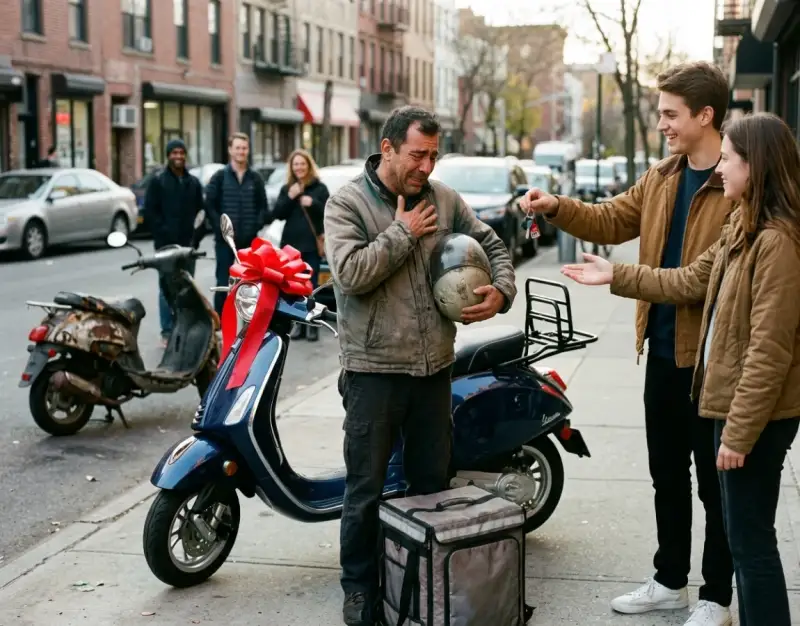
Modern urban logistics rely heavily on an invisible army of gig workers, independent couriers, and delivery drivers who brave extreme weather, relentless traffic, and grueling hours to keep the wheels of commerce turning. For many of these frontline workers, a vehicle—whether a battered scooter, a high-mileage car, or a sturdy bicycle—is not merely a convenience; it is the sole lifeline separating financial stability from total destitution. When that vital machine breaks down beyond repair, the catastrophic financial shock can instantly derail an entire family’s future, turning a minor mechanical failure into an insurmountable barrier to survival.
Yet, in the midst of daily economic pressures, human empathy continues to find extraordinary ways to break through the noise. Across neighborhoods worldwide, ordinary citizens are shifting from passive observers to active catalysts of positive change, transforming everyday compassion into structured, life-changing interventions. Just as communities have rallied to address systemic inequities through initiatives like Social Change Agents: Fighting Food Deserts With Mobile Farmers Markets, individuals are increasingly recognizing that targeted, immediate philanthropy can completely rewrite a struggling worker's life story. When a community unites around a shared mission of upliftment, the resulting ripple effects extend far beyond a single material gift, restoring faith in humanity and inspiring systemic cycles of goodwill.
This article explores the anatomy of a profound act of grassroots generosity: the surprise replacement of a hardworking delivery driver’s broken-down scooter. By examining the precise mechanics of community mobilization, the psychological and economic barriers faced by gig economy workers, and the strategic blueprint required to execute a life-altering surprise, we aim to provide a comprehensive guide for modern changemakers. Whether you are looking to orchestrate a local vehicle donation story or simply understand how structured random acts of generosity can heal fractured neighborhoods, this exhaustive examination provides the actionable frameworks, psychological insights, and operational rigor needed to turn compassion into measurable reality.
Understanding the Modern Gig Economy and the Vulnerability of Frontline Couriers
The Structural Precarity of Independent Delivery Work
The contemporary gig economy promises flexibility and independence, yet it often strips away the safety nets traditionally provided by formal employment. Independent delivery drivers operate as micro-entrepreneurs, bearing 100 percent of the overhead costs associated with their trade—including fuel, insurance, routine maintenance, and catastrophic repairs. When a primary vehicle fails, these workers do not have access to paid sick leave, corporate fleet replacements, or unemployment insurance to bridge the gap during downtime. Every hour spent off the road translates directly to a zero-dollar income day, creating an aggressive panic cycle where basic necessities like rent and groceries are immediately jeopardized.
Compounding this financial exposure is the psychological toll of chronic precarity. Drivers often labor in isolation, navigating high-stress urban environments while worrying about the invisible expiration date of aging machinery. Understanding this high-wire existence is essential for anyone hoping to engage in meaningful kindness in action. True empathy requires looking past the transaction of a dropped-off package to see the human being balancing delicate economic margins underneath. When we acknowledge these systemic vulnerabilities, our approach to helping shifts from fleeting charity to empowering, dignity-centered intervention.
The Ripple Effect of a Single Mechanical Failure
To fully grasp the magnitude of a delivery driver surprise, one must analyze the devastating domino effect that a broken-down vehicle triggers in a working-class household. A blown engine or a cracked frame does not just stop a delivery route; it halts the generation of cash flow required to fix the vehicle in the first place. Without savings to absorb the shock, families are often forced to choose between predatory payday loans, high-interest credit, or abandoning their primary source of income entirely. This vicious cycle frequently leads to eviction, food insecurity, and insurmountable debt spirals.
Conversely, intervening at this precise point of failure yields exponential returns. By removing the immediate mechanical and financial bottleneck, a surprise vehicle donation acts as a force multiplier for stability. It instantly restores earning capacity, reduces chronic anxiety, and allows the recipient to redirect their cognitive and financial resources toward long-term goals like education, family healthcare, and emergency savings. Recognizing this mechanical vulnerability as a pivotal intervention point allows communities to maximize the impact of their philanthropic efforts.
The Genesis of a Movement: Spotting Need and Mobilizing Community
Identifying Genuine Need Amidst Urban Anonymity
In sprawling metropolitan areas, millions of people cross paths daily without ever truly seeing one another. Spotting a genuine opportunity for impactful kindness requires deliberate observation and active community engagement. The delivery driver whose story inspired our movement was not a stranger who asked for help; he was a familiar face who consistently greeted neighborhood residents with exceptional warmth, despite visibly struggling with a sputtering, smoke-belching motor scooter that required constant manual kicking to start.
Identifying such candidates for major support involves looking for indicators of quiet resilience: individuals who work tirelessly, maintain an unyielding positive attitude despite obvious hardships, and whose livelihoods depend entirely on a fragile piece of equipment. By paying attention to the micro-interactions of daily life—a friendly wave, a shared joke, an exhausted posture—observant community members can identify those who are most deserving of targeted, life-changing support without waiting for formal applications or public pleas for assistance.
Building the Core Coalition and Establishing Trust
Orchestrating a complex intervention like a vehicle replacement cannot be accomplished in an isolated vacuum; it demands a dedicated coalition of diverse skills and resources. The foundational phase of any successful generosity initiative involves gathering a core team of trusted allies—ranging from local mechanics and neighborhood organizers to digital content creators and financial contributors. Each member brings a distinct capability, whether it is diagnosing vehicle reliability, navigating administrative paperwork like title transfers, or rallying digital networks for funding.
Transparency and trust are paramount during this formative stage. When pooling community funds or coordinating surprise logistics, clear communication channels and meticulous record-keeping ensure that every contributor feels confident in the collective mission. Establishing clear leadership roles within the coalition prevents operational friction, allowing the team to move quickly and decisively when the window of opportunity opens to acquire and present the replacement vehicle.
Sourcing, Inspecting, and Funding the Replacement Vehicle
Sourcing Reliable Equipment on a Grassroots Budget
Once a community coalition is formed and initial enthusiasm translates into pledged resources, the immediate tactical challenge becomes sourcing an appropriate, reliable replacement vehicle. In the context of a scooter or delivery moped, this requires balancing affordability with mechanical durability. Purchasing a brand-new vehicle is rarely feasible or necessary; instead, the search focuses on certified pre-owned models known for longevity, fuel efficiency, and readily available replacement parts.
Leveraging local networks, digital marketplaces, and word-of-mouth connections often uncovers hidden gems—such as a retired delivery vehicle offered at a generous discount by a sympathetic local dealer, or a well-maintained model donated outright by a community member looking to clear their garage. Conducting thorough market research ensures that funds raised through community generosity are stretched to their absolute maximum, securing a machine that will serve the recipient reliably for years to come without imposing heavy ongoing maintenance burdens.
Comprehensive Mechanical Inspection and Safety Overhauls
Handing over a used vehicle without rigorous vetting is not an act of kindness; it is a potential liability that could saddle the recipient with unexpected repair bills and safety risks. Before any vehicle is presented as part of a delivery driver surprise, it must undergo a comprehensive, professional multi-point inspection. This includes evaluating the braking system, tire tread integrity, electrical wiring, suspension, and engine performance.
Partnering with a local, sympathetic mechanic shop is an invaluable strategy during this phase. Many businesses are eager to contribute their expertise pro bono or at cost when they understand the philanthropic nature of the project. Ensuring that the scooter is registered, fully serviced, fitted with essential accessories like a secure delivery rack and a weather-resistant helmet, and topped off with a full tank of fuel guarantees that the recipient can hit the road safely on day one without any hidden financial surprises.
Executing the Surprise: Orchestration, Documentation, and Delivery
Designing the Unforgettable Reveal Experience
The moment of delivery represents the emotional climax of the entire endeavor, requiring careful choreography to ensure maximum emotional resonance and absolute respect for the recipient's dignity. The surprise must be planned around the driver’s natural daily routine—perhaps intercepting them at their usual morning coffee stop, their favorite local restaurant pickup point, or during a carefully staged mock delivery orchestrated by trusted local merchants.
Surprise execution also requires emotional intelligence. The reveal should celebrate the recipient's tireless work ethic and character rather than framing them as a helpless charity case. Presenting the keys alongside letters of appreciation from dozens of regular customers transforms the moment from a simple material transaction into a profound validation of their human worth. Capturing this moment authentically—while remaining respectful of personal boundaries—allows the story to inspire a much wider audience.
Leveraging Digital Storytelling to Inspire Systemic Change
Documenting a vehicle donation story through ethical, compelling digital storytelling serves a purpose far greater than vanity or viral engagement. When shared transparently across digital platforms, these narratives act as powerful catalysts for broader social change, proving that everyday people possess the collective agency to solve localized economic crises. Much like how urban environmental projects demonstrate global renewal, as explored in Global Goodness: How Micro-Forests Are Bringing Biodiversity Back to Concrete Jungles, sharing localized acts of kindness cultivates a cultural ecosystem where generosity becomes the default social expectation.
When crafting digital content around acts of kindness, creators must prioritize the recipient's comfort and agency, securing explicit consent and focusing the narrative on community resilience rather than pity. Highlighting the collaborative effort behind the scenes encourages viewers to look around their own neighborhoods, identify hidden struggles, and replicate the blueprint in their respective communities.
Long-Term Support and Sustainability: Ensuring Lasting Success
Beyond the Keys: Ongoing Maintenance and Financial Buffers
The cameras stop rolling and the initial celebration concludes, but the real-world responsibilities of vehicle ownership continue indefinitely. A truly responsible kindness initiative does not abandon the recipient the moment the keys are handed over. Long-term sustainability requires establishing a safety net for future maintenance, insurance renewals, and unexpected mechanical hiccups. Forward-thinking coalitions often establish a dedicated maintenance fund or partner with local service shops to provide free oil changes and tune-ups for the first year of ownership.
Furthermore, connecting the recipient with financial literacy resources, local credit unions, or community development financial institutions (CDFIs) can help them build personal emergency savings. By transforming a one-time charitable gift into a stepping stone toward long-term financial independence, communities ensure that the intervention delivers permanent, generational stability rather than a temporary fix.
Fostering Peer-to-Peer Mentorship Networks
Sustainable community impact thrives on reciprocity and interconnectedness. Recipients of major community support often possess a profound desire to pay their gratitude forward, evolving into powerful community advocates and peer mentors for other struggling gig workers. Establishing informal mentorship networks allows seasoned drivers to share route optimization tips, vehicle maintenance basics, and emotional support with newcomers entering the gig economy.
Just as culinary visionaries have transformed elite kitchens into community lifelines, as detailed in Voices of Change: The Chef Who Turned His Michelin-Star Kitchen Into a Soup Kitchen, grassroots initiatives prove that existing community assets can be repurposed to uplift the most vulnerable among us. When recipients become leaders within these support ecosystems, the culture of kindness becomes self-sustaining and infinitely scalable.
Real-World Case Studies & Scenarios: Success vs. Common Failures
Examining real-world applications of community-led vehicle donations reveals stark contrasts between well-planned, dignity-centered executions and well-intentioned but flawed attempts. Analyzing these scenarios provides invaluable empirical lessons for future changemakers.
Scenario A: The Structured, Dignity-First Coalition (Successful Execution)
- The Premise: A neighborhood coffee shop owner notices a regular courier struggling with a failing scooter. She rallies 15 regular customers, forming a core committee with a local mechanic.
- The Execution: The team quietly crowdfunds $2,500, purchases a certified pre-owned scooter, puts it through a rigorous 30-point mechanical inspection, covers the first year of insurance, and presents it during a surprise morning gathering.
- The Outcome: The driver’s income increases by 45% within the first month. The excess crowdfunding surplus is placed into an emergency maintenance fund. The recipient becomes an active volunteer in local neighborhood cleanup efforts.
- Key Lesson: Comprehensive planning, mechanical vetting, and centering the recipient's dignity yield long-term stability and multiply community goodwill.
Scenario B: The Impulse Purchase Without Vetting (Common Failure)
- The Premise: An online influencer spots a delivery driver on social media posting about a broken-down bike and hastily launches a viral GoFundMe without verifying vehicle specifications or legal requirements.
- The Execution: Eager to capture viral momentum, the organizer purchases the cheapest available used scooter online without a mechanical inspection. The vehicle lacks proper title documentation and suffers from a cracked transmission case.
- The Outcome: The recipient receives the scooter amidst heavy media fanfare, only to face $800 in immediate repair bills and state registration roadblocks they cannot afford. The vehicle sits idle, and public excitement turns to disillusionment.
- Key Lesson: Prioritizing viral speed over thorough mechanical and legal preparation creates toxic liabilities for vulnerable recipients, undermining the core spirit of generosity.
Critical Mistakes and How to Avoid Them
Even the most compassionate organizers can stumble if they lack operational foresight. Avoiding the following five critical mistakes ensures your kindness initiative achieves its maximum positive impact.
- Neglecting Legal and Administrative Title Transfers: Handing over physical keys without properly transferring vehicle titles, registration, and insurance leaves the recipient legally exposed and unable to operate the machine legally. Countermeasure: Always allocate funds and administrative time to complete all Department of Motor Vehicles (DMV) paperwork prior to the public reveal.
- Failing to Account for Ongoing Maintenance Costs: Gifting a machine without covering fuel, insurance, or minor upkeep sets the recipient up for eventual financial failure. Countermeasure: Build a small buffer fund into your crowdfunding campaign specifically designated for the recipient’s first year of operating expenses.
- Disregarding the Recipient's Personal Boundaries and Privacy: Forcing a deeply personal moment into viral media spectacles without explicit consent can humiliate the recipient and reduce their humanity to clickbait. Countermeasure: Always have a transparent, honest conversation with the recipient beforehand to ensure they are comfortable with public celebration and media coverage.
- Purchasing Uninspected, Low-Quality Machinery: Sourcing the cheapest vehicle available to maximize monetary savings often results in a dangerous, unreliable lemon. Countermeasure: Partner with professional mechanics to inspect every prospective vehicle before purchase, refusing to compromise on essential safety standards.
- Operating in an Isolated Vacuum Without Community Feedback: Launching a solo campaign without local allies limits your resource pool and increases the risk of blind spots. Countermeasure: Build a diverse core team representing local businesses, technical experts, and community members to share the operational workload.
Comprehensive Comparison Table: Strategic Approaches to Grassroots Generosity
| Strategy Metric | Ad-Hoc / Impulse Generosity | Structured Kindness in Action |
|---|---|---|
| Planning & Vetting | Zero mechanical inspection; reliant on online listings and fast emotional appeal. | Multi-point professional inspection, title verification, and safety checks. |
| Financial Sustainability | One-time material gift leaves recipient exposed to ongoing maintenance and insurance costs. | Includes buffer funds for insurance, fuel, and first-year maintenance. |
| Dignity & Respect | Often treats recipient as a passive charity case for public entertainment. | Centers recipient agency, character, and hard work with explicit consent. |
| Community Impact | Fleeting viral moment with little long-term infrastructure or relationship building. | Builds lasting peer networks, mentorship opportunities, and localized goodwill. |
Frequently Asked Questions
How do I approach a stranger about a potential vehicle donation without making them uncomfortable?
Approaching someone requires immense tact, empathy, and respect for personal boundaries. Start by establishing a genuine rapport through normal daily interactions—such as being a polite customer, asking about their day, and listening actively. When you feel a connection, express your admiration for their hard work and gently explain that you and a few friends have noticed their struggles with their equipment and would love to explore ways to support them. Always give them an easy out so they never feel pressured, cornered, or obligated to accept.
What legal and tax considerations apply when gifting a vehicle to an individual?
Gift regulations vary by jurisdiction, but generally, transferring a vehicle requires a signed title, a bill of sale (often marked as a gift), passing state emissions and safety inspections, and completing official DMV transfer paperwork. From a tax perspective, casual personal gifts under specific annual monetary thresholds rarely trigger federal gift tax liabilities for the giver, but it is always wise to consult local state laws or a friendly local tax professional to ensure the title transfer is completely clean and free of back taxes or liens.
How can we ensure that community crowdfunding campaigns remain transparent and trustworthy?
Transparency is the absolute bedrock of successful grassroots philanthropy. To maintain trust, use established crowdfunding platforms with built-in buyer protections and regular update features. Clearly state your fundraising goals, itemize exactly how the funds will be allocated (e.g., vehicle purchase cost, DMV fees, insurance coverage, maintenance reserve), and post regular photo or video progress updates showing the community where their contributions are going.
What should we do if the recipient refuses the vehicle donation out of pride or modesty?
A refusal is often rooted in dignity, self-reliance, or fear of social obligation. If a recipient hesitates or declines, do not pressure them. Validate their strong work ethic and explain that the gift is not charity, but a gesture of collective gratitude from neighbors who deeply value their daily contributions to the community. Sometimes framing the gift as an investment in a local micro-business partnership or allowing them to "pay it forward" by mentoring others can ease their hesitations.
How can businesses get involved in supporting gig workers and delivery drivers?
Local businesses—ranging from restaurants and cafes to auto repair shops—are uniquely positioned to support frontline couriers. Restaurants can provide designated waiting areas with complimentary drinking water and restroom access. Auto repair shops can offer discounted maintenance packages or free annual safety inspections for local delivery workers. By embedding support into daily business operations, commercial enterprises can help foster a resilient, compassionate local economy.
Strategic Roadmap & Final Takeaway
As we look toward the next two to five years, the intersection of grassroots philanthropy and the gig economy will only grow in importance. Urban populations are becoming increasingly dense, reliance on independent delivery logistics will continue to expand, and economic pressures on frontline workers will demand innovative, community-led safety nets. The future of social change does not rely solely on massive institutional grants; it rests in the hands of everyday neighbors who refuse to remain indifferent to the struggles unfolding right outside their front doors.
Your actionable next step is simple: look closer at the world around you. Identify the hardworking individuals who keep your daily routine functioning smoothly—the delivery drivers, postal workers, street vendors, and couriers. By combining compassionate observation with structured planning, rigorous mechanical vetting, and deep respect for human dignity, you have the power to put kindness in action. Whether you orchestrate a major vehicle donation story or perform a smaller random act of generosity, remember that every act of authentic care ripples outward, proving that community resilience is our greatest collective asset.
Be the first to share a gentle reflection on this story.