
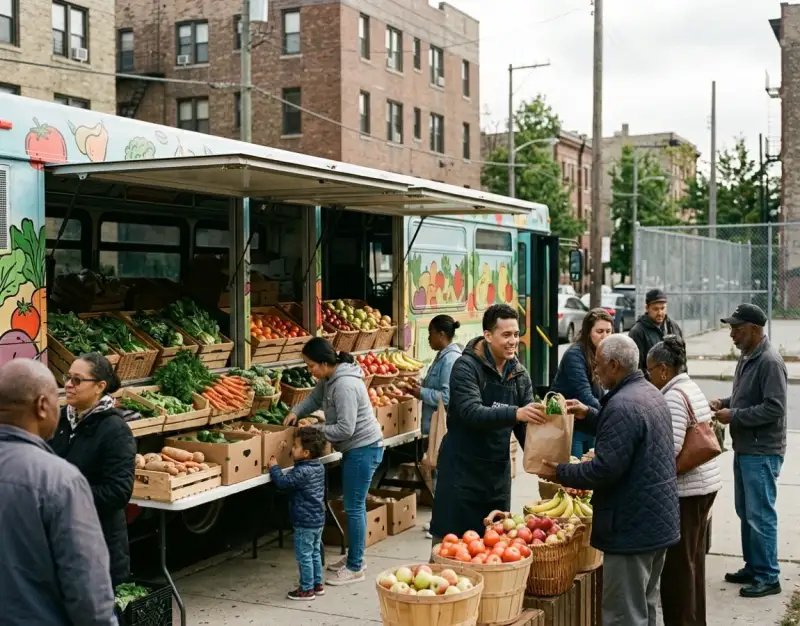
In the quiet corners of modern urban landscapes and neglected rural outposts alike, a silent crisis persists. Millions of families wake up every day miles away from the nearest grocery store, surrounded instead by convenience stores stocked with shelf-stable, highly processed, calorie-dense foods. These geographic pockets—known universally as food deserts—represent a profound systemic failure of nutritional equity. Yet, where traditional retail giants see unprofitable demographics and logistical nightmares, modern visionaries see an open canvas for grassroots innovation. These dedicated social change agents are rewriting the rules of community health, transforming how marginalized populations interact with nutrition through an agile, community-centered intervention: the mobile farmers market.
Over the past decade, the paradigm of community wellness has shifted dramatically. Philanthropic models relying solely on emergency food pantries and canned food drives are increasingly recognized as temporary stopgap measures that fail to address the root causes of diet-related chronic illnesses. What has fundamentally changed is our understanding of food accessibility as a multi-dimensional challenge encompassing geography, economics, culture, and infrastructure. Concurrently, technological advancements in fleet routing, low-cost refrigeration, and electronic benefit transfer (EBT) processing have lowered the barrier to entry for decentralized distribution. Just as urban innovators are looking to urban re-greening projects such as Global Goodness: How Micro-Forests Are Bringing Biodiversity Back to Concrete Jungles to heal fragmented ecosystems, community organizers are deploying mobile fleets to restore vital nutritional lifelines directly to the doorsteps of those most in need.
The core thesis of this comprehensive examination is straightforward yet transformative: mobile farmers markets are not merely retail vehicles on wheels; they are dynamic catalysts for systemic community empowerment. By bypassing the immense capital requirements of brick-and-mortar supermarkets, these rolling markets bridge the chasm between regional agricultural producers and underserved neighborhoods. They restore local economies, foster intergenerational health education, and reclaim public space for wellness. Throughout this article, we will dissect the mechanical blueprints, operational frameworks, real-world case studies, and strategic nuances required to launch, scale, and sustain a mobile farmers market that creates generational impact.
Foundational Principles and Mechanics of Mobile Food Access
To understand the efficacy of mobile markets, one must first deconstruct the anatomy of a food desert and the structural failures that sustain it. Food deserts are characterized by a lack of fresh fruit, vegetables, and other healthful whole foods, usually found in impoverished areas. This scarcity is compounded by inadequate public transportation networks, forcing residents to spend hours navigating multiple bus lines just to purchase an apple or a bunch of fresh kale. The economic engine of traditional grocery retail relies on high-volume foot traffic and substantial square footage—metrics that fail in low-density or economically depressed neighborhoods. Mobile farmers markets disrupt this paradigm by inverting the supply chain: instead of forcing the consumer to travel to the food, the food travels directly to the consumer.
The operational mechanics of a successful mobile market rest upon three critical pillars: route optimization, cold-chain integrity, and inclusive payment processing. Unlike fixed-location markets that wait for customers to browse, a mobile market operates on a rigorous, highly publicized schedule. It pulls up to designated community hubs—senior centers, public housing complexes, community health clinics, and after-school centers—transforming a concrete parking lot into a vibrant, open-air bazaar within minutes. Maintaining the nutritional integrity of delicate greens and vine-ripened fruits requires robust mobile refrigeration, climate-controlled cargo areas, and rapid inventory turnover. Furthermore, true accessibility demands that these markets accept Supplemental Nutrition Assistance Program (SNAP) benefits, Pandemic-EBT, and local nutrition incentive programs like Double Up Food Bucks, ensuring that low-income shoppers possess real purchasing power.
Beyond logistics, these initiatives function as living laboratories for food desert solutions. They operate at the intersection of public health, agriculture, and social justice. By purchasing surplus or seconds-quality produce directly from regional small-scale farmers, mobile markets create an alternative economic pipeline that supports local agriculture while undercutting the exploitative pricing models of corporate food monopolies. This dual-impact model ensures that every transaction reinforces regional economic resilience while directly nourishing a vulnerable consumer.
Strategic Blueprint: Assessing Community Need and Stakeholder Mapping
The foundation of any enduring social enterprise lies in exhaustive community assessment and stakeholder mapping. Before a single vehicle is purchased or a single farm partnership is struck, organizers must immerse themselves in the target geography to understand its unique socioeconomic tapestry. This initial phase prevents the imposition of top-down solutions that ignore local realities and ensures that the eventual service route aligns perfectly with community rhythms and geographic choke points.
Conducting a comprehensive needs assessment requires combining quantitative demographic data with qualitative community listening sessions. Organizers should analyze census data regarding vehicle ownership rates, median household income, diabetes and hypertension prevalence, and proximity to existing supermarkets. However, data points on a spreadsheet cannot capture cultural food preferences or localized safety concerns. Change agents must host town halls, partner with trusted neighborhood faith-based organizations, and interview local leaders to map out existing community assets.
Stakeholder mapping must extend beyond the immediate consumer base to include municipal authorities, health clinics, and agricultural producers. Collaborating with local transit agencies can help identify optimal parking locations that are ADA-compliant and easily accessible by foot. Similarly, partnering with community health workers (CHWs) allows the mobile market to integrate clinical wellness checks with nutritional distribution—a synergy that mirrors how visionary culinary leaders collaborate across sectors, much like the inspiring narrative found in Voices of Change: The Chef Who Turned His Michelin-Star Kitchen Into a Soup Kitchen. By treating community members as co-designers rather than passive recipients, organizers build immediate trust and long-term program loyalty.
Fleet Procurement, Customization, and Cold-Chain Engineering
Once the operational footprint and route geography are established, the next critical phase involves selecting and outfitting the physical vehicle. The choice of vehicle dictates operational capacity, maintenance overhead, and geographic maneuverability. Options range from retrofitted step vans and refrigerated box trucks to converted school buses and specialized cargo trailers pulled by heavy-duty pickup trucks. Each configuration presents distinct advantages and limitations.
When selecting a vehicle, organizers must prioritize mechanical reliability, fuel efficiency, and interior ergonomics. A retrofitted step van offers excellent walk-in storage and allows customers to step inside out of the elements, creating an authentic farmers market ambiance. Conversely, a refrigerated box truck with a liftgate may offer greater payload capacity and easier loading/unloading mechanics for heavy bins of produce. Interior customization must incorporate food-safe, easily sanitized surfaces such as stainless steel countertops, modular display shelving, and secure tie-downs to prevent produce bruising during transit over bumpy urban streets.
Cold-chain engineering is arguably the most critical technical component of mobile market operations. Perishable produce degrades rapidly in fluctuating temperatures. Fleet vehicles must be equipped with auxiliary battery banks, shore power hookups for overnight storage, and heavy-duty refrigeration units capable of maintaining precise temperature zones (typically 34°F to 40°F for leafy greens and root vegetables). Regular temperature loggers and strict standard operating procedures (SOPs) for inventory rotation ensure that food safety standards exceed regulatory requirements, protecting both the consumer and the organization's liability.
Forging Sustainable Supply Chains and Farm Partnerships
The lifeblood of a mobile farmers market is the quality and consistency of its agricultural inventory. Sourcing produce requires establishing symbiotic relationships with regional growers, mid-scale farmers, and cooperative networks. Unlike large commercial distributors that demand massive uniform volume, mobile markets often thrive on farm-diversity, seasonality, and the inclusion of culturally relevant produce that reflects the demographic makeup of the neighborhoods served.
Developing resilient supply chains begins with transparent, equitable grower agreements. Organizers should establish forward-contracting models that guarantee farmers a fair price for their harvests, shielding them from the volatile price fluctuations of traditional commodity markets. Furthermore, mobile markets serve as an ideal outlet for agricultural "seconds"—wholesome, highly nutritious fruits and vegetables that possess cosmetic imperfections preventing them from meeting strict supermarket aesthetic standards. By purchasing these surplus items, mobile markets reduce on-farm food waste while securing premium stock at accessible wholesale rates.
Culturally relevant sourcing is a non-negotiable component of community trust. If a neighborhood has a high concentration of Latinx, Afro-Caribbean, or Southeast Asian residents, the inventory must feature staples such as plantains, malanga, bitter melon, fresh cilantro, and serrano peppers. When residents see their cultural heritage honored on the shelves of the mobile market, participation transforms from a transactional grocery trip into a celebration of community identity. This attention to detail elevates fresh produce access from a clinical health intervention into a joyful, community-affirming ritual.
Financial Architecture, Grant Funding, and Subsidy Models
Operating a mobile farmers market requires a sophisticated financial architecture that balances social mission with operational sustainability. Because target communities often experience profound economic marginalization, marking up produce to fully cover high transportation and labor costs can price out the very individuals who need the service most. Consequently, successful programs rely on blended funding models that combine earned revenue with philanthropic grants, municipal subsidies, and innovative incentive match programs.
Diversifying revenue streams is essential for long-term viability. While direct-to-consumer produce sales generate baseline operational cash flow, organizations should actively pursue foundation grants focused on public health, preventative medicine, and social equity. Additionally, partnering with local hospital systems and accountable care organizations (ACOs) opens pathways for healthcare-funded subsidies. Under "produce prescription" (PRx) models, physicians write clinical prescriptions for fresh fruits and vegetables, which patients redeem directly at the mobile market, with costs covered by healthcare grants or Medicaid waiver programs.
Technology integration plays a pivotal role in modernizing financial operations. Equipping mobile units with robust cellular point-of-sale (POS) systems that seamlessly process SNAP, EBT, credit, debit, and cash is mandatory. Furthermore, implementing automated incentive matching—such as instantly doubling SNAP dollars at the register—removes friction for the shopper while tracking exact data metrics required by institutional funders. Transparent financial reporting and rigorous impact metrics ensure that donors and municipal partners see a clear return on investment in community health outcomes.
Community Engagement, Education, and Intergenerational Outreach
A mobile farmers market is far more than a mobile grocery store; it is a vibrant community gathering space that sparks behavioral change. Simply parking a truck and selling cheap vegetables is insufficient if consumers do not know how to prepare unfamiliar produce or lack the kitchen infrastructure to cook from scratch. Therefore, holistic programs embed education, culinary demonstration, and intergenerational engagement directly into every market stop.
Integrating nutrition education on-site transforms the market experience. Cooking demonstrations featuring simple, low-cost recipes utilizing that day's harvest allow shoppers to taste dishes before purchasing ingredients. Handouts featuring bilingual recipe cards, storage tips, and nutritional breakdowns empower residents to experiment with new foods. These educational touchpoints create a welcoming, low-pressure environment where community members can ask questions, share family recipes, and build social capital with their neighbors.
To deepen community roots, mobile markets can collaborate with local youth groups and senior organizations. Pairing older adults who possess lifelong culinary wisdom with younger residents creates powerful intergenerational mentorship loops, akin to the collaborative frameworks explored in Collaborative Welfare: Pairing Senior Mentors With At-Risk Youth for Life-Changing Guidance. When youth participate in running the market stand or learning traditional recipes from seniors, the initiative fosters civic pride, bridges generational divides, and instills lifelong habits of health and community stewardship.
Real-World Case Studies and Operational Scenarios
Examining practical execution requires analyzing both successful deployments and instructive failures. Consider the trajectory of "MetroSprout Mobile," a fictionalized composite of several highly successful urban mobile market initiatives operating across the United States. In its first year, MetroSprout struggled with mechanical breakdowns, imprecise routing schedules, and low turnout in designated low-income zones. The leadership team quickly realized their mistake: they had chosen a heavy diesel truck that frequently overheated in stop-and-go city traffic, and they had scheduled stops during standard working hours when elderly residents were resting and working-age adults were absent.
Through rigorous operational pivoting, MetroSprout restructured its entire methodology. They transitioned to a reliable, custom-fitted refrigerated electric van, slashed maintenance downtime by 60%, and conducted a second round of community listening sessions. Armed with qualitative feedback, they shifted their operating hours to late afternoons and Saturday mornings, perfectly aligning with community availability. They also partnered with local community health centers to offer free blood pressure screenings right next to the mobile market stand. Within eighteen months, average customer transactions tripled, SNAP redemptions increased by 400%, and the organization achieved 75% operational self-sufficiency through earned revenue.
Conversely, failure cases often stem from poor supply chain redundancy and inadequate financial runway. Organizations that rely solely on a single farm partner frequently experience sudden inventory collapses due to weather events or crop failures, destroying consumer trust. Similarly, programs that fail to secure multi-year funding streams often collapse the moment an initial grant cycle expires. The lesson is clear: resilience requires diversified grower networks, conservative cash flow forecasting, and deep, institutionalized community integration.
| Operational Dimension | Traditional Brick-and-Mortar Grocery | Standard Emergency Food Pantry | Mobile Farmers Market Initiative |
|---|---|---|---|
| Geographic Flexibility | Fixed location; completely immobile | Fixed location; dependent on facility access | High mobility; reaches isolated pockets directly |
| Produce Quality & Origin | Mass-market commercial supply chains | Often surplus, canned, or near-expiration items | Fresh, regional, seasonal whole foods |
| Dignity & Choice | Standard retail shopping experience | Charitable distribution; limited or no choice | Market-style browsing with full purchasing dignity |
| Ancillary Health Services | Rarely integrated | Infrequently available | High integration (PRx, screenings, cooking demos) |
| Capital Expenditure | Extremely high ($1M+ for store setup) | Moderate (facility lease and refrigeration) | Low-to-moderate ($50k–$150k for vehicle and outfitting) |
Critical Mistakes and How to Avoid Them
Launching a mobile market is fraught with operational hazards. Recognizing and avoiding costly missteps is essential for long-term survival and community impact. Below are the five most critical mistakes practitioners make, paired with actionable countermeasures.
- Failing to Secure Multi-Year Operating Capital: Relying entirely on short-term pilot grants creates severe financial cliffs. Countermeasure: Build a blended financial model from day one, integrating earned revenue targets, municipal contracts, healthcare partnerships, and philanthropic endowments to ensure a minimum of three years of runway.
- Ignoring Local Cultural and Culinary Preferences: Stocking upscale organic produce that local residents do not recognize or know how to cook leads to high spoilage rates and low community adoption. Countermeasure: Conduct exhaustive pre-launch community surveys and establish sourcing advisory boards led by neighborhood residents.
- Underestimating Vehicle Maintenance and Cold-Chain Vulnerabilities: Mechanical breakdowns mid-route or refrigeration failures destroy inventory and severely damage organizational credibility. Countermeasure: Invest in preventative maintenance schedules, partner with reliable commercial mechanics, install real-time temperature monitoring sensors, and maintain backup cooling protocols.
- Rigid Scheduling and Poor Route Optimization: Operating during inconvenient hours or selecting hard-to-reach locations drastically reduces customer volume. Countermeasure: Co-design routes and schedules directly with community stakeholders, ensuring stops coincide with existing community flows and transit hubs.
- Neglecting Data Collection and Impact Measurement: Failing to track metrics such as pounds of produce sold, SNAP utilization rates, and health outcomes makes it impossible to secure future funding or prove programmatic value. Countermeasure: Implement user-friendly POS tracking systems and partner with academic or public health institutions to conduct longitudinal health impact studies.
Frequently Asked Questions (FAQ)
How much capital is typically required to launch a mobile farmers market?
The initial capital investment varies widely depending on the scale of the operation, but typically ranges from $50,000 to $150,000. This budget covers the procurement and customization of a reliable refrigerated vehicle, initial inventory, point-of-sale hardware, marketing collateral, and working capital for the first six months. Many organizations successfully offset these startup costs by combining municipal economic development grants, vehicle donations, and philanthropic seed funding.
How do mobile farmers markets ensure food safety during transit?
Food safety is maintained through strict adherence to cold-chain engineering and regulatory health codes. Vehicles are equipped with commercial-grade refrigeration units, insulated walls, and auxiliary power supplies. Operators utilize digital temperature loggers that provide real-time alerts if cargo bay temperatures fluctuate outside safe zones (34°F–40°F). Additionally, daily sanitization protocols, strict inventory rotation (First-In, First-Out), and adherence to local health department guidelines ensure complete product integrity.
Can mobile markets accept government food assistance benefits like SNAP and EBT?
Yes, and accepting these benefits is crucial for financial viability and equitable access. Mobile markets can apply for a free retailer authorization number through the USDA Food and Nutrition Service (FNS). Modern cellular POS systems allow operators to process SNAP/EBT transactions wirelessly at every stop. Furthermore, partnering with organizations like Market Match enables operators to offer financial incentive programs that instantly double the purchasing power of SNAP shoppers for fresh fruits and vegetables.
What is the best way to handle food waste and unsold inventory?
Unsold inventory is an inevitable reality of perishable retail. Successful mobile market operators mitigate waste through a tiered surplus management strategy. This includes dynamic pricing discounts near the end of a route, partnerships with local soup kitchens or emergency food shelters to absorb wholesome surplus daily, and composting arrangements with local urban farms or community gardens for items that are no longer fit for human consumption.
How do mobile markets measure their long-term impact on community health?
Impact measurement requires a mixed-methods approach combining quantitative sales metrics with qualitative health assessments. Operators track total pounds of produce sold, number of unique customers served, dollar volume of SNAP/EBT processed, and frequency of repeat shoppers. To measure health outcomes, progressive programs partner with local public health researchers to track biometric indicators (such as blood pressure and HbA1c levels) among regular participants over multi-year study periods.
Strategic Roadmap and Final Takeaway
As we look toward the next two to five years, the landscape of urban agriculture and nutritional equity is poised for profound evolution. We anticipate a surge in electric-powered commercial fleets, reducing the carbon footprint of mobile markets while lowering ongoing fuel and maintenance overhead. Furthermore, as healthcare systems increasingly embrace preventative, food-as-medicine paradigms, institutional partnerships between hospitals and mobile market operators will transition from experimental pilots into standardized, reimbursable components of public health infrastructure. Technology will also play a larger role, with predictive routing algorithms and mobile apps allowing consumers to track exact vehicle locations and pre-order custom produce boxes.
The ultimate takeaway for aspiring social change agents is clear: dismantling food deserts requires moving beyond charity toward systemic, dignified, and community-led commerce. Mobile farmers markets embody this philosophy by bringing health, economic vitality, and joy directly to the curb. By combining rigorous operational logistics with deep community empathy, these rolling bazaars prove that equitable access to fresh food is not an impossible dream, but an achievable, rolling reality waiting to be driven into every neighborhood in need.
Be the first to share a gentle reflection on this story.