
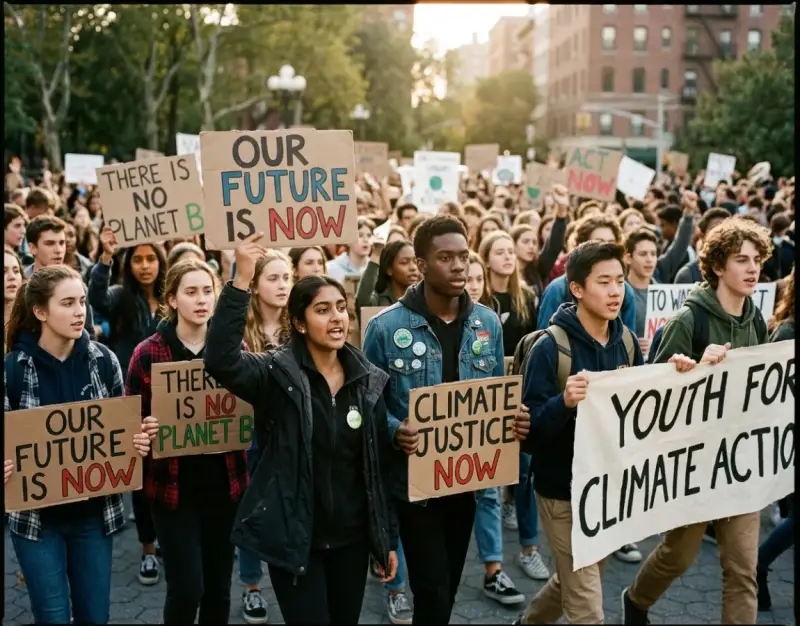
The dawn of the twenty-first century has witnessed a profound paradigm shift in how global crises are addressed, analyzed, and challenged. Nowhere is this transformation more palpable than in the realm of planetary stewardship. For decades, environmental policy was viewed through the rigid prism of bureaucratic negotiation, incremental legislative adjustments, and corporate-led sustainability pledges that often prioritized economic expediency over ecological survival. Today, however, that sterile boardroom paradigm has been fundamentally disrupted. The driving force behind this seismic change is not found in the halls of traditional power, but in the classrooms, digital networks, and public squares inhabited by a generation that refuses to inherit a dying world.
This phenomenon—broadly defined as youth climate action—represents far more than a passing wave of adolescent idealism. It is a highly coordinated, strategically sophisticated, and morally uncompromising social movement. Teen activists across the globe are leveraging digital communication, grassroots organizing, and intersectional frameworks to demand immediate, systemic accountability. As ecological degradation accelerates, these young leaders are redefining what it means to participate in civic life, proving that age is no barrier to wielding profound political and cultural influence. Their mobilization is intricately tied to the broader fight for environmental justice, ensuring that marginalized communities—who bear the heaviest burdens of industrial pollution and climate destabilization—are placed at the center of the conversation.
At Caring Connections, we recognize that true societal progress relies on empowering the voices of those who will shape tomorrow. Understanding the mechanics of this generational awakening requires diving deep into its foundational principles, strategic frameworks, and real-world impacts. Whether you are an educator, a policy maker, or an older ally seeking to support this dynamic cohort, analyzing the anatomy of teen-led climate movements offers an invaluable masterclass in modern advocacy. Just as local initiatives like learning How to Organize a Warmth Drive: Collecting Coats, Blankets, and Essentials for Winter demonstrate the profound impact of grassroots community care, youth climate action scales this empathetic impulse to a planetary level, demanding structural protection for vulnerable populations everywhere.
Foundational Principles and Mechanics of Modern Climate Activism
The Intersectional Nature of Ecological Advocacy
Modern youth climate action operates on a deeply intersectional framework, departing sharply from the singular focus of early twentieth-century conservationism. Today's teen activists understand that climate change cannot be isolated from socioeconomic inequality, racial injustice, gender disparities, and historical colonialism. Environmental justice demands that the conversation move beyond carbon footprints to examine systemic structures that place toxic facilities in low-income neighborhoods and Indigenous territories. Young leaders articulate this connection fluently, demonstrating that protecting the earth is synonymous with defending human rights, civil liberties, and economic equity.
This holistic understanding changes how campaigns are structured. Rather than treating ecological degradation as a purely scientific or technical problem, youth-led movements treat it as a profound moral crisis rooted in systemic exploitation. By linking climate breakdown to issues like housing access, healthcare disparities, and labor rights, teen activists build expansive coalitions that unite traditionally siloed advocacy groups. This interconnected strategy amplifies their reach, drawing in diverse participants who might not otherwise engage with traditional environmental messaging.
Furthermore, this intersectional lens informs the internal culture of contemporary youth movements. Participatory democracy, horizontal leadership structures, and radical inclusivity are prioritized over hierarchical command-and-control models. By ensuring that leadership roles are distributed equitably among youth from diverse backgrounds, these movements model the very world they wish to create—one defined by equity, mutual respect, and shared stewardship.
Digital Native Organizing and Global Solidarity
The operational velocity of contemporary youth movements is largely fueled by their status as digital natives. Platforms like Instagram, TikTok, and X (formerly Twitter) serve as decentralized organizing hubs where strategies, infographics, and calls to action can go viral across continents in a matter of hours. This digital infrastructure allows teen activists to bypass traditional media gatekeepers, curating their own narratives and educating millions of peers without relying on mainstream editorial approval.
Global solidarity is forged in real-time through these digital channels. A school strike initiated by a single teenager in Stockholm can instantly inspire synchronized walkouts in major urban centers across North America, Europe, Asia, and the Global South. This transnational connectivity transforms isolated local actions into a unified global chorus. The mechanics of digital organizing rely heavily on visual storytelling and accessible language, breaking down complex climate science into digestible, emotionally resonant content that mobilizes large numbers of young people.
However, digital mobilization is not without its operational challenges. Algorithmic shifts, digital fatigue, and the threat of online harassment require activists to constantly adapt their engagement tactics. Despite these hurdles, the ability of teenagers to orchestrate massive transnational mobilizations using smartphones demonstrates an unprecedented level of organizational agility that legacy institutions frequently struggle to match.
Strategic Blueprint for Amplifying Youth Voices
Cultivating Authentic Mentorship Without Co-optation
For youth climate action to achieve maximum impact, adult allies, educators, and institutions must master the delicate balance of providing support without exercising undue control. Authentic mentorship involves creating spaces where teenagers can voice their ideas, test unconventional strategies, and take operational leadership roles without facing institutional gatekeeping or paternalistic interference.
Adults working with teen activists should act as resource multipliers rather than directors. This means leveraging professional networks, funding opportunities, and institutional access to amplify youth-led initiatives while stepping back to let young people drive the narrative. Co-optation—where older organizations use youth faces for public relations while denying them real decision-making power—is a major pitfall that destroys trust and alienates young organizers.
To establish genuine collaborative frameworks, organizations must institute formal youth advisory boards with binding authority over sustainability and climate policies. When adults listen actively and honor the strategic instincts of teenagers, intergenerational partnerships yield innovative solutions that combine the wisdom of experience with the unyielding urgency of youth.
Integrating Climate Literacy into Educational Curriculums
Empowering future leaders requires transforming educational institutions from passive learning environments into active incubators for civic engagement and ecological literacy. Traditional science education often treats climate change as a distant future scenario, divorcing the data from human agency and political context. Modern educational strategy demands an integrated curriculum that teaches not only the atmospheric mechanics of global warming but also the history of social movements, policy-making processes, and civic participation.
Schools must encourage project-based learning where students analyze local environmental challenges—such as urban heat islands, watershed pollution, or energy inefficiency in school buildings—and design actionable intervention strategies. This hands-on approach transforms abstract scientific concepts into tangible problems that students can solve within their own communities.
Additionally, educational institutions should partner with local environmental justice organizations to offer internships, field studies, and community service opportunities. By bridging the gap between classroom theory and real-world advocacy, schools equip students with the practical skills, critical thinking abilities, and emotional resilience required to sustain long-term civic engagement.
Leveraging Creative Arts and Storytelling in Advocacy
Data alone rarely moves hearts and minds; compelling narratives do. Teen activists have intuitively grasped the power of the creative arts—including visual art, spoken word poetry, theater, music, and digital media—to communicate the emotional weight of the climate crisis. Storytelling humanizes abstract statistics, translating parts-per-million of carbon dioxide into stories of displaced families, vanishing ecosystems, and lost cultural heritage.
Advocacy campaigns that incorporate artistic expression consistently achieve higher engagement and emotional resonance. Whether through striking murals painted on urban concrete walls, theatricaldie-ins staged in corporate lobbies, or documentary shorts shared on social media, youth are utilizing culture-jamming techniques to disrupt business-as-usual narratives. This creative output captures public imagination in ways that dry policy briefs rarely accomplish.
Practitioners supporting youth movements should allocate dedicated resources for arts-based advocacy. Workshops focusing on narrative design, graphic illustration, and public speaking help young activists refine their messaging, ensuring their creative output cuts through the overwhelming noise of modern media environments.
Real-World Case Studies and Scenarios
Scenario A: The Urban High School Coalition for Clean Transit
Consider a case study of a coalition of high school students in a major metropolitan area who noticed that diesel-powered municipal and school buses were disproportionately polluting low-income neighborhoods where many of them lived. Recognizing the direct link between emissions, childhood asthma rates, and broader climate degradation, these teen activists formed an autonomous advocacy group called "Breathe Clean Youth."
Instead of merely protesting outside city hall, the coalition executed a meticulously researched strategy:
- Partnered with university researchers to measure particulate matter concentrations around bus depots and school zones.
- Conducted town hall meetings with affected community members to document public health impacts.
- Drafted a municipal policy proposal outlining a phased transition to electric bus fleets, funded partly through federal clean energy grants.
- Launched a targeted social media campaign featuring video testimonies from local children suffering from respiratory illnesses.
The result? Within eighteen months, the city council adopted their framework, allocating municipal funds to accelerate the electrification of the public transit fleet. This case study demonstrates how rigorous data collection combined with community-centric storytelling yields concrete policy victories.
Scenario B: The Pitfalls of Performative Corporate Engagement
In stark contrast, consider the scenario of a multinational energy corporation that invited a youth climate council to advise on its sustainability initiatives. Initially heralded as a progressive step toward intergenerational dialogue, the initiative quickly deteriorated due to structural flaws and institutional resistance.
The failures observed in this scenario include:
- Lack of Executive Access: The youth advisors were isolated within a low-level corporate social responsibility department with no channel to the board of directors.
- Tokenization: Teen participants were trotted out for annual shareholder meetings and promotional photo shoots while core fossil fuel expansion projects continued unabated.
- Non-Disclosure Agreements: Strict legal constraints prevented youth members from publicly discussing the inadequate nature of the corporation's carbon reduction targets.
Upon realizing they were being used for greenwashing, the youth council staged a coordinated walkout, publishing an open letter detailing their exploitation. This cautionary tale illustrates that superficial engagement without structural power backfires spectacularly, resulting in reputational damage and broken trust.
Critical Mistakes to Avoid in Youth Climate Advocacy
Navigating the complex landscape of environmental activism requires avoiding several recurring pitfalls that can derail campaigns, burn out participants, and compromise long-term efficacy. Understanding these strategic missteps is essential for practitioners, educators, and young leaders alike.
- Burnout and Heroification: Placing entire movements on the shoulders of a few charismatic teenage spokespeople creates unsustainable pressure and makes movements vulnerable to collapse if those individuals step back. Countermeasure: Distribute leadership horizontally, emphasize collective responsibility, and build robust support systems that prioritize mental health and self-care.
- Exclusively Focusing on Individual Carbon Footprints: Shifting the entire burden of reform onto individual lifestyle choices (e.g., recycling, reducing personal plastic use) distracts from the systemic drivers of the crisis. Countermeasure: Ground all messaging and strategy in structural accountability, targeting corporate emissions, legislative loopholes, and fossil fuel subsidies.
- Excluding Marginalized Voices: Movements driven entirely by privileged urban youth often fail to address the acute, frontline realities of Indigenous communities, rural populations, and low-income neighborhoods of color. Countermeasure: Adopt an intersectional framework from inception, ensuring leadership is diverse and community-led solutions are prioritized.
- Ignoring Legal and Legislative Pathways: Relying solely on protests and awareness-raising campaigns without engaging in the tedious work of policy drafting, legal challenges, and lobbying limits long-term impact. Countermeasure: Partner with legal advocacy organizations to train youth in strategic litigation and policy formulation.
- Failing to Measure and Evaluate Impact: Operating on enthusiasm alone without tracking metrics, milestones, or policy outcomes can lead to strategic drift and disillusionment. Countermeasure: Establish clear key performance indicators (KPIs) for campaigns, assessing legislative progress, coalition growth, and public engagement regularly.
- Just as maintaining emotional health and building strong interpersonal bonds is vital—much like understanding how The Butterfly Effect of Compliments: How One Positive Word Can Rewire Someone's Entire Day can transform personal relationships—activists must nurture internal community care to prevent emotional exhaustion in high-stress advocacy environments.
Comprehensive Comparison Table: Approaches to Climate Advocacy
To better understand how youth-led movements differ from traditional advocacy models, examine the comparative breakdown below:
| Strategic Dimension | Traditional Institutional Advocacy | Modern Youth-Led Climate Action |
|---|---|---|
| Core Motivation | Incremental reform, risk mitigation, economic balance | Existential urgency, systemic overhaul, climate justice |
| Organizational Structure | Hierarchical, bureaucratic, top-down management | Decentralized, horizontal, participatory networks |
| Communication Channels | Press releases, formal lobbying, institutional publications | Digital-first, viral multimedia, direct public storytelling |
| Inclusivity Framework | Often professionalized, requiring specialized credentials | Intersectional, barrier-free, open-access participation |
| Tactical Approach | Compromise-driven negotiation behind closed doors | Public mobilization, moral confrontation, strategic litigation |
Frequently Asked Questions (FAQ)
Why is youth climate action more effective today than in previous decades?
Today's youth climate movement benefits from unprecedented digital connectivity and globalization. In past decades, environmental organizing was limited by geographic barriers and the gatekeeping of traditional media outlets. Today, a teenager with a smartphone can organize a global mobilization, access peer-reviewed scientific data instantly, and build cross-continental solidarity networks in real time. Furthermore, the undeniable acceleration of climate impacts has created a universal sense of urgency that transcends generational divides.
How can adults best support teen activists without taking over their movements?
Adults can serve as effective allies by providing logistical resources, funding, legal counsel, and safe spaces for organizing while deliberately stepping back from operational leadership. True support involves listening to youth priorities rather than imposing adult agendas. When adults respect youth autonomy and offer institutional protection against retaliation, young activists can operate with greater confidence and strategic scope.
What is the relationship between climate action and environmental justice?
Environmental justice recognizes that the burdens of ecological degradation and pollution are borne disproportionately by low-income communities, communities of color, and Indigenous populations. Youth climate action is deeply intertwined with this framework because young activists understand that solving the climate crisis requires dismantling the systemic inequalities that place toxic infrastructure in vulnerable neighborhoods. True climate action cannot exist without fighting for social and racial equity.
How do youth activists deal with burnout and climate anxiety?
Climate anxiety—often referred to as eco-anxiety—is a pervasive psychological challenge among young people facing an uncertain ecological future. Youth movements combat this by fostering strong peer support communities, prioritizing mental health check-ins, and balancing intense political work with joyful collective activities like art-making, outdoor recreation, and community care. Collective action itself serves as the most powerful antidote to despair.
Can teenagers actually influence global policy and corporate decisions?
Yes. Over the past several years, youth-led lawsuits have forced governments to acknowledge constitutional failures regarding climate protection. School strikes have disrupted national political agendas, and shareholder resolutions backed by youth pressure have forced major corporations to reconsider fossil fuel investments. While entrenched interests remain powerful, the moral clarity and electoral weight of mobilized youth are increasingly impossible for decision-makers to ignore.
Strategic Roadmap and Final Takeaway
As we look toward the next two to five years, the trajectory of youth climate action points toward even greater institutional integration and legal sophistication. We will likely see an increase in youth-led climate litigation targeting state and federal governments for human rights violations, alongside expanded participation in electoral politics as the youngest cohort of activists reaches voting age. Corporations and policymakers can no longer treat youth activism as a temporary trend; it is the permanent vanguard of modern ecological stewardship.
The ultimate takeaway is clear: the energy, moral clarity, and strategic innovation exhibited by teen activists represent our greatest hope for navigating the planetary crises ahead. Empowering these future leaders is not merely an act of intergenerational generosity—it is an absolute strategic necessity for the survival of human society and the natural world.
Be the first to share a gentle reflection on this story.