
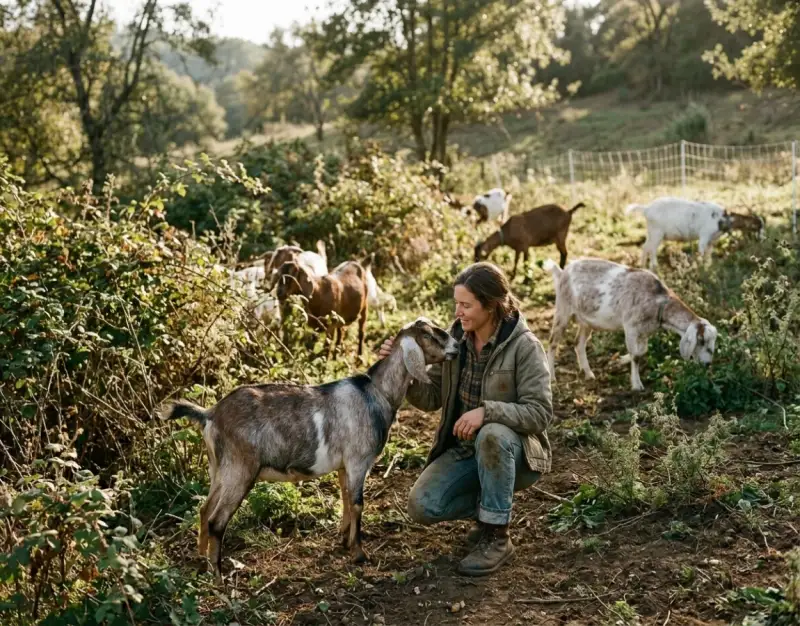
The modern landscape management movement is undergoing a quiet, four-legged revolution. Across municipal parks, rugged highway embankments, sprawling suburban greenbelts, and delicate ecological preserves, heavy machinery and chemical herbicides are increasingly being replaced by herds of hungry, agile goats. This shift represents much more than a nostalgic return to simpler times; it is a sophisticated, highly scientific ecological strategy rooted in one of humanity's oldest relationships. The deepening exploration of human animal bonds reveals that our connection with domesticated livestock extends far beyond farm-to-table economics or companionship, reaching deep into the mechanics of planetary health, environmental restoration, and regenerative agriculture.
For decades, land managers fought invasive flora like kudzu, English ivy, Scotch broom, and multiflora rose with a blunt-force arsenal of synthetic glyphosate and heavy fossil-fuel-burning brush hogs. Yet, these conventional methods frequently triggered unintended ecological catastrophes: chemical runoff poisoned local watersheds, beneficial insect populations plummeted, and herbicide-resistant "superweeds" emerged stronger than before. Enter targeted goat grazing—a deliberate, highly managed practice that utilizes the natural browsing behavior of ruminants to strip away problematic vegetation down to the root crown without disturbing the delicate soil microbiome. By turning animals into active participants in ecological healing, land stewards are rewriting the rules of conservation, proving that sustainable land management can be both economically viable and deeply ecological.
At its core, this approach bridges the gap between animal husbandry and high-stakes environmental science. It acknowledges that human animal bonds are reciprocal, dynamic relationships capable of transforming how we interact with our natural environment. Just as we see communities mobilizing around renewable infrastructure—mirroring the grassroots empowerment found when Global Goodness: How Community Solar Grids Are Bringing Clean Energy to Remote Villages electrifies off-grid regions—herdsmen, ecologists, and citizen scientists are partnering with livestock to heal scarred landscapes. This comprehensive, exhaustive guide will explore the mechanics of this practice, the science behind ruminant digestion, strategic deployment blueprints, and the future of sustainable weed removal.
Understanding the Mechanics of Targeted Goat Grazing
The Biological Advantage of Browser Physiology
To truly appreciate why goats outperform other livestock in vegetation management, one must examine their unique evolutionary biology. Unlike cattle and sheep, which are primarily grazers designed to consume flat grasses close to the ground, goats are physiological "browsers." Their upper lips are remarkably prehensile, allowing them to selectively pluck leaves, bark, buds, and seed heads from woody vines and prickly shrubs while bypassing or leaving desirable turf grasses relatively untouched. This selective feeding mechanism is the bedrock of effective eco friendly weed removal, preventing the accidental destruction of native grasses that hold topsoil together.
Furthermore, a goat’s digestive tract acts as a biological weed-seed incinerator. Thanks to a four-chambered stomach—the rumen, reticulum, omasum, and abomasum—and a specialized fermentation process, goats digest seeds that they consume, rendering the vast majority of them non-viable before they ever pass out in manure. This drastically cuts down the risk of spreading invasive species from one project site to another. When deployed correctly, herds act as selective pruning machines that mimic ancient megafauna disturbances, triggering natural succession pathways that favor native flora over aggressive, non-native invaders.
The Symbiosis of Human-Animal Bonds in Herding
The success of any targeted grazing operation hinges entirely on the quality of the relationship established between the handler and the herd. Goats are sentient, highly social, and remarkably intelligent animals capable of complex emotional bonding and rapid learning. Trust-based human animal bonds allow handlers to guide massive herds through complex, urban, or ecologically fragile terrain using minimal physical force, relying instead on verbal cues, trained guard animals, and positive reinforcement.
When animals feel safe and understood within their human-managed social structure, their cortisol levels drop, grazing efficiency increases, and herd cohesion strengthens. This psychological wellbeing translates directly into land management efficacy. Stressed goats scatter, graze erratically, and fail to target unwanted vegetation thoroughly. By fostering a deep, respectful working relationship with their livestock, modern shepherds unlock a level of ecological precision that no automated drone or tractor-mounted GPS system could ever replicate.
Designing a Sustainable Land Management Strategy
Site Assessment and Ecological Mapping
Before a single hoof touches the soil, a rigorous site assessment must be conducted to establish baseline ecological metrics. Sustainable land management requires understanding not just what weeds are present, but how they interact with the broader ecosystem, local wildlife breeding cycles, and hydrology. Land managers map out the density of invasive species, identify rare native plants that require exclusion fencing, and assess slope gradients to prevent erosion during heavy downpours. This preliminary audit ensures that the deployment of livestock maximizes weed suppression while safeguarding sensitive habitats.
During this phase, managers also calculate the "Animal Unit Month" (AUM) equivalent for goats, estimating the stocking rate needed to clear a specific acreage within a designated timeframe without overgrazing. Precision planning prevents ecological over-correction, where animals strip a landscape so bare that wind and water erosion take over. By integrating botanical surveys with livestock capacity planning, projects achieve a harmonious balance between aggressive eradication and restorative preservation.
Fencing Infrastructure and Containment Engineering
Containment is the logistical backbone of targeted grazing. Because goats are notoriously curious and agile escape artists, traditional barbed-wire fencing is rarely sufficient. Modern practitioners utilize specialized portable electric netting powered by solar-charged batteries. This semi-permanent infrastructure allows handlers to section off distinct management zones—known as "paddocks"—forcing the goats to concentrate their feeding pressure on targeted patches of weeds before rotating them to fresh ground.
Designing these paddocks requires an intimate knowledge of goat psychology and physical capability. Fences must be checked twice daily for voltage drops caused by encroaching brush, and perimeter security must account for local predators such as coyotes, stray dogs, and birds of prey. The inclusion of livestock guardian dogs (LGDs)—such as Great Pyrenees or Anatolian Shepherds—within the electric fencing perimeter creates a multi-layered security system that protects the herd and maintains uninterrupted grazing momentum.
The Step-by-Step Implementation Blueprint
Phase 1: Mobilization, Transport, and Herd Acclimation
The operational phase begins with the safe transport of the herd from home pasture to the project site. Stress management during transit is paramount to ensure the animals arrive in peak physical condition. Once unloaded into a temporary staging pen, the goats undergo a 24-hour acclimation period. Handlers provide fresh water, mineral supplements, and a small amount of familiar roughage to settle their rumens as they adjust to new environmental sights, sounds, and smells.
Crucially, handlers use this initial window to establish visual and auditory boundaries with the herd. By maintaining a calm, predictable presence, humans reinforce the bonds of trust that keep the animals manageable in unfamiliar surroundings. This preparatory phase minimizes flight responses and ensures that when the electric netting opens into the primary weed zone, the goats begin browsing immediately rather than panicking or pacing the fence lines.
Phase 2: Intensive Rotational Browsing and Stocking Pressure
Once acclimated, the herd is introduced to the first management paddock at high stocking density. This technique, known as mob grazing or pulse grazing, forces the animals to consume everything in front of them—including unpalatable weeds—rather than selectively picking only the sweetest shoots. Goats are naturally wasteful eaters, trampling and stripping bark off invasive woody stems like Chinese privet and buckthorn, which effectively ring-barks the plant and starves its root system of nutrients.
Handlers monitor the paddock continuously, watching for the exact moment when the target vegetation has been defoliated by roughly 70 to 80 percent, but before bare soil is exposed to erosion risks. This dynamic supervision requires daily adjustments to internal fencing lines, shifting the herd into fresh forage corridors with clockwork precision. The speed of rotation depends entirely on weather conditions, weed density, and the size of the herd.
Phase 3: Post-Grazing Recovery and Ecosystem Monitoring
Removing the goats from a paddock marks the beginning of the crucial recovery phase. Sustainable land management dictates that grazed land must be given adequate rest to regenerate its root reserves and allow native seed banks to germinate. During this resting window, ecological monitors track soil moisture retention, microbial activity, and the emergence of desirable native vegetation.
In many cases, the natural deposition of manure and urine by the goats acts as a potent, chemical-free fertilizer, jumpstarting soil biology and inoculating the earth with beneficial microorganisms. Just as community health initiatives—such as the vital outreach documented when looking at Collaborative Welfare: Community Clinics Providing Free Healthcare to the Uninsured—strengthen human resilience, proper rotational grazing builds systemic resilience into degraded soil networks, preparing the land to withstand future environmental shocks.
Real-World Case Studies and Operational Scenarios
Scenario A: Municipal Park Restoration in the Pacific Northwest
In a densely populated municipal park in Washington State, an aggressive invasion of Himalayan blackberry threatened to choke out native Garry oak savannas. Traditional removal using bulldozers was impossible due to steep ravine topography and strict environmental zoning laws designed to protect salmon-bearing streams. The city contracted a professional targeted grazing outfit deploying a herd of 150 Boer-cross goats.
Over a three-week deployment, the goats systematically stripped the multi-stemmed blackberry thickets down to bare wood. Because the project utilized solar-powered electric fencing set back 50 feet from the stream bank, zero chemical herbicides entered the watershed. Subsequent replanting of native camas lilies and sword ferns succeeded because the goat manure enriched the soil without burning delicate root systems. The project achieved a 92% eradication rate of invasive blackberry without a single gallon of synthetic chemical being sprayed.
Scenario B: Solar Farm Vegetation Management (Agrivoltaics)
Solar energy installations present a unique landscape challenge: how to keep vegetation from shading photovoltaic panels without damaging expensive wiring or triggering fire hazards with gas-powered weed trimmers. A utility-scale solar farm in California partnered with a livestock operator to graze sheep and goats beneath and around thousands of tracking solar panels.
While sheep managed the low-growing grasses, the goats targeted climbing weeds and woody shrubs that threatened to bridge electrical connections. This agrivoltaic synergy saved the energy company 40% in annual maintenance costs while providing the livestock producer with free, high-quality forage. The symbiotic human-animal bonds fostered in managing these animals across high-voltage industrial zones proved that green energy and regenerative agriculture can coexist profitably.
Critical Mistakes and How to Avoid Them
While targeted grazing is an immensely powerful ecological tool, improper execution can lead to severe environmental degradation and animal welfare violations. Avoiding the following five costly mistakes is essential for any practitioner:
- Mistake 1: Overgrazing and Soil Compaction. Leaving goats in a paddock past the point of optimal defoliation strips the soil bare, destroys root systems, and causes severe erosion during rains. Countermeasure: Strictly adhere to a high-intensity, short-duration rotational schedule and pull animals off the land the moment target weed thresholds are met.
- Mistake 2: Failing to Screen for Toxic Plants. Goats are resilient, but they are not immune to poisonous flora such as azaleas, oleander, wild cherry wilt, and certain species of nightshade. Countermeasure: Conduct a meticulous botanical inventory before releasing the herd and fence off isolated pockets of toxic ornamental or wild plants.
- Mistake 3: Inadequate Predator Protection. Urban fringes and rural woodlots are rife with predators that view domestic goats as easy prey. Relying solely on perimeter fences invites disaster. Countermeasure: Always deploy bonded livestock guardian dogs, install night-pen enclosures, and ensure electric netting operates at maximum recommended voltage.
- Mistake 4: Neglecting Animal Health and Parasite Management. Concentrating large numbers of ruminants on small parcels can cause explosive outbreaks of internal parasites like barber's pole worm (*Haemonchus contortus*). Countermeasure: Implement FAMACHA eye-score monitoring, rotate pastures frequently to break parasite life cycles, and maintain close veterinary oversight.
- Mistake 5: Ignoring Public Relations and Community Engagement. Dropping livestock into urban or suburban parks without notifying residents often triggers panic, calls to animal control, and gate-tampering. Countermeasure: Install informative educational signage, host community "meet-the-herd" days, and establish clear communication channels with local stakeholders.
Comprehensive Comparison of Vegetation Control Methods
| Evaluation Metric | Targeted Goat Grazing | Synthetic Herbicides | Mechanical Mowing / Brush Hogs |
|---|---|---|---|
| Ecological Impact | Regenerates soil microbiome, deposits natural organic fertilizer, protects native species. | Chemical runoff into watersheds, toxic to beneficial insects and amphibians. | Destroys ground-nesting wildlife, compacts soil via heavy machinery tracks. |
| Steep / Rocky Terrain Suitability | Exceptional; goats are natural climbers and navigate cliffs with ease. | High labor requirement; backpack sprayers are hazardous on steep slopes. | Extremely low; high risk of equipment rollover and injury. |
| Long-Term Weed Suppression | High; repeated defoliation starves root crowns and depletes seed banks. | Moderate to Low; chemical-resistant weed strains frequently evolve over time. | Low; most woody invasive species vigorously resprout from cut stumps. |
| Carbon Footprint | Near zero; zero fossil fuels consumed for propulsion or cutting mechanisms. | High; involves chemical manufacturing, packaging, and fuel-powered spray rigs. | High; heavy reliance on diesel-powered tractors and two-stroke engines. |
Frequently Asked Questions
Do goats eat all plants, or are there weeds they refuse to touch?
Contrary to popular folklore, goats are actually quite selective eaters and do not consume trash or indiscriminately devour every green thing in sight. They exhibit strong preferences for woody brush, broadleaf weeds, and thorny vines, often ignoring desirable turf grasses until preferred browse is exhausted. Understanding these nutritional preferences is vital for successful eco friendly weed removal, as managers must tailor herd composition to match the specific invasive species infesting the landscape.
How do handlers prevent goats from escaping their temporary enclosures?
Containment relies on a combination of psychological conditioning, high-tensile portable electric netting, and trained livestock guardian animals. Goats quickly learn that touching electric fencing results in an unpleasant, harmless shock, teaching them to respect boundaries. Additionally, ensuring that animals have constant access to fresh water, mineral blocks, and adequate forage within their paddock eliminates the primary motivation for fence-testing and escaping.
Are targeted grazing projects safe for domestic pets and park visitors?
Yes, when managed correctly, targeted grazing operations are remarkably safe for the public. However, because working herds often include protective livestock guardian dogs bred to deter predators, human visitors must be educated on appropriate boundaries. Clear signage, designated viewing areas, and public awareness campaigns ensure that human-animal bonds remain harmonious, preventing well-meaning citizens from feeding unauthorized foods to the working livestock or disrupting the herd.
How does targeted grazing compare in cost to traditional clearing methods?
While upfront labor and infrastructure investments—such as portable fencing, water transport trailers, and animal veterinary care—can be comparable to traditional clearing, the long-term cost benefits are substantial. Traditional methods require recurring chemical applications and mechanical repairs year after year because invasive weeds routinely resprout. Targeted grazing, by contrast, weakens the root systems of invasive species progressively with each rotation, leading to a permanent reduction in weed density and lower maintenance expenditures over time.
Can targeted goat grazing be used year-round in all climates?
Climate and seasonal dormancy dictate the operational calendar for targeted grazing. In temperate and Mediterranean climates, grazing can occur for the greater part of the year. In harsh winter environments with heavy snowfall and freezing temperatures, herds must be brought back to a primary homestead farm for supplemental feeding, shelter, and lambing/kidding management. Operations resume in early spring just as invasive weed species begin their aggressive germination cycle.
Strategic Roadmap and Final Takeaway
As municipalities, agricultural enterprises, and conservation organizations grapple with the escalating threats of climate change, biodiversity loss, and invasive species proliferation, the demand for sustainable land management tools has never been more urgent. Targeted goat grazing stands at the vanguard of this ecological renaissance. By harnessing the innate biological behaviors of ruminants and honoring the profound human animal bonds that have sustained agricultural civilizations for millennia, we are proving that humanity does not need to dominate nature to heal it.
Looking ahead over the next two to five years, the industry is poised for exponential growth, driven by advances in GPS-collared virtual fencing, automated solar water troughs, and data-driven pasture management software. For landowners, conservationists, and municipal leaders looking to embrace true sustainability, the path forward is clear: put down the chemical sprayers, power down the heavy tractors, and let the herds lead the way toward a greener, more resilient ecological future.
Be the first to share a gentle reflection on this story.