
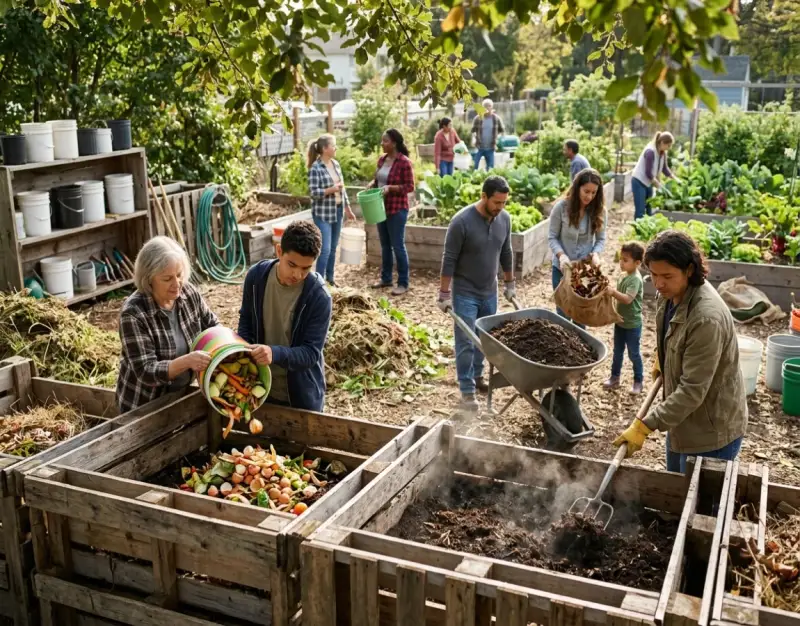
Walk down almost any residential street on a Tuesday evening, and you will witness a modern environmental tragedy taking place in plastic bins pushed to the curb: perfectly viable organic matter—banana peels, coffee grounds, crisp apple cores, and wilted spinach leaves—discarded alongside non-recyclable packaging. Globally, roughly one-third of all food produced for human consumption is lost or wasted, amounting to an astonishing 1.3 billion tons annually. When this organic treasure trove is buried in anaerobic municipal landfills, it decomposes without oxygen, producing methane gas—a greenhouse gas roughly 28 to 36 times more potent than carbon dioxide over a 100-year timescale. Yet, localized environmental activism and grassroots organizing are turning the tide on this crisis, proving that ecological restoration can begin right in our own backyards.
For decades, waste management has been viewed through a centralized, top-down lens: municipal trucks haul our discards away to invisible expanses, disconnecting urban and suburban citizens from the natural cycles of decay and rebirth. However, a profound paradigm shift is underway within our Uplifting Communities: The Rise of Free Neighborhood Pantries and How to Build One framework of local stewardship. Neighborhoods are no longer waiting for municipal governments to solve systemic environmental issues. Instead, citizen-led initiatives are reclaiming organic waste streams, transforming trash into rich, dark humus often referred to as "local gold." This movement goes far beyond mere municipal diversion; it is a masterclass in civic engagement, ecological literacy, and relational trust-building that heals both the soil beneath our feet and the social fabric binding our communities together.
The core thesis of this comprehensive guide is that starting a community compost initiative is not merely an exercise in waste management, but a radical act of community care and environmental sustainability. By demystifying the biological, logistical, and social dimensions of community-scale composting, this guide equips everyday changemakers, neighborhood leaders, and passionate advocates with an exhaustive roadmap. From navigating municipal regulations and securing land to managing carbon-to-nitrogen ratios and inspiring neighborhood participation, we will explore every facet required to turn organic waste into a thriving engine of local renewal. Whether you are an experienced backyard gardener or an urban resident looking to make a tangible difference, the journey of transforming waste into local gold begins here.
Foundational Principles & Mechanics of Composting
To successfully orchestrate a community compost initiative, one must first master the biological and chemical mechanics of decomposition. Composting is not simply throwing organic matter into a pile and waiting for nature to take its course; it is an orchestrated biological enterprise involving billions of microscopic workers. At its core, composting is the controlled, aerobic decomposition of organic materials by microorganisms. Bacteria, fungi, actinomycetes, and protozoa work in tandem to break down complex organic polymers into simpler compounds, ultimately yielding a stable, nutrient-rich soil amendment rich in humic acids and beneficial soil microbes.
The success of any composting system hinges upon four fundamental biological pillars: carbon (the "browns"), nitrogen (the "greens"), moisture, and oxygen. Balancing these elements dictates the speed, odor profile, and overall efficacy of the pile. Carbon-rich materials—such as dry leaves, wood chips, shredded cardboard, and straw—provide the structural framework for the pile and serve as an energy source for microbial respiration. Nitrogen-rich materials—such as food scraps, coffee grounds, fresh grass clippings, and garden waste—supply the proteins and amino acids necessary for microbial growth and reproduction. The ideal carbon-to-nitrogen (C:N) ratio by weight hovers around 30:1, providing microbes with an optimal diet for rapid decomposition.
Moisture and aeration are the twin engines that keep the microbial engine running. A compost pile should maintain a moisture content of roughly 40 to 60 percent, roughly equivalent to the feel of a wrung-out sponge. If the pile is too dry, microbial activity grinds to a halt; if it is too wet, water displaces oxygen within the pore spaces, creating anaerobic conditions that foster foul-smelling putrefaction rather than sweet-smelling aerobic decay. Oxygen is supplied through passive aeration (via the structural bulk of coarse browns) and active intervention (turning the pile with pitchforks or tumbling the drum). When managed correctly, internal thermophilic temperatures rise to between 130°F and 160°F, a critical threshold that naturally pasteurizes weed seeds and neutralizes human and plant pathogens.
Step 1: Assessing the Landscape & Assembling Your Core Team
Mapping Community Needs and Gathering Baseline Data
Before driving a single stake into the ground or purchasing equipment, you must conduct a thorough reconnaissance of your neighborhood’s specific needs, constraints, and assets. Begin by identifying the primary drivers for your initiative: Is your neighborhood suffering from food deserts and depleted soil? Are local residents frustrated by the lack of municipal composting options? Or is there a community garden crying out for high-grade organic amendments? Conducting a waste audit among a small group of interested households can yield invaluable quantitative data, revealing approximately how many pounds of organic waste your prospective network generates weekly.
Simultaneously, evaluate existing local infrastructure and community networks. Look for potential partner organizations such as local farmers' markets, neighborhood associations, churches with underutilized land, or urban agriculture collectives. Establishing early dialogues with these stakeholders prevents duplication of effort and builds a coalition of institutional allies. Documenting your baseline metrics—such as projected household participation and estimated monthly tonnage diverted—will also prove crucial when applying for micro-grants, seeking zoning permissions, or pitching your concept to local business owners who might supply carbon materials like wood shavings or coffee chaff.
Recruiting Dedicated Core Organizers and Establishing Roles
No community compost initiative was ever successfully built by a single individual working in isolation; burnout is an imminent hazard when administrative, physical, and logistical burdens rest on one set of shoulders. When launching your project, channel the same intentionality explored in Burnout to Breakthrough: How Practicing Compassion Can Rescue Your Mental Health to ensure your leadership team practices sustainable self-care and collaborative delegation. Build a steering committee comprising individuals with diverse, complementary skill sets: a detail-oriented treasurer to manage finances, a charismatic communications lead for outreach, an operations manager to oversee site maintenance, and an educational coordinator to train participants.
Define clear roles, operational boundaries, and decision-making protocols within your core team early on. Draft a simple governance charter outlining how conflicts will be resolved, how operational tasks will be rotated, and how new volunteers will be onboarded. By distributing leadership and fostering a culture of mutual support, you protect the initiative from single-point-of-failure vulnerabilities while creating a welcoming space where civic participation feels life-giving rather than burdensome.
Securing Site Approval, Zoning, and Land Partnerships
Finding the right physical footprint is often the most formidable hurdle for an urban or suburban composting initiative. Ideal sites require adequate access for drop-offs, sufficient space for active piles and curing bins, a water source for moisture management, and a buffer distance from sensitive residential property lines to mitigate potential nuisance concerns. Potential locations include community gardens, public parks (with municipal permission), school campuses, church yards, and underutilized commercial lots.
Navigating municipal zoning codes and health department regulations demands patience, diplomacy, and meticulous preparation. Many cities have outdated ordinances that lump composting in with solid waste transfer stations, triggering prohibitive permitting requirements. Approach your local zoning board or environmental services department not as an adversary, but as a collaborative partner. Present a well-researched operational plan that details vector control (keeping rodents and flies out), odor mitigation strategies (maintaining correct C:N ratios and covering fresh scraps immediately), and leachate management. Securing formal written agreements or memorandums of understanding (MOUs) with landowners ensures your project enjoys long-term security.
Step 2: Designing Your Composting System & Infrastructure
Selecting the Right Composting Methodology for Your Scale
The scale and location of your community initiative will dictate the mechanical architecture of your composting system. There is no one-size-fits-all approach; rather, organizers must choose among open-air windrows, three-bin wooden systems, in-vessel tumblers, or vermicomposting setups. For neighborhood initiatives handling between 100 and 500 pounds of food scrap per week, a classic three-bin wooden or wire-mesh system is often the gold standard. It allows for easy turning, clear segregation of stages (active filling, active heating, and curing), and scalability.
Alternatively, if space is strictly constrained—such as in a paved courtyard or tight urban alleyway—aerated static piles (ASPs) or continuous-flow vermicomposting systems utilizing red wigglers (*Eisenia fetida*) may be more appropriate. Vermicomposting is particularly effective for schools and indoor community spaces because it operates silently, generates zero odor when managed correctly, and produces premium worm castings that command high value among local horticulturalists. Evaluate your site's physical dimensions, labor availability, and seasonal weather patterns before committing capital to hardware.
Procuring Durable Materials and Sourcing Carbon Stocks
Investing in robust, weather-resistant materials upfront saves countless hours of repair work and prevents structural failures down the road. Avoid flimsy plastic bins designed for single households; instead, opt for pressure-treated lumber, heavy-gauge hardware cloth, recycled plastic pallets, or commercial-grade tumbling drums. Ensure that all collection buckets distributed to participating households feature secure, airtight lids with rubber gaskets to prevent insect attraction and accidental spills during transit.
Equally critical is securing a reliable, high-volume supply of carbon-rich "browns." While food scraps arrive daily, carbon must be stockpiled meticulously. Forge partnerships with local arborists, tree service companies, and carpenters to secure free wood chips and sawdust. Connect with local coffee shops for burlap sacks and coffee chaff, or work with landscape contractors who routinely discard autumn leaves. Store your dry browns under a breathable tarp or inside a shed to keep them dry; wet carbon materials lose their structural porosity and fail to aerate the incoming food waste effectively.
Establishing Strict Site Security, Signage, and Sanitation Protocols
A well-run community compost site must be impeccably clean, clearly organized, and intuitively navigable for participants who may have varying levels of composting experience. Install large, weather-proof educational signage at eye level detailing exactly what is accepted (fruit scraps, vegetable peelings, coffee grounds, eggshells) and what is strictly prohibited (meat, dairy, oils, pet waste, plastics, and chemically treated wood). Clear, visual graphics featuring photographs rather than just text are essential for multicultural or multilingual neighborhoods.
Sanitation and vector management form the bedrock of community trust. Unmanaged compost sites can attract rats, raccoons, and stinging insects, quickly souring neighborhood relations. Implement mandatory operational protocols: every single deposit of food waste must be immediately buried beneath a 4-to-6-inch layer of carbon material (the "brown blanket" rule). Equip the site with handwashing stations, a dedicated hose or rain barrel for watering, sanitized tools hung neatly on racks, and secure trash cans for any rogue non-compostable packaging brought in by mistake.
Step 3: Building Community Engagement and Educational Pipelines
Designing Accessible Onboarding and Drop-Off Protocols
The operational success of your initiative relies entirely on the consistency and accuracy of your participant pool. If community members contaminate the incoming waste streams with plastic bags, produce stickers, or forbidden food items, processing times skyrocket and the quality of your finished "local gold" degrades. Create a frictionless yet rigorous onboarding process. Prospective participants should attend a brief 20-minute orientation workshop—offered both in person and via video recording—where they learn the fundamental mechanics of sorting and dropping off their waste.
Establish a secure, convenient drop-off mechanism. Depending on your site's security, you might utilize a locked shed or bin system accessed via a combination lock code, which is provided to participants only after completing orientation. Implement a clean-bucket exchange system: participants bring their full, sealed household bucket, empty its contents into the active processing bin, rinse their bucket at the washing station using greywater filters, and store it for their next collection cycle. This ritual reinforces accountability and maintains immaculate site hygiene.
Hosting Hands-On Workshops and Community Workdays
Composting is fundamentally a tactile, sensory experience. To transform passive participants into passionate ecological stewards, regularly host community workdays, pile-turning parties, and educational workshops. Invite local master gardeners, soil scientists, and permaculturists to lead sessions on soil food web dynamics, sheet mulching, and seed starting using finished compost. These events serve a dual purpose: they accomplish heavy physical labor (such as turning massive windrows or screening finished compost) while fostering deep social bonds among neighbors who might otherwise never interact.
Make these workdays family-friendly and celebratory by incorporating potlucks, music, and children's activities like worm-bin petting zoos or seed-bomb making. When community members physically touch the steaming, rich compost, smell the earthy aroma of actinomycetes bacteria, and witness the transformation of what was once garbage into fertile life, a profound psychological shift occurs. They begin to see themselves not as passive consumers generating waste, but as active regenerators participating in a closed-loop local ecosystem.
Leveraging Digital Communication and Transparent Impact Metrics
In our hyper-connected digital age, maintaining momentum requires transparent, engaging communication channels. Utilize platforms like WhatsApp, Slack, or local Facebook groups to share weekly updates, celebrate milestones, and troubleshoot contamination issues in real time. Create a monthly digital newsletter featuring impact metrics: how many pounds of food waste diverted from landfills, how many equivalent pounds of greenhouse gas emissions prevented, and how many gallons of finished compost distributed to local gardens and tree wells.
Gamify the experience where appropriate by highlighting top-contributing households or community blocks. When participants can visually track the cumulative impact of their daily kitchen habits, pride replaces chore fatigue. Furthermore, maintaining an open, responsive digital feedback loop allows organizers to catch operational friction points—such as a broken latch on a drop-off bin or a sudden influx of unapproved squash rinds—before they escalate into systemic failures.
Step 4: Processing, Refining, and Harvesting Your "Local Gold"
Mastering Active Management, Temperature Monitoring, and Turning Schedules
Once your community site is receiving steady inputs and your carbon blankets are functioning smoothly, the active management phase begins. This is where science meets art. Monitor the internal temperature of your thermophilic piles using a long-stem dial thermometer inserted into the core. Temperatures should ideally peak between 130°F and 150°F within the first 7 to 10 days. This heat blast accelerates breakdown and destroys weed seeds and harmful bacteria.
Establish a regular turning schedule—typically every 7 to 14 days during the active heating phase. Turning redistributes outer, cooler materials into the microbial hot center of the pile and reintroduces vital oxygen pore spaces. Watch for sensory cues: a sweet, earthy, forest-floor aroma indicates healthy aerobic conditions, while a sharp ammonia or sulfur smell signals compaction, excess moisture, or insufficient carbon, requiring an immediate infusion of dry wood chips and a thorough pitchfork turning.
The Curing Phase and Pathogen Reduction Safeguards
After the active thermophilic heating phase subsides (usually taking 4 to 8 weeks depending on ambient climate and volume), the pile enters the curing phase. Do not skip or rush this critical step. During curing, mesophilic fungi and earthworms colonize the cooling mass, synthesizing complex humic substances and stabilizing nutrients into plant-available forms. Raw, uncured compost contains organic acids and unstable nitrogen compounds that can actually inhibit plant growth or burn delicate root systems.
Allow your compost to cure undisturbed in dedicated secondary bins for an additional 4 to 8 weeks. Throughout this period, maintain moderate moisture levels and monitor the material until it reaches ambient soil temperature. Conduct a simple germination test—often called the cress test—by planting radish or cress seeds in a sample of your finished compost to ensure all phytotoxic compounds have fully dissipated. Once the material resembles dark, crumbly, sweet-smelling soil with zero recognizable food remnants, it is officially transformed into local gold.
Screening, Quality Control, and Equitable Distribution Models
The final operational hurdle before distribution is refining the texture of your finished product. Even well-decomposed piles contain stray items like avocado pits, peach stones, eggshells, or un-degraded wood chips that require removal. Pass your cured compost through a trommel screen or a hand-built hardware-cloth screen (typically 1/4-inch mesh) mounted over a wheelbarrow. The fine, uniform humus falls through effortlessly, while oversized chunks are tossed back into the active pile to finish breaking down.
Now comes the most rewarding moment of the entire initiative: harvesting and distributing the golden harvest. Design an equitable, community-centric distribution model. Allocate a set percentage of the finished compost directly back to participating households as a "dividend" for their waste collection efforts. Dedicate another portion to local public green spaces, community gardens, street tree basins, and school yards. By sharing the bounty openly, you tangibly demonstrate the restorative power of environmental sustainability and cement community investment for future seasons.
Real-World Case Studies & Scenarios
Examining real-world implementations reveals the stark contrast between thriving community compost initiatives and those that succumb to common pitfalls. Consider the Greenpoint Community Composting Collective in urban Brooklyn, New York. Operating in a densely populated neighborhood with minimal green space, this grassroots initiative partnered with a local community garden to establish a secure, three-bin wooden system fed by 45 neighborhood households. By implementing mandatory orientation workshops, a strict bucket-exchange protocol, and partnering with local coffee shops for spent grounds and wood shavings, the collective successfully diverts over 1,200 pounds of organic waste every month. Their secret weapon? A hyper-engaged digital chat group and monthly weekend workdays that double as vibrant neighborhood social gatherings.
Conversely, consider the cautionary tale of the Oakridge Neighborhood Drop-Off in a mid-sized suburban municipality. Launched with immense enthusiasm by a neighborhood association, the site operated on a purely honor-system basis with open-topped bins and zero educational onboarding. Within three weeks, local residents began dumping entire cooked meals, plastic takeout containers, and dog waste bags into the piles. The resulting anaerobic conditions triggered unbearable odors, attracted rat infestations, and prompted angry complaints to the city council, leading to a swift shutdown and a local ordinance restricting neighborhood composting sites. The critical takeaway is clear: without robust education, strict operational boundaries, and vigilant site management, even the most well-intentioned ecological projects can unravel.
Critical Mistakes & How to Avoid Them
Launching and maintaining a community compost initiative is a deeply rewarding endeavor, but it is fraught with operational hazards. Recognizing these pitfalls before they threaten your site ensures long-term viability and community harmony.
- Ignoring the Carbon-to-Nitrogen Balance (The Sludge Trap): Accepting massive influxes of wet food scraps without hoarding sufficient dry carbon materials invariably results in a cold, waterlogged, stinky, anaerobic sludge pit. Countermeasure: Enforce a strict "two parts brown for every one part green" rule and maintain an overflowing, weather-protected stockpile of wood chips and shredded leaves before accepting a single food scrap.
- Neglecting Pest and Vector Management: Leaving food waste exposed on the surface of the pile acts as an open invitation for rats, raccoons, mice, and blowflies, instantly alienating neighbors and landowners. Countermeasure: Implement the mandatory "brown blanket" rule, ensuring every incoming deposit of food waste is immediately buried beneath at least 4 to 6 inches of carbon material.
- Failing to Establish Clear Governance and Delegation: Relying on a single passionate founder to handle daily maintenance, administration, and education guarantees rapid burnout and project collapse. Countermeasure: Build a steering committee, divide operational responsibilities into clear roles, and rotate physical workdays among the broader participant community.
- Skipping Participant Education and Onboarding: Allowing unvetted community members to drop off waste without understanding sorting rules inevitably leads to severe contamination with plastics, stickers, and prohibited foods. Countermeasure: Make attendance at a brief orientation workshop and completion of a simple sorting agreement mandatory prerequisites for accessing drop-off bins.
- Overlooking Municipal Regulations and Zoning Laws: Launching a large-scale neighborhood site on public or commercial land without checking local health, zoning, or solid waste ordinances can result in sudden cease-and-desist orders. Countermeasure: Engage local municipal authorities and property owners proactively, presenting a rigorous operational plan that addresses odor, vectors, and leachate control from day one.
Comprehensive Comparison Table
| Composting System | Ideal Scale & Setting | Pros | Cons | Maintenance Effort |
|---|---|---|---|---|
| Three-Bin Wooden System | Neighborhood gardens, community plots (100–500 lbs/week) | Highly scalable, excellent aeration, great for teaching | Requires physical labor to turn, susceptible to heavy rain if uncovered | Moderate to High (Weekly turning & monitoring) |
| In-Vessel Tumblers | Tight urban alleyways, paved courtyards, small groups | Pest-proof, contained, quick thermophilic heating cycles | Limited total volume capacity, mechanical parts can break | Low to Moderate (Regular drum rotation) |
| Vermicomposting (Worm Bins) | Indoor community spaces, schools, small urban footprints | Zero odor, produces premium worm castings, quiet | Sensitive to temperature extremes, strict food limitations | Moderate (Moisture and feeding regulation) |
| Aerated Static Piles (ASP) | Large community initiatives, micro-haulers (500+ lbs/week) | Fast processing times, minimal manual turning required | Requires electricity, blowers, and technical setup knowledge | Low physical / High technical oversight |
Frequently Asked Questions (FAQ)
What types of food waste should be strictly prohibited in a community compost site?
To prevent foul odors, pest infestations, and vector attraction, community compost sites should strictly prohibit meat, fish, dairy products, oils, fats, grease, dog and cat waste, diseased plant materials, and chemically treated wood or paper products. While these materials do break down in industrial composting facilities that reach extremely high sustained temperatures, open-air or three-bin neighborhood systems rarely maintain the consistent conditions required to break down animal proteins safely without attracting rodents and producing noxious odors.
How do you handle winter freezing in colder climates without shutting down the initiative?
Winter composting presents unique challenges, as sub-freezing temperatures slow microbial activity and freeze piles solid. However, decomposition does not stop entirely; thermophilic bacteria simply go dormant until spring. To maintain your initiative through winter, ensure your carbon stockpile is stored in a dry, accessible location because frozen wood chips are nearly impossible to manage. Consider utilizing larger pile volumes, which provide natural thermal mass to resist freezing, or transition to a double-bin system where one bin freezes solid while the other remains active near building foundations or under hoop-house covers.
What is the best way to handle contamination when community members drop off unapproved items?
Contamination is an inevitable hurdle, but it can be effectively managed through transparent communication and preventative design. When you discover plastic produce stickers, rubber bands, or prohibited food items in your drop-off buckets, remove them immediately and place them in a visible "wall of shame" or contamination box near the sorting station. Use this as a gentle educational opportunity by posting a photo in your digital group chat with a friendly reminder on how to sort properly. If specific households repeatedly contaminate inputs, require them to re-take the orientation workshop before regaining access to the drop-off bins.
How can we secure funding or micro-grants for building our community compost infrastructure?
Funding your initiative is entirely achievable by tapping into local, regional, and national grants dedicated to environmental sustainability, food waste reduction, and community development. Look for grants offered by municipal sustainability offices, local community foundations, corporate social responsibility programs of grocery chains or waste management companies, and environmental non-profits. When crafting your grant proposal, emphasize measurable impact metrics—such as pounds of food waste diverted from landfills, greenhouse gas reductions, and community educational hours—rather than just purchasing hardware.
How long does it take from raw food scrap deposit to harvesting finished compost?
The timeline from raw food scrap to finished "local gold" typically ranges between 3 to 6 months, depending heavily on your climate, seasonal temperatures, carbon-to-nitrogen balance, and frequency of turning. During the warm summer months with active thermophilic management (frequent turning and optimal moisture), active decomposition can occur in 4 to 8 weeks, followed by another 4 to 8 weeks of curing. In colder winter months or with passive systems, the process naturally extends closer to 6 to 9 months. Patience is essential; rushing the curing phase can yield immature compost that inhibits plant growth.
Strategic Roadmap & Final Takeaway
As we look toward the next two to five years, the landscape of urban waste management and civic ecology is poised for transformative growth. Municipalities increasingly recognize that centralized waste infrastructure is both economically unsustainable and environmentally catastrophic. Consequently, decentralized, neighborhood-scale initiatives are transitioning from fringe eco-experiments into vital pillars of municipal climate resilience. Emerging trends point toward increased municipal funding for micro-haulers, integration of community composting networks with urban agriculture master plans, and policy frameworks that incentivize hyper-local organic diversion.
The ultimate takeaway of starting a community compost initiative extends far beyond the rich, dark humus you harvest after months of careful tending. Composting is an act of profound relational healing—a tangible way to mend the metabolic rift between human consumption and planetary regeneration. By gathering your neighbors, turning organic waste into local gold, and closing the nutrient loop in your backyard or community garden, you are proving that systemic environmental change begins with local kindness and collective action. Roll up your sleeves, gather your browns, and start building the fertile future your community deserves.
Be the first to share a gentle reflection on this story.